
Unlock the White House Watch newsletter for free
Your guide to what Trump’s second term means for Washington, business and the world
Key Takeaways:
- **Escalating Trade War and Supply Chain Disruption:** The symbolic renaming of Lake Ontario underscores deepening US-Canada tensions, with collapsed trade talks threatening critical cross-border supply chains, particularly in automotive, steel, and lumber sectors. This will lead to increased operational costs and potential re-shoring efforts.
- **Heightened Market Volatility and Investor Uncertainty:** Unilateral actions and aggressive rhetoric from the White House are injecting significant uncertainty into North American markets, impacting investor sentiment, currency stability (CAD likely to face headwinds), and deterring new cross-border investment.
- **Inflationary Pressures and Economic Slowdown Risks:** Tariffs on key goods are poised to raise input costs for businesses and consumer prices, potentially contributing to inflation while simultaneously risking an economic slowdown in both nations as trade flows are disrupted and confidence wanes.
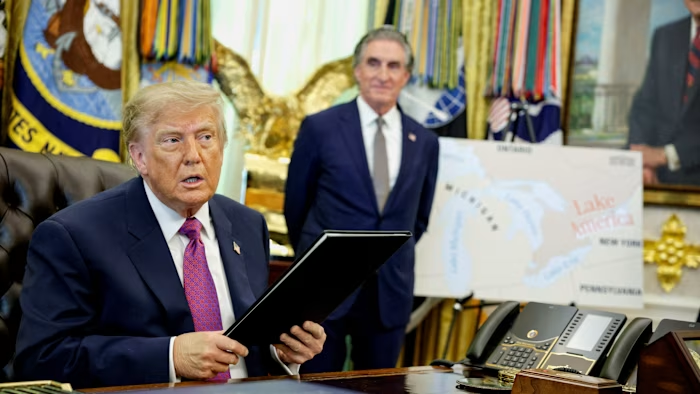
Donald Trump stepped up his war of words with Ottawa on Thursday, ordering his government to “immediately” change the name of Lake Ontario, which sits between Canada and the US, to “Lake America”. This seemingly symbolic decree, while not altering the physical geography, sends a chilling ripple through financial markets, signaling a significant escalation in the ongoing economic skirmish between two of the world’s closest trading partners.
The US president on Thursday signed an executive order that will change the name of the vast body of water, which straddles the border between the province of Ontario and New York State, in an important federal mapping system that is widely followed by state and local governments and private industry. While the immediate financial cost of updating maps and related documentation might be negligible, the underlying message of unilateral assertion and disregard for bilateral agreements poses a far greater threat to investor confidence and cross-border commerce.
EFFECTIVE IMMEDIATELY: Lake Ontario is renamed to LAKE AMERICA! 🇺🇸pic.twitter.com/ZFww8PexiW
— The White House (@WhiteHouse) August 27, 2026
“The lake will continue to play a pivotal role in shaping America’s future and the global economy,” Trump’s executive order said. This statement, juxtaposed with the aggressive nature of the renaming, highlights a growing disconnect between political rhetoric and the realities of integrated North American supply chains. Last year, the president signed an executive order renaming the Gulf of Mexico, which borders Mexico, the US and Cuba, as the Gulf of America, establishing a pattern of such politically charged actions.
Canada’s Prime Minister Mark Carney responded, emphasizing the historical and cultural significance: “The name Lake Ontario comes from the Wendat word Ontari’io, which, appropriately, means ‘the lake is beautiful, the lake is big’.” He added, “The name is more than 400 years old, predating both the Confederation of Canada and the Declaration of Independence of the United States of America.”
From a market perspective, Carney’s subsequent remarks are particularly telling: “We know that America is changing. Their trading relationships, their foreign policies, their national monuments, their hydronyms,” Carney added. “Canadians also know that naming reality means calling it Lake Ontario — then, now and always.” This firm stance from Ottawa signals a protracted period of trade and diplomatic tension, rather than a quick resolution, which will undoubtedly keep the Canadian dollar under pressure and inject uncertainty into commodity markets where Canada plays a significant role.
Kathy Hochul, governor of New York, the only US state on the lake, responded to Trump’s name change on Thursday with a post on X. “New York won’t be calling it that,” she wrote. This internal dissent within the US further complicates the regulatory environment for businesses operating across state lines and highlights the potential for fragmented adherence to federal directives, adding another layer of operational risk.
Trump’s decision to rename the lake underscores fraying relations between the US and Canada, which are launching tit-for-tat tariffs against each other after trade talks collapsed. This is the crux of the financial concern. The direct impact of tariffs on steel, aluminum, vehicles, and lumber translates into higher input costs for manufacturers, increased prices for consumers, and disrupted, finely tuned supply chains that have been optimized over decades under agreements like NAFTA and USMCA. For the automotive sector, where parts often cross the border multiple times before final assembly, these tariffs represent significant operational headwinds and could force costly re-evaluation of production strategies.
Since the US president took office 18 months ago, Canada has faced relentless attacks from the White House on its sovereignty, character and economy, with Trump slapping tariffs on his country’s second-biggest trading partner. Late last week, trade talks between the two sides fell apart, with US trade representative Jamieson Greer saying Washington had offered Ottawa “significant tariff reductions” on steel, aluminium, vehicles and lumber but Canada had rejected the deal. This impasse indicates that businesses reliant on cross-border trade should brace for continued volatility and potential long-term shifts in sourcing and logistics.
However, Carney said he had suspended the negotiations after the Trump administration had offered a “bad deal” with numerous last-minute changes. Carney later said his country was “at war” over trade with the US after the president “miscalculated” Canada’s response to his tariff attack. This aggressive language from both sides suggests that political will for de-escalation is low, making resolution a distant prospect and embedding a geopolitical risk premium into assets tied to the North American economy.
Canadians, angry at Washington’s hostility, have backed Carney’s stance even though they could face economic consequences. This domestic support empowers Ottawa to maintain its firm negotiating position, potentially prolonging the trade dispute and its associated economic costs, including potential job losses in export-oriented industries and inflationary pressures from imported goods.
US vice-president JD Vance this week resumed attacks on Canada, calling it “a country that has underinvested in its military that quite literally would get invaded by a foreign country were it not for the umbrella of protection provided by” the US. While seemingly a defense issue, such rhetoric exacerbates the perception of an unstable bilateral relationship, deterring foreign direct investment into Canada and increasing the cost of capital for Canadian firms. Earlier this year Canada met the 2 per cent of GDP Nato defence spending target and pledged to increase military funding to 5 per cent by 2035, a fact that may mitigate some, but not all, of the market’s concerns regarding Canada’s strategic positioning.
US commerce secretary Howard Lutnick on Thursday doubled down on his attacks over trade talks. “We had a deal, we shook hands, the president announced it,” he said. “Canada made the decision for political purposes, they wanted to walk away.” This narrative, aimed at shifting blame, only further entrenches the adversarial stance, making it harder for businesses to predict future trade policy and plan accordingly.
After Trump signed his order on Thursday, Doug Burgum, US interior secretary, posted: “The places and waters that border our nation and support our economy should reflect the greatness of the United States.” This nationalistic sentiment, while resonating with certain voter bases, sends a clear signal to international investors about the “America First” doctrine guiding policy, suggesting that economic decisions will prioritize perceived national interest over multilateral cooperation.
“At this point I think the only surprising thing is that he [Trump] didn’t decide to call it Lake Trump,” said Brian Rathbun, at the University of Toronto’s Munk School of Global Affairs and Public Policy. This observation underscores the deeply personal and unilateral nature of these actions, which further heightens market uncertainty as policy becomes less predictable and more susceptible to individual political whims.
Market Impact:
The escalation of US-Canada tensions, symbolized by the Lake Ontario renaming and underpinned by collapsed trade talks, is poised to inject significant volatility into North American financial markets. Investors should brace for continued pressure on the Canadian dollar (CAD) against the US dollar (USD), reflecting capital flight and reduced confidence in Canada’s economic outlook. Sector-specific headwinds are pronounced for automotive manufacturers, steel and aluminum producers, and the lumber industry, which face increased input costs, disrupted supply chains, and potential shifts in global trade flows. Companies with significant cross-border operations will likely see pressure on profit margins and may accelerate plans for supply chain diversification or near-shoring to mitigate geopolitical risks. The broader economic implications include potential inflationary pressures from tariffs impacting consumer goods, alongside a risk of decelerated GDP growth in both nations as trade friction dampens investment and consumption. Financial institutions and real estate markets, particularly in border regions, could also feel secondary effects from reduced economic activity and investor uncertainty, making a cautious outlook advisable for the foreseeable future.