

Brian Brenberg and Larry Kudlow analyze the U.S.-Canada trade dispute. Kudlow argues the conflict is about more than dairy and poultry, pointing to a Chinese transshipment issue as the key reason the US must stand firm.
Key Takeaways:
- Escalating Trade Tensions:Former President Trump’s threat to ban Bombardier sales in the U.S. without domestic manufacturing signals a potential re-escalation of protectionist trade policies, injecting significant political and regulatory risk into the aerospace sector.
- Integrated Global Supply Chains:Bombardier’s extensive U.S. operational footprint, including manufacturing facilities, a vast American supplier network, and thousands of direct/indirect jobs, underscores the deeply integrated nature of modern global industries, making swift localization challenging and potentially disruptive.
- Cross-Border Investment Uncertainty:The dispute highlights persistent trade frictions between the U.S. and Canada, creating an environment of heightened uncertainty for foreign direct investment (FDI) and raising questions about market access stability under future administrations.
Trump’s Bombardier Threat: A Deep Dive into Trade Protectionism and Market Volatility
In a stark Labor Day pronouncement that reverberated through global financial markets and corporate boardrooms, former President Donald Trump declared his intent to block Canadian jet manufacturer Bombardier from selling in the United States unless the company commits to building its products domestically. This aggressive stance, articulated via Truth Social, not only targets a specific foreign enterprise but also signals a potential re-ignition of the protectionist trade policies that characterized his previous administration, immediately injecting a fresh wave of political risk into an already complex global economic landscape.
Trump’s declaration – “NO MORE SELLING BOMBARDIER IN THE UNITED STATES!” – was framed around a perceived imbalance: “Over 50% of their revenue comes from the United States — They live off American Buyers, American Companies, American Airports, and American Service — All while Canada blocks our GREAT American Banks, and Companies, throughout the U.S.A.” His assertion that Bombardier “must build here, and stop treating America like a ‘piggybank’” underscores a demand for greater reciprocity and onshoring of manufacturing, a consistent theme in his economic platform.
This aggressive rhetoric is not an isolated incident but rather a re-ignition of simmering trade disputes between the two North American allies. As analysts like Larry Kudlow have previously highlighted, the friction extends beyond surface-level issues like dairy and poultry, touching upon deeper strategic concerns, including potential Chinese transshipment issues that influence Washington’s resolve to maintain a firm stance on trade. Such broader geopolitical and economic grievances provide critical context to the targeted pressure on companies like Bombardier, signaling that the current dispute is part of a larger, intricate web of trade policy objectives.
The immediate market reaction, while not yet fully materialized in official policy, is one of heightened uncertainty. For investors in Bombardier (TSX: BBD.B) and the broader aerospace sector, such presidential threats create a significant political risk premium, potentially leading to increased stock volatility and a re-evaluation of long-term investment strategies. Companies with significant cross-border operations are particularly vulnerable to sudden shifts in trade policy, which can disrupt supply chains, alter cost structures, and erode market access.
Left: U.S. Sen. Jerry Moran, R-Kan., talks on a cellphone as he arrives to a closed Senate Appropriations Committee hearing at the U.S. Capitol on June 2, 2026, in Washington, D.C. Right: President Donald Trump steps off Air Force One at Morristown M(Left: Eric Lee/Getty Images; Right: Jim WATSON / AFP via Getty Images / Getty Images)
Bombardier’s Deep American Roots and Market Implications
Bombardier quickly moved to counter this narrative, emphasizing its deep and multifaceted economic footprint within the United States. The company highlighted its substantial operational presence across more than 20 states, employing thousands of American workers directly and indirectly. This includes significant facilities in Kansas, Texas, Arizona, Florida, Connecticut, Illinois, Delaware, California, Washington D.C., and New Jersey.
In its statement, Bombardier detailed that its aircraft are built with crucial American-made components, including engines and avionics, sourced from approximately 2,800 American companies across 47 states, amounting to over $2.5 billion in annual spending. Critically, the wings for Bombardier’s world’s fastest business jet are manufactured by American workers at its Red Oak, Texas facility, while crucial flight control components are made in its Los Angeles, California area facility. The company also announced plans to further expand its U.S. defense activities and service network, including a new facility in Fort Wayne, Indiana, later this year.
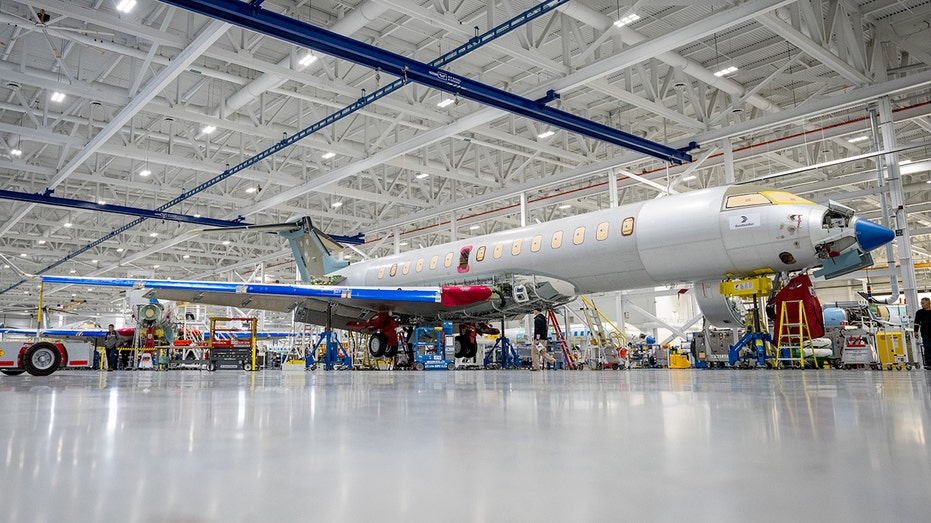
Bombardier Global aircraft under assembly during a tour of the company’s facility in Mississauga, Ontario, Canada, on Friday, May 8, 2026.(Arlyn McAdorey/Bloomberg via Getty Images / Getty Images)
This intricate web of operations underscores the complex reality of modern aerospace manufacturing, where components and expertise are sourced globally, challenging simplistic notions of “Made in America” versus “Made in Canada.” For the market, this illustrates the potential for severe supply chain disruption if protectionist measures are enacted. Forcing a company to fully localize production, particularly for highly specialized and capital-intensive goods like business jets, is not a swift or inexpensive undertaking. It would involve massive capital expenditure, potential delays, and could ultimately increase costs for the end consumer, impacting Bombardier’s competitive positioning against rivals like Gulfstream or Dassault.
Political Pushback and Broader Trade Context
Senator Jerry Moran, R-Kan., immediately rose to Bombardier’s defense, highlighting the company’s positive impact in Kansas. Moran noted that Bombardier’s presence in Wichita supports over a thousand employees who contribute to the nation’s defense and aerospace capabilities. His rapid outreach to the Trump administration to ensure awareness of Bombardier’s “significant contributions to Kansas” illustrates the intense political cross-currents at play. Localized economic stakes, such as job creation and contributions to critical sectors, often clash with broader nationalistic trade agendas.
A Bombardier flag during an entry-into-service celebration event for the Bombardier Global 8000 jet at the Bombardier Aircraft Assembly Centre in Mississauga, Ontario, Canada, on Monday, Dec. 8, 2025.(Laura Proctor/Bloomberg via Getty Images / Getty Images)
The underlying premise of Trump’s argument – that Canada unfairly blocks U.S. banks and companies – touches upon long-standing grievances that have at times strained the USMCA (United States-Mexico-Canada Agreement). While specific examples of such blocking practices are debatable and often complex, the perception fuels protectionist sentiment. Such threats, particularly from a potential future administration, serve as a stark reminder of the inherent political risks associated with cross-border investment, potentially deterring foreign direct investment (FDI) into the U.S. by companies wary of sudden policy shifts and unpredictable regulatory environments.
The situation highlights a fundamental tension in global trade: the desire for domestic job creation and industrial strength versus the efficiencies and cost benefits of integrated international supply chains. As global economies become more interconnected, the impact of protectionist rhetoric and potential policy shifts extends far beyond the targeted company, creating ripples across entire industries and national economies.
Market Impact
For Bombardier, a company already navigating a competitive global aerospace market, the prospect of its largest market being curtailed or conditioned upon significant, unplanned capital expenditures in the U.S. introduces substantial commercial and financial uncertainty. Investors would likely price in increased risk, potentially leading to downward pressure on its stock (TSX: BBD.B), and a reevaluation of its growth projections and capital allocation strategies. The company might face higher borrowing costs or struggle to attract investment for its stated expansion plans. Beyond Bombardier, the broader aerospace and defense sector could feel ripple effects, as global supply chains, already stressed, might face further pressure to localize production, potentially increasing costs and reducing efficiency across the industry. This could lead to a reassessment of manufacturing footprints by other multinational corporations with significant U.S. market exposure. The incident also casts a shadow over U.S.-Canada economic relations, potentially reigniting trade disputes that the USMCA was designed to mitigate. Should such policies be enacted, Canadian companies with significant U.S. market exposure would face heightened scrutiny, and the overall climate for cross-border investment could sour. More broadly, the market implication lies in the increased perception of policy risk for foreign companies operating in the U.S. Uncertainty regarding future trade policies can deter foreign direct investment, impacting job creation and economic growth in the long term. This underscores how presidential rhetoric, even when theoretical, can have tangible effects on investment decisions and market sentiment, compelling companies to factor political volatility more heavily into their strategic planning.