
Unlock the Editor’s Digest for free
Roula Khalaf, Editor of the FT, selects her favourite stories in this weekly newsletter.
Key Takeaways
- Singapore’s substantial ministerial pay increase underscores its unique “premium talent” governance model, a deliberate strategy to attract and retain top-tier leadership crucial for the city-state’s economic efficiency and global competitiveness, while also serving as a deterrent against corruption.
- The move intensifies the inherent tension between the government’s economic pragmatism – maintaining highly compensated, meritocratic leadership vital for Singapore’s sustained growth – and domestic public sentiment, potentially testing the social contract that underpins long-term political stability and investor confidence.
- While reinforcing Singapore’s commitment to robust governance, recent high-profile corruption scandals complicate the narrative, suggesting that generous compensation alone may not fully insulate against malfeasance, prompting increased scrutiny from ESG-focused investors regarding the efficacy of its unique compensation framework.
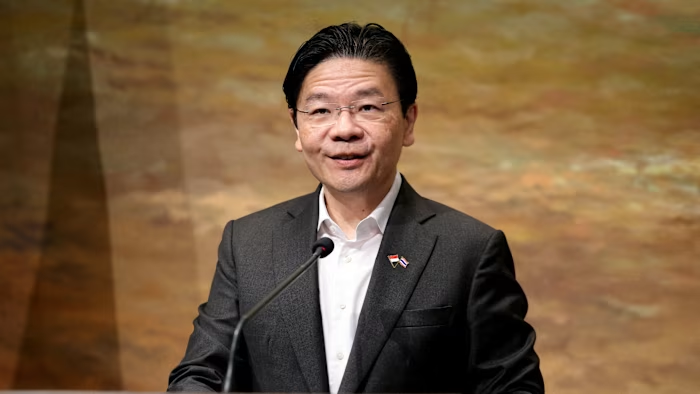
Singapore, a global financial nexus renowned for its economic stability and clean governance, has once again put its distinctive approach to public service compensation in the spotlight. The government recently announced a dramatic one-off pay rise for its ministers, including Prime Minister Lawrence Wong, who already holds the distinction of being the highest-paid head of government globally. This decision, emerging from an independent review, is set to increase pay for some senior ministers by as much as 9 per cent, despite consistent domestic disapproval of politicians’ high salaries.
Prime Minister Wong confirmed on Tuesday his acceptance of these recommendations, which will see entry-level ministers’ annual remuneration climb from S$1.1 million to S$1.2 million, effective next month. More notably, Wong’s own comprehensive pay package, encompassing salary and bonuses, is slated to rise from S$2.2 million (approximately US$1.7 million) to a substantial S$3.6 million (US$2.8 million) a year. In a gesture aimed at addressing public sentiment and potentially mitigating political fallout, Wong stated he would donate the increased portion of his pay to charity for the next five years, assuming he remains in office.
Addressing parliament, Wong articulated the government’s rationale: “We cannot avoid this issue simply because it is politically difficult, and this is not just a matter of pay. It is ultimately about whether Singapore will continue to have the quality of political leadership we need to take our country forward and to serve Singaporeans well in the years ahead.” This statement encapsulates Singapore’s long-standing philosophy: that competitive remuneration is essential to attract the best talent into public service, ensuring effective governance that drives national prosperity and acts as a potent deterrent against corruption.
This philosophy is a cornerstone of the “Singapore Inc.” model – a highly efficient, meritocratic government that operates with corporate-like discipline and is widely credited for the city-state’s remarkable transformation into a global economic powerhouse. The argument is that in a highly competitive global market for talent, especially in sectors like finance, technology, and advanced manufacturing where Singapore excels, the public service must offer salaries that can compete with lucrative private sector opportunities. This strategy aims to prevent a ‘brain drain’ from critical government roles, ensuring that the country’s leadership remains robust and capable of navigating complex geopolitical and economic challenges. For international investors, this has historically been a significant selling point: a guarantee of stable, competent, and uncorrupt leadership that fosters a predictable and business-friendly environment.
Wong’s revised pay package significantly outstrips that of other major world leaders, such as the US president’s $400,000 annual salary or the UK prime minister’s $237,000. Even Hong Kong’s chief executive, John Lee, comes in at a distant second with $719,000. This stark contrast highlights Singapore’s unique position as a small, resource-poor nation that has leveraged exceptional governance to achieve outsized economic success. It underscores its explicit strategy to view public service compensation not merely as a cost, but as a strategic investment in national leadership quality and economic competitiveness, essential for a nation that thrives on global integration and innovation.
The latest adjustment follows previous reviews, the last significant change being a 36 per cent cut in ministerial salaries in 2012 in response to public discontent over high pay. A subsequent review in 2017 led to no changes. The present increases, according to Wong, who also serves as Singapore’s finance minister, are primarily driven by rising pay scales in the private sector and civil service. “If we want our political system to remain effective, we cannot allow its basic terms of service to drift further and further away from reality,” he asserted, highlighting challenges in attracting new candidates to political office who might otherwise opt for more lucrative careers in the private sector.
The government’s methodology for determining ministerial pay is anchored to the salaries of the 1,000 highest-earning Singaporean citizens, a direct linkage to the broader economic health and private sector remuneration trends. This benchmark system, designed to ensure public service pay remains competitive, reflects the dynamic nature of Singapore’s high-income economy. As private sector wages climb, fueled by robust growth in key industries like finance, biotechnology, and digital services, and a perennially tight labor market, the government argues it must adjust ministerial compensation proportionally. Failing to do so, they contend, risks creating a significant disparity that could deter high-calibre individuals, who are in high demand globally, from committing to the demanding and often less publicly rewarding path of political leadership.
However, this economic pragmatism coexists with a delicate political balance. While the high-pay, low-corruption narrative has largely held true, recent events have introduced complexities that could test public trust and investor perceptions. The country, which prides itself on its reputation for clean governance and a transparent legal framework, has experienced several political scandals in recent years. Notably, former transport minister S Iswaran was sentenced to a year in prison in 2024 for accepting over $300,000 in gifts as a public servant and obstructing justice. These gifts allegedly included tickets to high-profile events such as English Premier League football matches, Formula 1 races, and various theatrical productions, as well as a business-class flight. This case also implicated billionaire property tycoon Ong Beng Seng, who pleaded guilty and received a fine.
Such incidents, while presented as isolated and swiftly dealt with by Singapore’s robust legal system, pose a challenge to the government’s core justification for high salaries. They suggest that while competitive pay aims to reduce the *incentive* for corruption, it does not entirely eliminate the *opportunity* or *temptation*. For foreign investors and analysts focusing on Environmental, Social, and Governance (ESG) criteria, these scandals, even in a system largely perceived as clean, could invite closer scrutiny regarding the robustness of internal controls, the effectiveness of deterrence mechanisms, and the overall efficacy of the governance framework, particularly given the explicit link between high pay and anti-corruption measures.
The long-term implications for Singapore’s unique social contract are also pertinent. In a society where the government has historically delivered consistent economic growth and stability, public acquiescence to high political salaries has been a trade-off for good governance. However, persistent public disapproval, especially when juxtaposed with rising costs of living, concerns about income inequality, and occasional governance lapses, could strain this contract. While immediate political instability is unlikely given the People’s Action Party’s long-standing dominance, the cumulative effect on public trust and social cohesion is a subtle yet significant factor for assessing long-term national resilience and, by extension, investment attractiveness.
Market Impact
The ministerial pay hike, while primarily a domestic policy decision, carries significant implications for market perception of Singapore. For investors, particularly those focused on long-term stability and governance quality, the move largely reinforces the “Singapore Inc.” model: a commitment to premium talent and efficiency as drivers of economic success. This could be viewed positively, signaling continued strong leadership dedicated to maintaining Singapore’s competitive edge in finance, trade, and technology, thereby bolstering confidence in its economic trajectory. However, the accompanying domestic disapproval and recent high-profile corruption scandals introduce a nuanced layer of risk. These factors could prompt increased scrutiny from ESG-conscious investors, who might question the social sustainability of such compensation in the face of public discontent, and the absolute efficacy of high pay as a corruption deterrent. While unlikely to directly impact the Singapore dollar (SGD) or immediate capital flows, any erosion of public trust or perceived governance weakness could subtly dampen investor sentiment over time, particularly for those valuing strong social cohesion alongside economic metrics. The market will closely watch how the government navigates the balance between its economic rationale and public expectations, as sustained social harmony and perceived fairness are crucial, often overlooked, components of Singapore’s enduring investment appeal.