
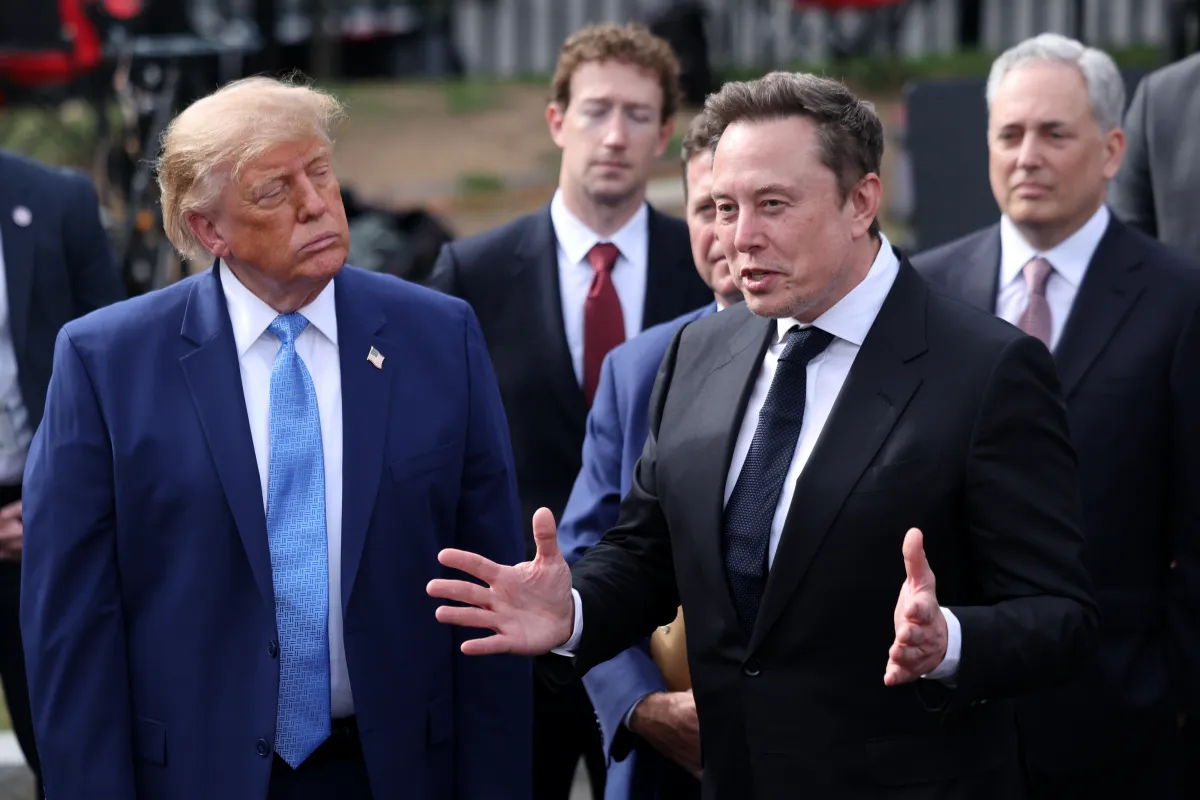
President Donald Trump hosted many of the biggest names in artificial intelligence this week — in part to announce that the U.S. government isn’t calling it artificial intelligence anymore. Now it’ssuperintelligence.
On the latest episode of TechCrunch’s Equity podcast, Kirsten Korosec, Sean O’Kane, and I discussed the motivation behind the meeting and what effect it might have on the AI industry. We were all pretty skeptical that the “Joint Commitment on Frontier Responsibilities” that the executives signed will amount to much, especially since — as Sean noted — it’s “deeply non-binding,” at least from a legal prospective. (Instead, Trump said he considers it “morally binding.”)
Kirsten suggested that the meeting’s real significance may have been as “a rebranding effort around AI.” (An effort that continued this weekend with Trump’s announcement of a new Super Intelligence Force.) For her, the big message was, “AI is going to kill us, it’s scary, it is going to take jobs — but super intelligence is not.”
Keep reading for a preview of our conversation, edited for length and clarity.
{content}
Key Takeaways
- The Trump administration’s official rebranding of “Artificial Intelligence” to “Super Intelligence” signals a strategic effort to reshape public perception and alleviate fears surrounding advanced AI.
- Despite a seemingly significant summit with top tech CEOs and a signed “Joint Commitment on Frontier Responsibilities,” the agreement is largely symbolic, non-binding, and indicates more political theater than substantive policy.
- Internal divisions within the White House and external skepticism from industry watchers suggest a complex, often contradictory approach to regulating and collaborating with major AI developers like Anthropic.
The White House’s AI Rebrand: From Artificial Fears to Super Intelligence Hopes
The landscape of technological innovation is perpetually shifting, but few shifts are as abrupt or as deliberate as the recent decree from the President of the United States. In a move that blended high-stakes diplomacy with a touch of linguistic rebranding, President Donald Trump recently convened a gathering of the tech world’s most influential figures – from Mark Zuckerberg to Jeff Bezos and Elon Musk – to announce a pivotal change: the U.S. government would no longer refer to advanced computational systems as “artificial intelligence.” Henceforth, the official nomenclature is “super intelligence.”
This eyebrow-raising directive, alongside the signing of a “Joint Commitment on Frontier Responsibilities,” sparked a lively debate on TechCrunch’s Equity podcast. My co-hosts, Kirsten Korosec and Sean O’Kane, and I delved into the underlying motivations of this summit, questioning its potential impact on the burgeoning AI industry and the broader public consciousness. Our consensus leaned towards skepticism, viewing the event as a masterclass in political spectacle rather than a genuine stride in AI governance.
The ‘Super Intelligence’ Mandate and Shifting Sands
The presidential order to adopt “super intelligence” as the official term for AI is more than a semantic tweak; it’s a calculated attempt to steer public perception. For months, President Trump had hinted at this linguistic pivot, suggesting a discomfort with the “artificial” label and its negative connotations. Now, it’s an executive mandate. As an official U.S. representative, one is expected to use “super intelligence,” not “artificial intelligence.”
This rebranding occurred in conjunction with a broader announcement concerning AI safety, a topic that, just weeks prior, the President had vehemently dismissed. He had asserted that calls for AI regulation were an attempt to constrain American leadership, even attributing such concerns to foreign or political adversaries. The swift reversal – from an anti-regulation stance to hosting a summit focused on AI safety pacts – underscores a significant, if perhaps cynical, political maneuver. It highlights a reactive approach, quickly cobbled together, to address growing public and industry anxieties about AI’s potential risks, even as the administration previously downplayed them.
High Stakes, High Drama: The Anthropic Conundrum
The narrative surrounding the summit was further complicated by the curious case of Anthropic, a leading AI research company. Days before the event, Anthropic CEO Dario Amodei was, by many accounts, “in the doghouse” with the administration. This friction reportedly stemmed from Anthropic’s stipulations regarding the ethical use of its technology, particularly concerning military applications, which had put them at odds with departments like the Pentagon.
Yet, in a dramatic eleventh-hour turn, Amodei received an unexpected 10 p.m. dinner invitation, leading to a sit-down with the President. This sudden rapprochement culminated in his presence at the subsequent luncheon, where he joined a pantheon of tech giants. The inclusion of figures like Zuckerberg, Bezos, and Musk at the same table underscored the immense influence of these individuals and their companies in shaping the future of technology and policy.
However, as Sean O’Kane keenly observed, the extent of genuine reconciliation with Anthropic remains questionable. Sean highlighted the continued vocal criticism from the Defense Department and figures like Emil Michael, suggesting that deep-seated animosities might persist despite the outward display of unity. This situation reflects a fragmented approach within the White House itself, where different factions hold divergent views on specific AI companies and their role in national strategy. While the Treasury Secretary might champion Anthropic, other departments remain deeply skeptical, illustrating that the administration’s stance on AI is far from monolithic.
A Pact of Paper: Morally Binding, Legally Empty?
Central to the summit was the signing of the “Joint Commitment on Frontier Responsibilities,” a document intended to signal a shared dedication to AI safety. However, a closer inspection reveals its limitations. Sean O’Kane pointed out one glaring detail: the document itself misspelled “United States.” More critically, it was “deeply non-binding,” a purely voluntary agreement. The President’s characterization of it as “morally binding” introduces a novel, if legally meaningless, descriptor into the lexicon of international and corporate agreements.
The rushed nature of the document’s creation, complete with its minor but telling error, suggests that the primary goal was the optics of an agreement rather than its substantive enforcement. While the pact may not instigate any major shifts in corporate behavior or regulatory frameworks, the fact that such a gesture was deemed necessary is significant. It acknowledges a growing imperative from both the public and within political circles to address AI’s potential societal impacts, even if the proposed solutions are more symbolic than practical.
The Rebranding Revelation: AI vs. Super Intelligence
Kirsten Korosec encapsulated the true essence of the entire event with her compelling insight: the summit was, at its heart, “a rebranding exercise around AI.” She argued that the underlying message was designed to soothe anxieties: “AI is going to kill us, it’s scary, it is going to take jobs — but super intelligence is not.” This distinction attempts to partition public perception, associating the “scary” elements with the old, now-discarded term, and painting the future, “super” version as benign, powerful, and perhaps even job-creating.
This rebranding effort seeks to manage the narrative, shifting focus from the existential threats often discussed in AI circles to a more palatable vision of advanced intelligence. Whether this linguistic pivot can genuinely assuage fears about job displacement, algorithmic bias, or autonomous weapons remains to be seen. Critics might argue that merely changing a label does not address the complex ethical and societal challenges posed by increasingly sophisticated AI systems. It’s a strategic move to control the public discourse, but one that may ultimately fail to mask the underlying concerns that necessitated such a summit in the first place.
Bottom Line
The recent White House AI summit and the rebranding of “artificial intelligence” to “super intelligence” appear to be less about formulating robust policy or genuine regulation, and more about political theater and perception management. The “Joint Commitment,” while signed by industry titans, is a largely symbolic, non-binding document, reflective of an administration quickly adapting to growing public concerns about AI. Despite the grand display of unity, underlying tensions with companies like Anthropic persist, revealing a fragmented approach within the government. Ultimately, the event served as a high-profile attempt to soften the public’s view of advanced AI, but its lasting impact on the industry or real-world safety measures remains highly questionable.
Source:{feed_title}