
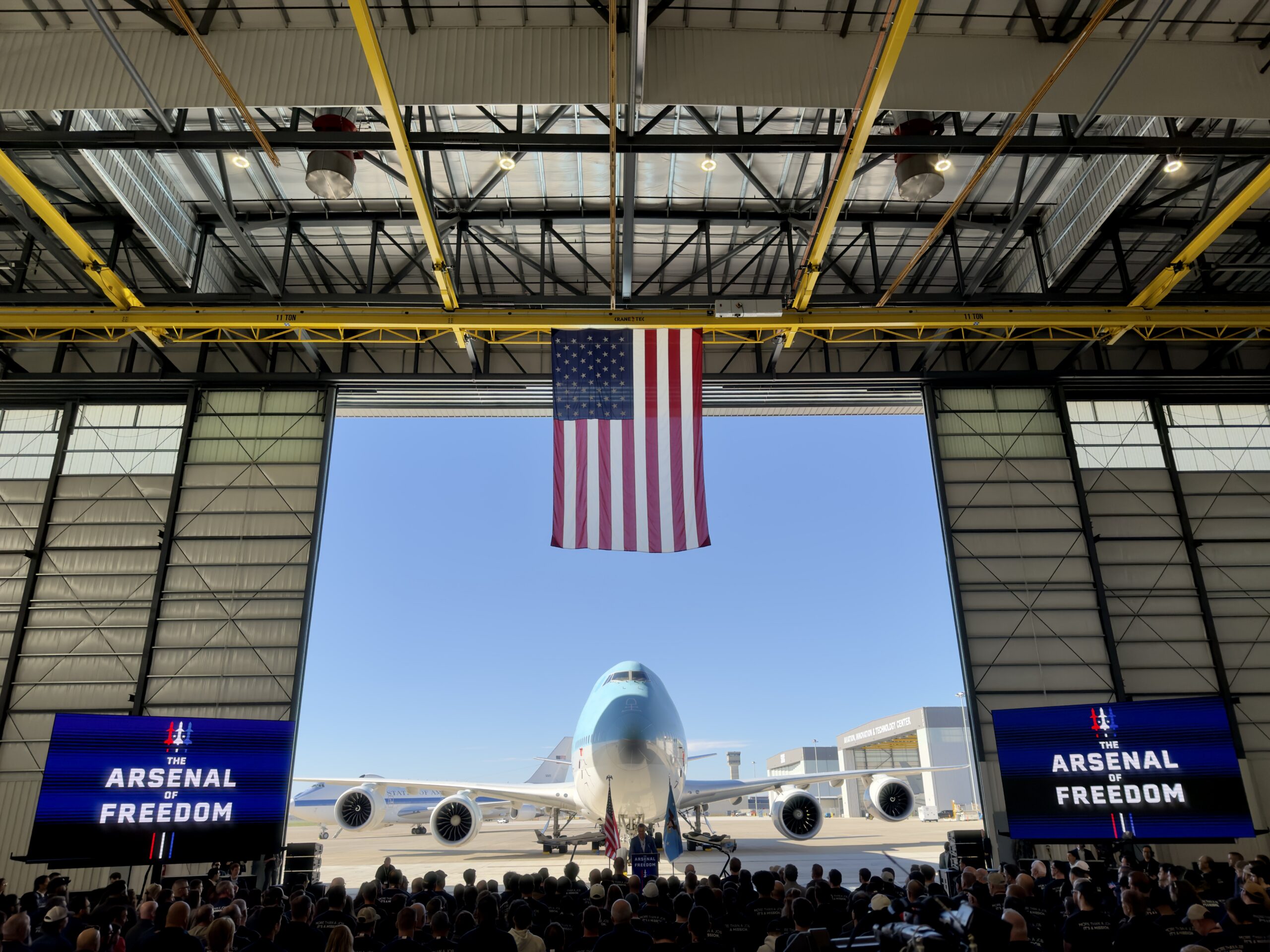
DAYTON, Ohio, and EAU CLAIRE, Wis.—Secretary of Defense Pete Hegseth visited Ohio and Wisconsin on October 20 as part of an initiative to emphasize domestic defense manufacturing. The tour, which included stops at facilities involved in producing the next-generation E-4C “Survivable Airborne Operations Center” (SAOC) aircraft, occurred in key electoral states approximately one month before midterm elections.
During a visit to the Sierra Nevada Corporation (SNC) in Dayton, Ohio, Secretary Hegseth stated, “We plan to spend even more in the future.” He also used the occasion to commend President Donald Trump and Ohio Republican Senator Bernie Moreno.
Hegseth elaborated on the Pentagon’s contracting strategy, stating, “We are providing larger and longer and more predictable contracts to companies so that they can deliver at scale and at pace.” He linked this approach to economic benefits, asserting, “That means more jobs, more reliable jobs, high-paying jobs as companies invest in their people. We’re going to reward leaders who invest in their workers, who expand their capacity, and who share our utter sense of urgency.”
Sierra Nevada Corporation acquired five Korean Air 747-8i jetliners, with plans to convert at least four into the new E-4C Survivable Airborne Operations Center (SAOC). Secretary Hegseth highlighted SNC, which secured a $13 billion contract to develop America’s next-generation nuclear command-and-control aircraft, a contract awarded over Boeing. Additionally, Shield AI recently received a contract for integrating artificial intelligence into aircraft. Unconfirmed reports suggest the Air Force may be considering an expansion of this fleet.
During discussions with reporters, Secretary Hegseth addressed his recent trip to the Middle East. He confirmed visits to U.S. fighter units and personnel and stated to Air & Space Forces Magazine that he met with Israeli Prime Minister Benjamin Netanyahu. Hegseth declined to disclose the specifics of his conversation with Netanyahu, including whether the possibility of renewed attacks on Iran was discussed, though he affirmed that the Israeli military “has great capabilities.”
Hegseth commented on the U.S. relationship with Israel’s armed forces, stating, “We’ve worked with the Israeli military quite a bit. They’ve been good partners.”
Separately, Hegseth informed Air & Space Forces Magazine that the Pentagon has not issued any directive to slow down SpaceX’s Starlink service, or its military counterpart Starshield which is controlled by the Department of Defense, for Ukraine. This statement comes amidst claims from Ukrainian officials that their access to the satellite internet service has been restricted, thereby impacting their drone operations and air defenses.
Secretary Hegseth further clarified the Pentagon’s stance on Starlink, stating, “We haven’t changed our posture in any way to all the Ukrainians. We haven’t pulled anything back. There are terms of service that ultimately need to be complied to, and that’s where Starlink has the option to make those decisions. But nothing’s changed from our view. We haven’t made any directives or anything like that. And we wish the Ukrainians, obviously, success.”
A report from The Wall Street Journal, published later on October 20, indicated that the decision to potentially restrict Starlink service was made by Elon Musk, the chief executive of SpaceX.
The primary objective of Secretary Hegseth’s multi-state tour was to advocate for increased defense spending and to underscore the Pentagon’s efforts to bolster the domestic defense industry.
Hegseth articulated the scale of proposed defense investment, stating, “We’re asking for a $1.5 trillion investment to make a generational investment to ensure that we remain the strongest and most powerful military in the world.” He linked this investment to economic growth, adding, “And those types of investments translate directly into high-paying jobs for American manufacturers.”
The new E-4C aircraft, being modernized by Sierra Nevada Corporation, are slated to replace the existing four E-4B National Airborne Operations Center aircraft, which have an average operational age exceeding 50 years.

Boeing was removed from the competition to modernize the E-4 nuclear command and control fleet in 2023, resulting in SNC becoming the sole contender. Despite this, the E-4C airframe itself continues to be based on Boeing’s 747-800i.
This contract represents the largest in SNC’s six-decade history and stands as one of the most substantial aircraft modernization agreements awarded to a company that is not the aircraft’s original equipment manufacturer. The E-4C conducted its inaugural test flight last year.
Secretary Hegseth additionally discussed his “Future of War” initiative, known as Project Meridian, and his proposals for establishing a new four-star Autonomous Warfare Command. He reiterated his commitment to fostering American manufacturing, an effort he stated he has pursued over the past year.

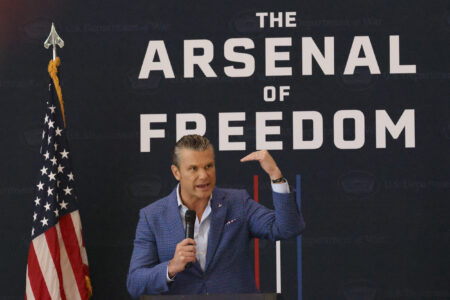
Following his Ohio visit, Hegseth traveled to Wisconsin, stopping in the rural congressional district represented by Rep. Derrick Van Orden. Van Orden, an ally of the current administration, is engaged in a closely contested re-election campaign widely considered a toss-up. Secretary Hegseth’s visit to Riverside Machine and Engineering, a small business, was conducted alongside Small Business Administrator Kelly Loeffler. This stop aimed to underscore efforts to invest in smaller defense contractors. Riverside Machine and Engineering functions as a subcontractor, producing components for radar systems and other equipment utilized by major defense contractors such as BAE Systems and Lockheed Martin, including parts for the F-35 fighter jet.
Hegseth emphasized the critical role of small businesses within the defense sector, stating, “Tens of thousands of small businesses are the core of our defense industrial base. Any supply chain is only as weak as its weakest link, and if you can’t make a critical subcomponent, then ultimately that F-35 doesn’t fly or ultimately that radar isn’t working.”
Why This Matters
Secretary Hegseth’s multi-state tour and his public statements carry significant implications across several critical domains, from national security and economic policy to international relations and domestic politics.
From a national security perspective, the focus on modernizing the E-4C SAOC aircraft is paramount. These ‘Doomsday planes’ serve as the airborne command posts for the U.S. President and Secretary of Defense in the event of a national emergency, particularly a nuclear attack. Replacing the aging E-4B fleet, which is over 50 years old, is crucial for maintaining a resilient and survivable nuclear command and control system. The integration of artificial intelligence into defense systems, as exemplified by the Shield AI contract, signals a broader strategic shift towards advanced technological capabilities to ensure military superiority.
Economically, the Pentagon’s strategy of awarding larger, more predictable contracts, such as the $13 billion deal with Sierra Nevada Corporation, aims to stimulate domestic manufacturing and create high-paying jobs. This approach not only strengthens the defense industrial base but also aligns with the administration’s broader economic narrative of investing in American industries. The emphasis on supporting small businesses, highlighted by the visit to Riverside Machine and Engineering, acknowledges their foundational role in the defense supply chain, ensuring that even highly specialized components are produced domestically and reliably.
In terms of foreign policy and international relations, Hegseth’s discussions touched upon ongoing geopolitical challenges. His visit to the Middle East and meeting with Israeli Prime Minister Netanyahu underscore the U.S.’s continued engagement in the region and its strategic partnership with Israel, particularly in a volatile environment where discussions about regional security, including Iran, remain sensitive. The Pentagon’s stance on Starlink for Ukraine reveals the complex interplay between commercial technology, military operations, and international conflict, highlighting the vulnerabilities introduced when critical infrastructure is reliant on private entities and their terms of service.
Domestically, the timing and location of Hegseth’s tour, specifically in key electoral states and alongside an administration ally facing a tight re-election battle, indicate the political dimension of defense spending. Promoting defense manufacturing and job creation can serve as a potent message to voters, linking national security imperatives with local economic benefits ahead of significant midterm elections. The call for a $1.5 trillion investment in the military also positions defense spending as a major policy platform, emphasizing preparedness and strength on the global stage.