
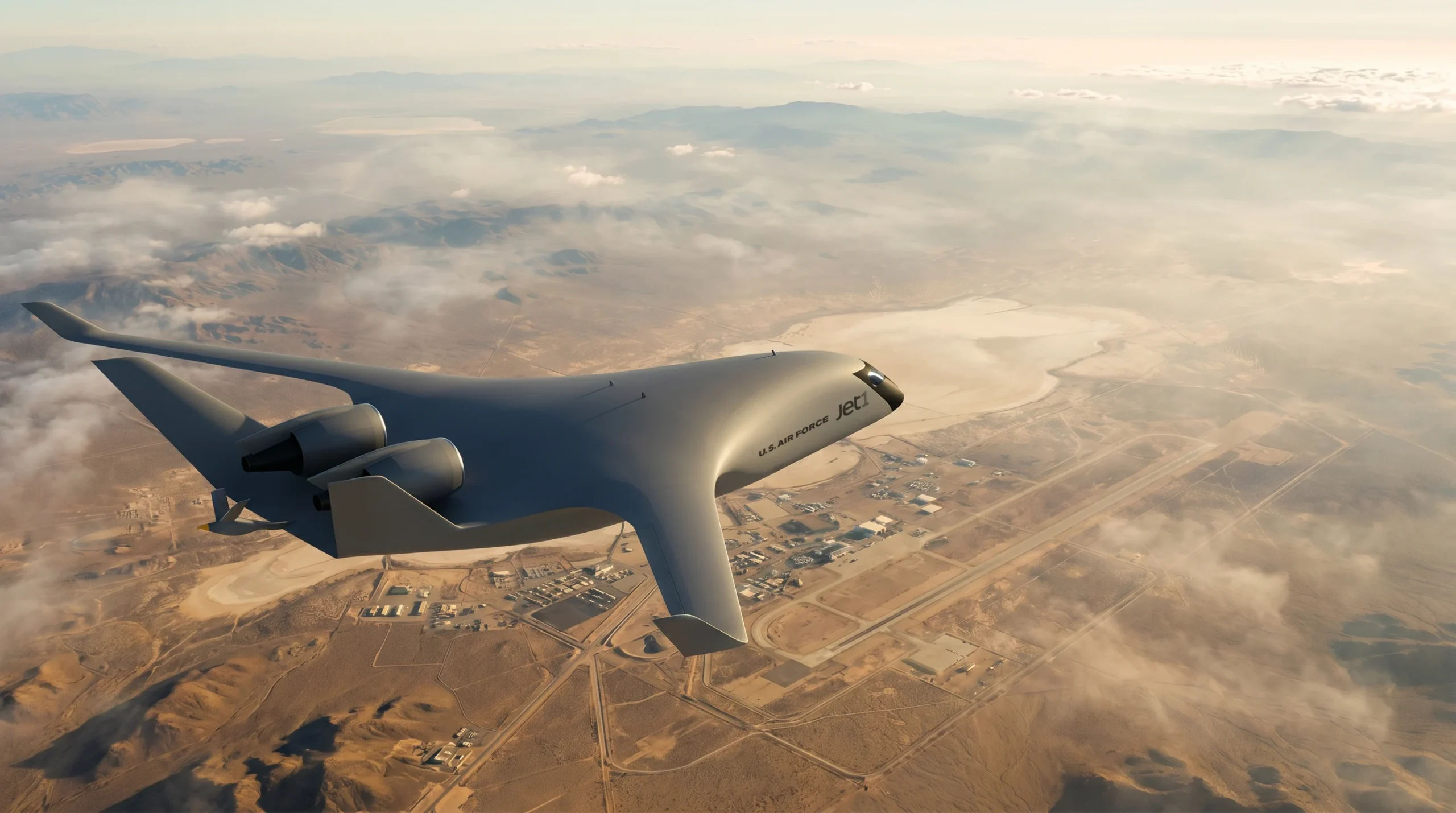
A recent analysis by a prominent Washington D.C. think tank suggests that a hypothetical blended-wing body (BWB) tanker aircraft could dramatically outperform the U.S. Air Force’s current KC-46A Pegasus refueler, potentially offering double the aerial refueling capacity. This recommendation comes as the Air Force prepares to evaluate a BWB demonstrator aircraft in the coming years, navigating its complex future tanker acquisition strategy amidst numerous competing modernization priorities, including advanced fighter jets and bombers.
The report, published by the Hudson Institute on October 27, articulates a compelling case for the U.S. Air Force to acquire a fleet of 250 advanced new tankers. This substantial expansion and modernization of the refueling fleet, the authors contend, is essential to address the significant logistical and operational challenges anticipated in a potential high-intensity conflict with China.
The Strategic Imperative: Refueling in a Contested Pacific
Traditionally, during military conflicts, the U.S. Air Force has relied on launching its tanker aircraft from relatively secure airfields located within a manageable distance of bomber and fighter strike objectives. These “uncontested airfields” have historically served as critical nodes for projecting air power. However, the vast geographical expanse of the Western Pacific region, combined with the increasing range and precision of China’s advanced missile capabilities, renders this conventional approach untenable in a future peer-level conflict.
Report authors Timothy A. Walton and Shane Dennin warn that by 2035, Chinese military forces are likely to possess the capability to significantly disrupt or suppress large-scale tanker operations. This threat extends not only to forward operating bases but potentially to many intermediate airfields that U.S. tankers have historically depended upon. Such a capability, they emphasize, “could collapse U.S. air operations and heavily contribute to U.S. defeat in a war against the People’s Republic of China,” highlighting the existential risk posed to American air superiority and power projection in the region.
The Hudson Institute’s conclusion is unequivocal: the solution lies in developing and fielding a new generation of tanker aircraft capable of operating effectively from much greater distances and carrying substantially larger fuel loads to the combat zone.
The Blended-Wing Body Solution: Enhanced Performance and Efficiency
Blended-wing body (BWB) aircraft represent a radical departure from traditional tube-and-wing designs. In a BWB configuration, the aircraft’s wings seamlessly merge into its fuselage, creating a more integrated and aerodynamic shape. This innovative design is celebrated for its potential to offer superior aerodynamic efficiency, meaning the aircraft can fly farther and carry more weight on less fuel. Additionally, the BWB architecture naturally lends itself to a larger internal cabin or cargo space, ideal for carrying vast quantities of fuel or other payloads.
According to the Hudson report, these inherent advantages translate into staggering performance gains for a BWB tanker. The analysis suggests that a “medium BWB can refuel more than twice as many force packages or refuel force packages more than twice as far as the KC-46A,” the Air Force’s newest tanker. Furthermore, at longer operational ranges and with higher fuel offloads—the amount of fuel transferred to receiving aircraft—the medium BWB could deliver “up to five times as many operationally relevant increments of fuel as the KC-46A.” This highlights the BWB’s potential not just for incremental improvement but for a transformative shift in aerial refueling capabilities.
The Air Force’s Engagement and Current Tanker Landscape
The U.S. Air Force has already initiated steps to explore the BWB concept. Since 2023, the service has been collaborating with the startup JetZero, which has partnered with aerospace giant Northrop Grumman, on a BWB demonstrator/prototype program. This experimental aircraft, designated Z4, is currently under development and is anticipated to achieve its first flight in late 2027.
An Air Force spokesperson recently confirmed that the “blended-wing body project is currently active, on schedule, and meeting assembly milestones; the demonstrator’s first flight is scheduled for late 2027.” While JetZero has proposed a tanker variant, dubbed KC-Z4, it is important to note that the Z4 demonstrator itself will not be equipped for actual aerial refueling operations, serving instead as a technology testbed for the foundational BWB design.
The Air Force’s overall future tanker plans remain in flux, complicated by several factors. The venerable KC-135 fleet, a backbone of aerial refueling for decades, is an Eisenhower-era design and is increasingly showing its age, demanding significant maintenance and modernization efforts. Air Force officials have consistently emphasized the critical need for refuelers that can not only carry fuel but also survive and operate effectively in increasingly contested airspace environments. This emphasis points towards aircraft with enhanced defensive systems, stealth characteristics, or the ability to operate at much greater standoff distances.
At one point, the Air Force was exploring a comprehensive Next-Generation Aerial Refueling System (NGAS) program to define and develop its future tanker. However, in its fiscal year 2027 budget request, the service pivoted its strategy, indicating a shift in focus towards enhancing protection systems for existing or near-term aircraft rather than immediately pursuing an entirely new aircraft design for NGAS. This change reflects the immediate need to address vulnerabilities while keeping options open for longer-term solutions.
Concurrently, the Air Force is still committed to acquiring up to 75 additional KC-46 Pegasus refuelers, beyond the existing program of record for 188 aircraft. This continued investment in the KC-46, however, is contingent upon the resolution of critical issues. In May, the Air Force finalized an agreement with Boeing, the manufacturer, to fix lingering problems with the Pegasus, most notably the improved remote vision system (RVS). The RVS is a crucial technological component that boom operators use to safely and accurately refuel other aircraft in flight. Senior Air Force leaders have made it clear that a fully functional and reliable RVS is a prerequisite before the service will finalize the new contract extension to procure the extra 75 tankers.
Hudson Institute Recommendations and Cost Projections
The Hudson Institute report outlines a phased approach for the Air Force’s tanker modernization. It recommends proceeding with the planned KC-46 production extension contract, ensuring a consistent influx of new, albeit conventional, refueling capacity. Subsequently, assuming the BWB demonstrator evaluation proves successful in 2027 and 2028, the report advises directing fiscal year 2027 research, development, test, and evaluation (RDTE) funding towards “mature medium-sized, long-range, high-offload capacity tanker designs, such as medium BWB.” This strategic allocation of funds would accelerate the development of the BWB concept from a demonstrator phase to a deployable military platform.
Crucially, the report also presents a compelling financial argument. While its proposed plan would necessitate “additional RDTE outlays in the late 2020s and early 2030s,” it projects significant long-term savings. The total RDTE, procurement, and operations and support costs over a 30-year period could amount to “$15.5 billion less than a plan that solely procured KC-46A.” This estimate is based on a direct comparison of acquiring and operating a fleet of 250 medium BWB tankers versus the same number of KC-46As, indicating that the higher upfront development costs of the BWB could be offset by its greater efficiency and operational advantages over its lifespan.
Expert Perspectives: Optimism Meets Fiscal Reality
Retired Air Force Gen. Mike Minihan, who commanded Air Mobility Command between 2021 and 2024, expressed strong belief in the potential of the BWB demonstrator effort. He viewed its conception as a vital step to reverse what he perceived as a historical neglect of tanker fleet modernization, particularly when compared to aggressive investments in fifth- and sixth-generation bombers and fighters.
“One of my biggest concerns was the equilibrium of the strike force with the enabling force,” Minihan, who retired in 2024, explained. “I love B-21, I love F-15 EX, I love F-35, I love the [Collaborative Combat Aircraft], … but if we don’t invest in the enablers to make those things successful, we’re going to look silly on the modern battlefield.” His continued conviction in the BWB design led him to join JetZero as an advisor earlier this year. He enthusiastically described the BWB’s potential, stating, “It’s almost two times everything—two times fuel the efficiency, two times the amount of receiver service, two times quicker, two times the distance—I mean, it’s quite remarkable.”
Douglas Birkey, Executive Director for the Air & Space Forces Association’s Mitchell Institute for Aerospace Studies, echoed the sentiment regarding the BWB’s potential benefits. “There is no question the Air Force needs new refueling capacity, and it needs to ensure that it can maximize offload range—you want to haul as much fuel as possible, not burn a whole lot on your way to the refueling track, offload as much as possible and then get back home,” Birkey observed. “And the blended-wing body has definite, distinct aerodynamic advantages, being highly efficient to maximize that off-loader range.”
However, Birkey tempered his optimism with a dose of skepticism regarding the Air Force’s ability to secure the necessary long-term funding for a next-generation BWB tanker within the current budget environment. The service’s fiscal year 2027 budget request of $267.7 billion, while a significant increase of $53 billion over its 2026 budget, still faces intense pressure from competing modernization priorities. Programs such as the development of the sixth-generation B-21 bomber and advanced F-47 fighter aircraft absorb a substantial portion of available investment, limiting funds for other critical areas like tanker fleet modernization. Birkey emphasized that acquiring and fielding a new fleet of BWB tankers would demand “even larger toplines of reliable funding over the next decade for the service.”
“There’s got to be sustained long-term investment; this isn’t a one-year plus-up kind of investment. They need a decade’s worth of solid investment,” Birkey stressed. “They’re making up for so much underinvestment.”
For its comprehensive report, the Hudson Institute evaluated several tanker concepts, including the existing KC-46A, the Airbus A330 MRTT+, a medium-sized BWB design, a medium-sized reduced signature design, and a collaborative tanker aircraft (the latter two envisioned for shuttling fuel from larger parent tankers over shorter distances). The KC-46A and A330 MRTT+ are considered medium-range, multirole designs. In contrast, the medium BWB is designed as a long-range, high-offload, dedicated tanker. The envisioned medium BWB tanker is being designed to carry an impressive 300,000 pounds of fuel, significantly more than the KC-46’s maximum capacity of 212,000 pounds and the A330 MRTT+’s 245,000 pounds.
Why This Matters
The debate surrounding the future of the U.S. Air Force’s tanker fleet is not merely a technical discussion among aviation experts; it is a critical national security issue with far-reaching implications. Aerial refueling is the linchpin of modern air power, enabling fighter jets, bombers, and surveillance aircraft to operate globally, project power over vast distances, and sustain operations in remote theaters. Without a robust and capable tanker fleet, the United States’ ability to respond to crises, deter aggression, and defend its interests worldwide would be severely curtailed.
The specific challenge highlighted by the Hudson Institute report—the rising threat from China’s anti-access/area denial (A2/AD) capabilities in the Pacific—underscores the urgent need for innovation. If U.S. tankers cannot operate safely or effectively in forward areas, the range and endurance of all other U.S. combat aircraft are drastically reduced. This directly impacts the credibility of U.S. deterrence and its capacity to defend allies in a potential conflict. Investing in advanced tankers like the proposed blended-wing body is essential for maintaining a strategic advantage and ensuring the freedom of navigation and overflight in vital global regions.
Beyond national security, this issue touches upon significant economic and technological considerations. The potential for a BWB tanker to offer superior fuel efficiency and operational performance translates into long-term cost savings for taxpayers, even with higher initial development costs. It also represents a major leap in aerospace engineering, potentially positioning the U.S. at the forefront of aviation innovation. However, the substantial funding required for such a program highlights the ongoing tension between military modernization needs and broader budgetary constraints, forcing difficult choices between competing priorities. The decisions made regarding the next generation of tankers will shape the U.S. military’s capabilities for decades to come, influencing global power dynamics and the efficacy of American air power in an increasingly complex world.
**U.S. Air Force Explores New Tanker Strategy, Advocates for Blended Wing Body Aircraft**
A recent strategic report has urged the U.S. Air Force to undertake a significant overhaul of its aerial refueling capabilities, proposing a holistic approach that includes bolstering existing infrastructure, enhancing current tanker systems, and introducing a new fleet of medium-sized Blended Wing Body (BWB) aircraft. The recommendations aim to equip the Air Force with a more resilient and capable refueling force, critical for operations in an increasingly contested global environment.
The report, authored by Hudson, outlines a multi-faceted strategy designed to address the evolving challenges posed by near-peer adversaries and the demands of global power projection. At the core of its findings is the recognition that the current tanker fleet, while vital, may face vulnerabilities in future conflicts, necessitating a more distributed and survivable architecture.
Hudson concluded that the Air Force should take a comprehensive approach that includes several key pillars:
- Prioritizing military construction and other funding to enhance capacity and resilience of its most important tanker airfields. This recommendation underscores the vulnerability of fixed infrastructure to long-range precision strikes and the need for hardened, dispersed, and more capable bases to support sustained aerial operations. Improving airfield capacity and resilience would ensure that critical refueling assets can operate effectively even under threat, reducing reliance on a few concentrated hubs.
- Continuing to increase funding for command, control, and communications (C3); self-defense; fuel transfer; and automation and autonomy mission systems for current and future tankers. This investment aims to upgrade the operational capabilities and survivability of the existing and future tanker fleet. Enhanced C3 systems would improve coordination and responsiveness, while better self-defense measures would offer protection against emerging threats. Advances in fuel transfer automation and autonomy could optimize refueling processes, reduce crew workload, and potentially enable operations in more challenging conditions.
- Developing and procuring 250 medium-sized, long-range, high-offload tankers, such as the medium Blended Wing Body (BWB), which could prove capable of standing in a moderate distance from threats. This is arguably the most transformative recommendation. The BWB concept, which integrates the aircraft’s body and wings into a single lifting surface, offers potential advantages in aerodynamic efficiency, fuel capacity, and stealth characteristics compared to traditional tube-and-wing designs. A medium-sized BWB could provide critical refueling support while operating further from adversary anti-access/area denial (A2/AD) zones, enhancing survivability and operational reach.
The report suggests that the Air Force could begin fielding this new fleet of medium BWBs by the mid-2030s. Crucially, it posits that this modernization could be achieved “for reasonable RDTE (Research, Development, Test, and Evaluation) and procurement costs that align with projected budgets, and it could cost considerably less than simply buying more KC-46As.” This cost-effectiveness argument is a significant factor in advocating for a new aircraft type rather than simply expanding the existing fleet.
To illustrate this point, the report provides a compelling financial comparison. It estimates that a mixed fleet, comprising approximately 260 existing KC-46 Pegasus tankers and 250 new medium BWB tankers, would incur total costs of $398 billion over a 30-year period. In contrast, fielding an additional 250 KC-46s to create a total fleet of 510 of the current generation tankers would cost an estimated $413 billion over the same timeframe. This suggests a potential savings of $15 billion by opting for the mixed fleet strategy.
The strategic rationale for a mixed fleet extends beyond mere cost savings. According to the report, both aircraft types would complement each other’s strengths. “Together, the force could succeed in its most stressing scenarios, as well as sustainably execute other operations across the world,” the report states. This implies that the KC-46 would continue to perform its vital roles in less contested environments and alongside the BWB in more challenging ones, leveraging the unique attributes of each platform.
The vision articulated in the report has garnered significant support from key figures within the defense community. General Mike Minihan (Ret.), the former chief of Air Mobility Command, expressed strong agreement with the necessity of this strategic shift. While acknowledging the importance of advanced “bombers and fighters of fifth and sixth generation,” Minihan highlighted a critical oversight: “we generally don’t pay attention to the enabling force until it fails.” He warned against the dangers of complacency, stating, “To think that we can take a four-generation gap between our strike force and our enabling force into combat with a near-peer adversary is a fool’s errand.” This underscores the urgency of modernizing the tanker fleet to keep pace with the advancements in combat aircraft and adversary capabilities.
Minihan further confirmed his long-standing support for the medium BWB demonstrator effort, noting, “It fits perfectly into the NGAS (Next-Generation Air Dominance) concept.” He emphasized the efficiency benefits, explaining, “Every pound of gas I save getting to the fight is a pound of gas I can give away to a fighter or a bomber.” This highlights how an aerodynamically superior tanker could not only enhance its own operational range and survivability but also extend the effective range and endurance of combat aircraft, maximizing their impact in theatre. The push for a BWB thus aligns with broader Air Force initiatives to develop more efficient, survivable, and interconnected systems for future warfare.
Why This Matters
The U.S. Air Force’s proposed shift in its aerial refueling strategy holds profound implications for global security, military doctrine, and aerospace innovation. Air superiority and the ability to project power globally are fundamentally dependent on air refueling capabilities. Without tankers, modern combat aircraft, designed for speed and agility but with limited internal fuel, cannot reach distant targets or sustain prolonged operations. This strategic pivot, therefore, directly impacts the U.S. military’s ability to respond to crises, deter aggression, and defend its interests and allies worldwide.
In an era of renewed great power competition, particularly with China and Russia, the need for a resilient tanker fleet is more critical than ever. Both potential adversaries possess advanced anti-access/area denial (A2/AD) capabilities, including long-range missiles and sophisticated air defenses, designed to push U.S. forces away from their borders. Conventional tankers, large and relatively slow, are vulnerable targets within these zones. The introduction of a medium-sized Blended Wing Body (BWB) tanker, capable of operating from a “moderate distance from threats,” represents a significant step towards enabling U.S. air power to operate effectively in these contested environments. It’s a recognition that future conflicts will demand assets that are not only capable but also survivable.
Furthermore, this strategy represents a substantial investment in the future of aerospace technology. The BWB concept, if widely adopted, could revolutionize aircraft design, leading to advancements in efficiency, stealth, and operational flexibility that extend beyond military applications. The commitment of hundreds of billions of dollars over decades would also have a significant economic impact, supporting jobs in the aerospace and defense sectors, driving innovation, and shaping the industrial base.
Finally, the emphasis on a “holistic approach” – including enhanced airfield resilience and upgraded command, control, and communications – highlights a broader shift towards integrated defense strategies. It acknowledges that military effectiveness is not solely about individual platforms but about the entire ecosystem of support, infrastructure, and information networks that enable them. For U.S. allies, a more robust and survivable American tanker fleet means enhanced collective defense capabilities and greater assurance of U.S. commitment to regional stability, reinforcing the fabric of international alliances. This strategic redirection is not merely about new aircraft; it’s about redefining how the U.S. Air Force will project power and maintain its edge in the complex security landscape of the 21st century.