
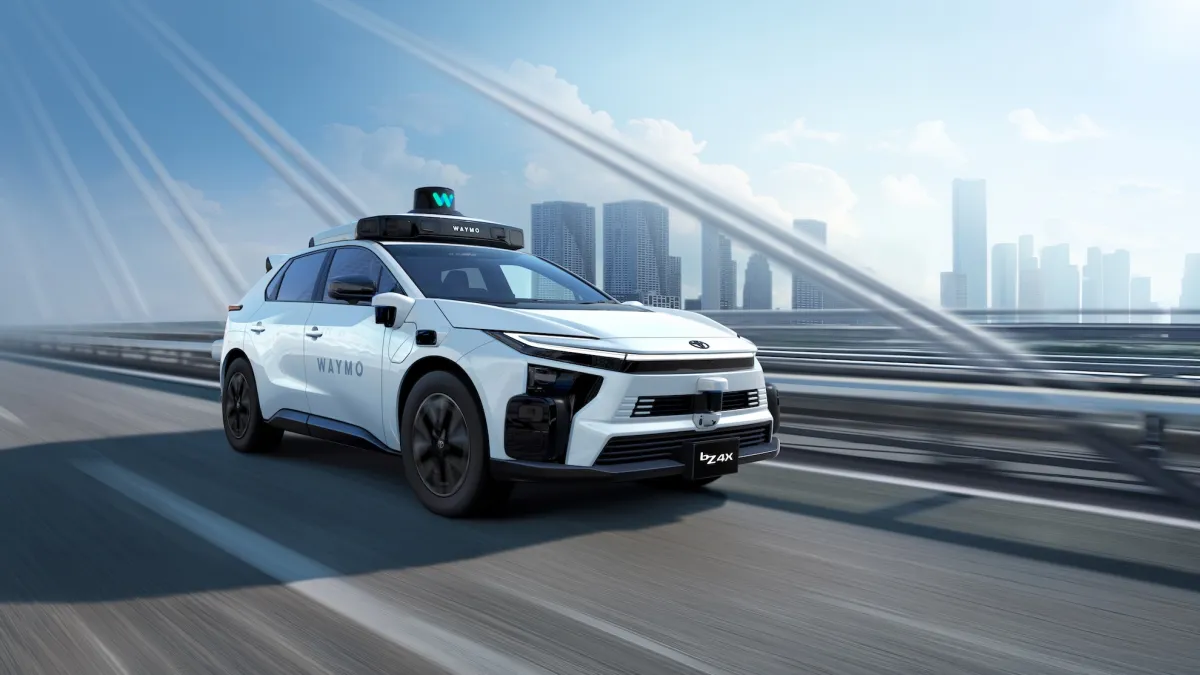
Waymo will begin testing autonomous Toyota bZ4X vehicles in Japan next year as part of a broader partnership with the automaker to provide electric vehicles for robotaxi operations in international markets, including the U.K.
Under the partnership announced Friday, Toyota will manufacture the 2027 bZ4X vehicles and integrate Waymo’s self-driving system at its Takaoka factory in Japan. (The electric vehicle is now known as the BZ in the North American market)
The autonomous bZ4X vehicles will initially be tested in Japan, where Waymo intends to eventually operate a robotaxi service. But the intent is to deploy these vehicles in other right-hand driving countries such as the U.K. Waymo has been testing its autonomous Jaguar I-Pace vehicles in London for months and plans to launch a robotaxi service there once it receives the necessary permits.
The announcement comes 18 months after Toyota and Waymo signed a preliminary agreement to explore the development and deployment of an autonomous vehicle platform. At the time, the agreement fell into the “let’s see what happens” category, with language vague enough to leave plenty of room for interpretation.
For now, the partnership looks more like a conventional vehicle supplier deal that helps Waymo fill specific regional needs while adding a new model to its robotaxi portfolio.
But the partnership could go beyond robotaxis. The companies said they will continue to look at bringing Waymo’s autonomous technology to personally owned Toyota vehicles.
Toyota and Waymo also announced plans to look at other future “initiatives” that would use “insights from Waymo’s real-world operations” to improve safety for other road users. What that might mean is unclear, although Hiroki Nakajima, executive vice president of Toyota and a board member, provided some clues.
“This collaboration will help scale that technology and bring it to customers in Japan and beyond through Waymo’s ride-hailing service, and in parallel, Toyota will continue to explore how integrating vehicles with traffic infrastructure can make those roads safer still,” he said in a statement.
When you purchase through links in our articles, we may earn a small commission. This doesn’t affect our editorial independence.
{content}
Key Takeaways
- Global Expansion Accelerated:Waymo is significantly expanding its international robotaxi ambitions, leveraging Toyota’s manufacturing prowess and the bZ4X EV for deployments starting in Japan and targeting other right-hand drive markets like the UK.
- Strategic Vehicle Partnership:The collaboration moves beyond exploratory talks, solidifying into a robust supplier agreement where Toyota will integrate Waymo’s autonomous driving system into purpose-built bZ4X vehicles, marking a crucial step towards scaling operations.
- Future Beyond Robotaxis:The partnership hints at broader implications, including the potential integration of Waymo’s technology into personally owned Toyota vehicles and utilizing Waymo’s real-world operational insights to enhance overall road safety through infrastructure integration.
Waymo and Toyota Forge Global Autonomous Alliance, Targeting Japan and Beyond
In a significant stride towards realizing a truly global autonomous future, Waymo, Google’s self-driving technology company, has unveiled an expanded and concrete partnership with automotive giant Toyota. The collaboration, initially a “let’s see what happens” scenario, has now matured into a definitive plan: Waymo will begin testing a fleet of autonomous Toyota bZ4X electric vehicles in Japan next year. This initiative is not merely a local experiment but a cornerstone of a broader strategy to deploy robotaxi services across international markets, with the UK explicitly on the roadmap.
The Alliance Takes Concrete Shape
The freshly announced agreement outlines a clear division of labor and a strategic timeline. Toyota will take on the manufacturing responsibility for the 2027 bZ4X vehicles, integrating Waymo’s advanced self-driving system directly into the production line at its Takaoka factory in Japan. This deep integration is pivotal, ensuring that the vehicles are designed from the ground up to operate autonomously, rather than being retrofitted. The bZ4X, known as the BZ in the North American market, represents a modern, all-electric platform well-suited for the demanding operational cycles of a robotaxi fleet.
Initial testing will commence in Japan, a market ripe with potential for autonomous solutions given its dense urban environments and an aging population seeking convenient mobility options. Waymo’s ultimate goal in Japan is to launch a full-fledged robotaxi service, mirroring its successful operations in U.S. cities like Phoenix and San Francisco. Crucially, this partnership also serves as a springboard for deployment in other right-hand drive countries, with the UK being a primary target. Waymo has already been conducting extensive testing with its autonomous Jaguar I-Pace vehicles in London, patiently awaiting the necessary permits to transition from testing to public service.
Strategic Rationale: A Global Vision Takes Hold
This reinforced partnership with Toyota underscores Waymo’s accelerating international ambitions. While Waymo has steadily expanded its footprint in the U.S., global scaling presents unique challenges, from regulatory hurdles to adapting to diverse driving cultures and infrastructure. Teaming with a manufacturing powerhouse like Toyota provides Waymo with an invaluable advantage.
Toyota’s Manufacturing Prowess and Global Reach
Toyota’s reputation for quality, reliability, and unparalleled manufacturing scale makes it an ideal partner. Its ability to produce vehicles at volume and ensure robust integration of complex systems is critical for Waymo’s commercialization efforts. Furthermore, Toyota’s global supply chain and market presence simplify the logistics of deploying autonomous fleets across disparate regions, mitigating the complexities Waymo might face operating independently.
The bZ4X Advantage
The choice of the all-electric bZ4X is also strategic. As cities worldwide increasingly prioritize sustainable transportation, an EV platform aligns perfectly with the environmental goals of modern urban mobility. The bZ4X’s contemporary design, passenger comfort, and efficient electric powertrain make it a strong candidate for a future-proof robotaxi service, offering a quiet, smooth, and emissions-free ride.
From Preliminary Talks to Concrete Deployment
The journey to this announcement began 18 months prior, with a preliminary agreement that, at the time, was light on specifics. It was an exploratory phase, a “let’s see what happens” moment where both companies cautiously assessed the potential synergy. The transition from vague language to a definitive manufacturing and deployment plan speaks volumes. It signifies a deepening trust between Waymo and Toyota, likely driven by Waymo’s continued progress in autonomous technology and Toyota’s recognition of the critical role self-driving will play in the future of mobility. This evolution highlights a maturing industry, where initial cautious collaborations are now giving way to concrete, long-term strategic alliances necessary for large-scale commercialization.
Beyond the Robotaxi: Future Horizons
While robotaxi deployment is the immediate focus, the partnership hints at aspirations that extend far beyond simply ferrying passengers. The companies explicitly stated their intention to explore bringing Waymo’s autonomous technology to personally owned Toyota vehicles. This visionary goal represents the ultimate prize for many in the autonomous driving sector – a future where self-driving capabilities are integrated into consumer vehicles, transforming individual ownership and travel.
Enhancing Road Safety Through Data Insights
Perhaps even more intriguing are the plans to look at other future “initiatives” that would use “insights from Waymo’s real-world operations” to improve safety for other road users. Hiroki Nakajima, Executive Vice President of Toyota, shed some light on this, stating, “Toyota will continue to explore how integrating vehicles with traffic infrastructure can make those roads safer still.” This suggests a holistic approach to safety, where Waymo’s extensive data on driving behaviors, edge cases, and environmental interactions can inform broader traffic management strategies, urban planning, and potentially even vehicle-to-infrastructure (V2I) communication systems. Such insights could benefit not just autonomous vehicles, but all road users, pushing the boundaries of what connected mobility can achieve for public safety.
The Road Ahead: Challenges and Opportunities
Despite the optimism, the path to widespread autonomous deployment is not without its hurdles. Regulatory frameworks in Japan, the UK, and other potential markets are still evolving. Public perception and acceptance remain critical factors. Scaling manufacturing, maintaining service quality, and achieving profitability in diverse geographical contexts will demand continuous innovation and meticulous execution. However, this partnership positions Waymo and Toyota strongly to tackle these challenges, leveraging Waymo’s technological leadership and Toyota’s manufacturing might to unlock new frontiers in mobility.
Bottom Line
The expanded Waymo-Toyota partnership marks a pivotal moment in the global race for autonomous mobility. By blending Waymo’s cutting-edge self-driving AI with Toyota’s legendary manufacturing prowess and global reach, the alliance is poised to accelerate the deployment of robotaxi services in key international markets like Japan and the UK. More than just a vehicle supply deal, this collaboration lays the groundwork for a future where autonomous technology extends beyond ride-hailing to personally owned vehicles and contributes to a safer, more efficient transportation ecosystem for everyone.
Source:{feed_title}