
Ohio Restaurant Caught in Political Firestorm Over Controversial Campaign Ad
MEDINA, Ohio – A small-town burger restaurant in Medina, Ohio, found itself at the center of a heated political controversy, facing accusations of supporting pedophilia after agreeing to host a campaign event for a Republican candidate. The incident highlights the escalating polarization of American politics, where local businesses can become battlegrounds for national ideological divides.
The backlash against P.J. Marley’s, a popular eatery known for its presence in Medina’s tranquil town square, began in late October. The Ohio Republican Party announced that a group of candidates, including Vivek Ramaswamy, then running for governor, would make a stop at the restaurant on the Saturday before the election. This announcement coincided with the release of a controversial campaign ad by Mr. Ramaswamy.
The ad featured the estranged mother of his Democratic opponent, Amy Acton, calling her a liar. The ad drew widespread criticism for its perceived insensitivity and implications, given Ms. Acton’s traumatic past: at age 12, her stepfather was charged with raping her, and her mother subsequently sided with the stepfather.
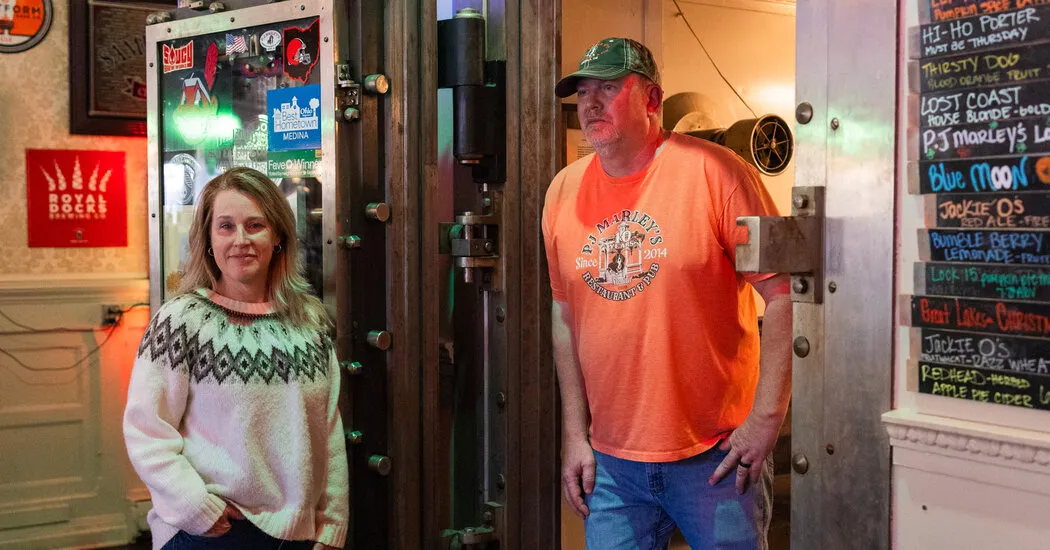
Patty and Jon Stahl, the husband-and-wife owners of P.J. Marley’s, had agreed to host the candidates prior to the ad’s release. Long-standing members of the Medina community, known for their civic involvement and for transforming a 122-year-old bank into their restaurant, the Stahls identified as small-business Republicans. They were interested in Mr. Ramaswamy’s proposals to lower property taxes and reduce utility costs, believing he could offer solutions to their business challenges.
Mr. Stahl emphasized that their decision to host the Republican ticket was not an endorsement of specific political positions, stating they would have extended the same courtesy to Democratic candidates. “People were saying, ‘Oh, you’re giving Vivek a platform,'” Mr. Stahl recounted. “I looked at it as he was giving us a platform.” The couple also expressed that they found Mr. Ramaswamy’s campaign ad to be in “poor taste.”
Escalating Backlash and Community Division
However, as the controversial ad continued to air, the restaurant began receiving an onslaught of angry calls and social media messages. A 16-year-old employee, who answered one of the first protest calls, reported hearing accusations of “pedophiles” from the caller. These accusations quickly escalated, with social media posts directly linking P.J. Marley’s to supporting pedophilia for hosting the candidate.
The Stahls found themselves in a difficult position. Other businesses that had initially agreed to host Mr. Ramaswamy’s events began to cancel, leaving the P.J. Marley’s owners to consider their own decision amidst mounting public pressure. What they had envisioned as a routine business and civic engagement had instead become a focal point for a fierce moral and political debate.
The controversy deeply divided the Medina community. Stacey Bene, a retired social worker and former Jazzercise student of Mrs. Stahl, sent a private Facebook message to Mrs. Stahl, revealing her own experience as a survivor of sexual assault at age 14. She urged Mrs. Stahl to cancel the event, stating, “I cannot separate you from the messages you are allowing to be spread at your facility.”
On social media, the debate raged. Loyal customers announced boycotts, while conservatives who had never visited the restaurant pledged their support. Local Democrats called for boycotts, leading to counter-calls and heated exchanges. The Stahls, in an attempt to manage the situation, deleted negative comments from their social media pages and maintained public silence.
In Medina County, where 62% of voters supported President Trump in the previous election, local Democrats, accustomed to being a minority, organized a protest outside P.J. Marley’s. Kellie Biegel, a local resident with a history of political activism, joined approximately 200 protesters in the town square on October 31. A video truck displayed an image of Mr. Ramaswamy with the question, “What kind of man runs this ad?” While most protesters remained in the square with signs promoting “KINDNESS WILL WIN,” Ms. Biegel joined a smaller group closer to the restaurant, shouting “Pedophile supporters!” directly at customers and livestreaming her actions.
The P.J. Marley’s incident was not an isolated event in Ohio’s political landscape during that election cycle. Allegations of physical and sexual abuse, and connections to convicted sex offenders, were themes present in other races. In the congressional contest, Republican Representative Max Miller faced accusations of abusing his ex-wife and toddler, which he denied. In the Senate race, the Republican incumbent, Jon Husted, was accused of taking money from associates of Jeffrey Epstein.
For the Stahls, the event exposed deep community wounds that, as one observer noted, would not easily heal once the election concluded. The episode underscored the profound impact that national political narratives, amplified by social media and contentious campaign tactics, can have on individuals and small businesses caught in the crossfire.
Why This Matters
The controversy surrounding P.J. Marley’s in Medina, Ohio, serves as a poignant microcosm of broader trends shaping contemporary global politics and social discourse. It illustrates several critical issues:
Firstly, it highlights the increasing **polarization and politicization of everyday life**. What was once a routine business decision to host a campaign event transformed into a moral battleground, demonstrating how deeply ingrained political divisions have become. Small businesses and local communities, regardless of their original intent, can be unwillingly drawn into national debates, facing intense pressure to align with one side or another.
Secondly, the incident underscores the **impact of contentious campaign tactics**. The use of highly personal and sensitive issues, particularly those involving allegations of abuse, in political advertising raises significant ethical questions. When campaigns employ such strategies, they risk not only damaging reputations but also inflicting further pain on victims and weaponizing trauma for political gain, as seen with Amy Acton’s past.
Thirdly, it showcases the **amplifying power and dangers of social media**. Platforms designed for connection can quickly become conduits for misinformation, outrage, and organized harassment. The rapid spread of accusations, often without full context or verification, can severely damage businesses and individuals, creating a hostile environment that overshadows nuanced discussion and understanding.
Finally, this event speaks to the **erosion of civil discourse and community cohesion**. The inability of a community to discuss political differences without resorting to personal attacks, boycotts, and public shaming indicates a decline in the capacity for respectful disagreement. Such incidents leave lasting scars on communities, making it harder for people of differing views to coexist and collaborate on local issues that transcend partisan lines. As political figures and pundits move on to the next election cycle, the wounds inflicted at the local level often persist, affecting social fabric long after the ballots are cast.
Local Business Caught in Political Storm Over Campaign Event
MEDINA COUNTY, Ohio — P.J. Marley’s, a local restaurant in Medina County, became an unexpected focal point of political contention following its decision to host a campaign event for a prominent Republican candidate, Mr. Ramaswamy. The event, held in a building that once served as a bank, drew a diverse crowd inside the establishment. Some attendees explicitly came to hear the candidates speak, while others simply aimed to show solidarity with the restaurant’s owners, the Stahls.
The Stahls, known in the community for instilling values of commitment and perseverance, initially planned to issue a public statement. This statement was intended to affirm their belief in fundamental principles of free speech and open dialogue, emphasizing that customers and political figures of all persuasions would remain welcome at their establishment. However, as the volume and intensity of disparaging messages escalated on their phones, they ultimately decided against posting it.
“Nothing we say at this point is going to make them happy,” Mr. Stahl reportedly commented, reflecting the futility he perceived in attempting to de-escalate the online harassment.
Inside the bustling restaurant, the thick, repurposed walls of the former bank effectively muffled the sounds of a protest unfolding outside. Campaign signs, strategically placed by Ramaswamy’s aides, further obscured the view from the front windows, creating a visible barrier between the political rally within and the demonstrations without. However, the employees were not shielded from the direct confrontation. Each time a staff member ventured outside, they were met with shouts and criticism from the protesters.
Personal Toll: Employees Face Direct Confrontation
Anthony Buchanan, a bartender at P.J. Marley’s, experienced this direct confrontation firsthand. Stepping out through a side door for a brief reprieve, he was met by a protester who repeatedly questioned, “How can you work for them?” Buchanan, who balances his bartending shifts with a career as a third-grade teacher, reflected on the personal economic realities that fueled his decision to work. He considered retorting, “If you’re honestly asking me that, you’re not aware of the way that life is. I’m a third-grade teacher. I work two jobs. I’m just trying to get my money.”
Instead of engaging, Buchanan returned to his duties, serving craft beers as candidates delivered speeches inside, warning of potential societal dangers should Republican representation not be secured in the upcoming elections. His experience underscored the broader challenge faced by individuals and small businesses navigating the increasingly polarized political landscape, where professional choices can be misconstrued as political endorsements.
Post-Election Landscape: Divisions Persist Despite Calls for Unity
The political event at P.J. Marley’s took place in the run-up to an election that saw significant shifts in Ohio’s political composition. Early the day after the election, Mr. Stahl reviewed the results, which indicated a sweep by Democratic candidates in nearly all statewide races across Ohio. Despite this broader trend, Mr. Ramaswamy did secure a victory in Medina County, though his margin was notably smaller compared to the support garnered by former President Trump in previous electoral contests within the same county.
Almost two weeks after the campaign event, the calls and messages of criticism directed at P.J. Marley’s continued unabated. Despite the persistent harassment, the Stahls expressed no regret regarding their decision to host the event. They observed that their business had not, to their knowledge, suffered financially, reinforcing their perception that they had successfully resisted what they viewed as attempts at intimidation.
However, Mr. Stahl admitted a degree of personal disquiet over the nature of the criticism. He was particularly bothered by the prevalence of disparaging comments made online by customers and acquaintances who had not engaged with him directly. Having decided not to post a public statement, he had also refrained from replying to any of the messages or emails, opting instead for a silence that mirrored the unposted statement.
Echoes of Polarization: Concession Speeches Meet Continued Online Animosity
Later that morning, Mr. Stahl sought out videos of the post-election speeches. He watched Mr. Ramaswamy’s concession, where the candidate acknowledged, “It was a tough race. It was bitter at times, in both directions,” before calling for unity to “bring Ohio together.” Subsequently, Mr. Stahl viewed remarks from Ms. Acton, another figure who, in a tone reflective of reconciliation, stated, “The healing begins today. We must never give up on one another.”
Despite these public calls for reconciliation from political leaders, the online animosity persisted. A new message notification appeared on Mr. Stahl’s Facebook account, containing the dismissive remark: “Oh well. You ruined your business over a loser!” In response, Mr. Stahl tapped the sender’s name and activated the block function, a small, decisive act of drawing a boundary in the face of ongoing negativity.
Kitty Bennett contributed research.
Why This Matters
The experience of P.J. Marley’s in Medina County, Ohio, offers a microcosm of the profound challenges facing democratic societies in an era of heightened political polarization and pervasive digital communication. This incident transcends a simple story of a local business hosting a political event; it illuminates several critical issues with far-reaching implications.
Firstly, it highlights the increasing pressure on neutral spaces and private entities to take sides in political disputes. Businesses like P.J. Marley’s often operate on principles of hospitality and open commerce, yet their decision to merely facilitate a platform for political expression can now subject them to intense public scrutiny, boycotts, and online harassment. This dynamic chills free speech, not just for the politicians, but for the proprietors who fear economic repercussions or social ostracization for adhering to principles of open dialogue.
Secondly, the episode underscores the destructive power of online echo chambers and the erosion of civil discourse. The Stahls’ decision not to post a statement, believing “Nothing we say at this point is going to make them happy,” speaks to a broader societal breakdown where dialogue is replaced by entrenched positions and personal attacks. The anonymity or perceived distance of online interactions emboldens individuals to engage in aggressive or disparaging communication that they might avoid in face-to-face encounters, as exemplified by the comments from “customers and acquaintances who had disparaged him online without ever directly talking to him.” This contributes to a fractured public square where genuine exchange is supplanted by condemnation.
Thirdly, the personal toll on individuals like bartender Anthony Buchanan illustrates the human cost of this polarization. Those simply trying to earn a living find themselves unwillingly drawn into political battles, facing direct verbal abuse for their association with a business that hosted a controversial event. This blurs the lines between professional and political identity, making it difficult for individuals to operate in public life without being subjected to ideological litmus tests.
Finally, the persistent harassment even after the election results, juxtaposed with calls for unity from political leaders, reveals the depth of societal division. While politicians may attempt to bridge divides post-election, the underlying animosity, amplified by digital platforms, often lingers and continues to affect everyday citizens and businesses. Understanding these dynamics is crucial for fostering healthier democratic practices, protecting freedom of expression, and ensuring that local economies are not unduly harmed by the broader political climate.