
Unlock the Editor’s Digest for free
Roula Khalaf, Editor of the FT, selects her favourite stories in this weekly newsletter.
Key Takeaways:
- **CEO Hubris & Market Risk:** Extreme CEO confidence, often manifested through hyperbolic market projections and dismissive attitudes, frequently precedes significant market corrections or corporate instability as inflated expectations collide with reality.
- **Erosion of Scrutiny:** Periods of extraordinary market success can foster a ‘cult of personality’ around dominant leaders, diminishing vital corporate governance and investor scrutiny, thereby masking underlying operational or ethical risks that can severely impact shareholder value.
- **Geopolitical & Regulatory Exposure:** For market-leading technology firms, aggressive tactics and alleged non-compliance with international regulations (e.g., export controls) pose substantial geopolitical risks, leading to potential sanctions, market access restrictions, and profound investor uncertainty.
The writer is co-author of ‘The Big Fail’ and ‘The Smartest Guys in the Room: The Amazing Rise and Scandalous Fall of Enron’
One of the immutable laws of business, often overlooked by bullish market participants, is that truth is stranger than fiction. In 2006, predicting the collapse of a major Wall Street investment bank would have been met with derision, deemed an irrational outlier in a seemingly stable financial ecosystem. Fast forward to today’s tech landscape: proposing a Netflix series earlier this year about the chief executive of a $5.8tn company, a titan at the epicentre of the global economy, having an affair with a suspected foreign intelligence operative and potentially undermining national security, would have been dismissed as implausible. Such scenarios are typically reserved for spy novels, not the realities impacting global market cap leaders.
As we now know, the improbable has become the stark reality. For Jensen Huang, who has resigned as CEO of Nvidia, and for Nvidia itself, which has seen its market capitalisation plummet by almost $2tn from its zenith, the reverberations across the tech sector and broader markets have been profound. This sudden and dramatic reversal underscores the fragility of even the most dominant market positions and the significant risk concentrated in a single, charismatic leader.
While the immediate future remains uncertain, a critical lesson for investors and market analysts is to recognise the insidious warning signs of growing hubris and the rise of an increasingly imperial CEO. These indicators, often dismissed as personality quirks during periods of explosive growth, typically presage significant corporate challenges and market value erosion. Companies overly beholden to such executives frequently exhibit an eerily similar pattern of behaviour, ultimately leading to a market re-evaluation.
One of the earliest red flags signaling potential market instability is the pervasive use of hyperbole in corporate communication. Consider Enron, which, in its heyday, first self-proclaimed as “the world’s leading energy company.” As its market ambitions inflated, this modest claim morphed into “the world’s leading company.” By late 2000, then-CEO Jeff Skilling was publicly asserting a “very reasonable chance that we will become the biggest corporation in the world.” Such grandiosity, while initially boosting investor confidence, simultaneously inflated market expectations to an unsustainable degree, setting the stage for a dramatic fall when reality inevitably failed to meet the hype.
Similarly, Dennis Kozlowski, the former CEO of Tyco International, in 2001, announced an ambitious target of $100bn in annual revenue by 2006. At the time, Tyco’s annual sales stood at approximately $36bn. These projections, far removed from current operational realities, tend to create a disconnect between market valuation and fundamental performance, making the stock vulnerable to sharp corrections.
Enron’s spectacular collapse into bankruptcy almost 25 years ago and Kozlowski’s eventual release from jail in 2014 serve as potent historical precedents of how unchecked corporate ambition, fueled by executive hubris, can lead to catastrophic market outcomes.
More recently, in a podcast interview with Lex Fridman, Huang articulated his conviction that Nvidia would inevitably achieve a $10tn market capitalisation, outpacing all other global corporations. Furthermore, when questioned about circular financing earlier this year, he famously stated that for every dollar Nvidia “put in,” $100 would come back. Conservatively estimating Nvidia’s “input” would imply almost $10tn in revenue, a figure approaching a third of the entire US GDP. These statements, while perhaps intended to inspire, inflate investor expectations to an almost mythical level, making the stock particularly susceptible to any deviation from this narrative. The market’s reaction to such lofty pronouncements often involves a premium valuation that discounts fundamental risks.
Equally striking and indicative of potential market friction have been the CEO’s comments concerning neoclouds — companies that rent AI computing infrastructure. During a recent European tour, Huang declared that Nscale would be a “zero” if not for Nvidia. While technically factual regarding Nvidia’s essential technology, such public pronouncements convey an unpleasant arrogance that can alienate crucial partners and customers. This pugilistic approach, described by former Biden officials as typical of Huang, mirrors the aggressive stance of Fannie Mae, the mortgage giant that entered conservatorship during the 2008 financial crisis. As an anonymous Congressional staffer once observed of Fannie: “Fannie has this grandmotherly image, but they’ll castrate you, decapitate you, tie you up and throw you in the Potomac. They’re absolutely ruthless.” When Fannie held unchecked power, its aggressive posture went largely unpunished. However, when market conditions turned and its vulnerabilities were exposed, the retribution inflicted upon the company was far more severe than it would have been had Fannie cultivated stronger goodwill. Huang’s successor will undoubtedly face myriad challenges, not least of which will be managing relationships with an ecosystem of stakeholders who may now be inclined to see the company stumble.
Nvidia’s aggressive stance has also extended to serious allegations concerning Megaspeed, a company reportedly linked to alleged Chinese spy Alice Huang, suspected of diverting Nvidia-powered equipment to China. Nvidia’s late October statement that “The diversion allegations against this regional cloud were thoroughly investigated and debunked last year,” bears an unsettling resemblance to Wirecard CEO Markus Braun’s dismissive remarks, “We do not expect any material thing to come up from this process,” when attempting to rebut FT allegations of accounting fraud. The FT’s subsequent reporting, indicating that multiple US agencies suspect Megaspeed has indeed diverted chips to China, introduces significant regulatory and geopolitical risk for Nvidia, threatening potential sanctions, export restrictions, and a severe blow to investor confidence in its global compliance frameworks.
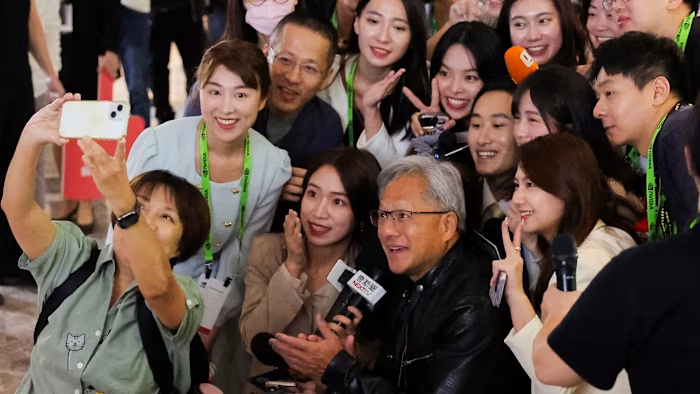
“You develop a level of confidence that becomes arrogance,” Mark Palmer, former Enron PR head, reflected years after its collapse. “Looking back, it’s shocking how full we were of ourselves.” This sentiment perfectly encapsulates the dangerous feedback loop between market success and executive self-belief. After the near collapse of pharmaceutical company Valeant, an investor recounted a key warning sign: the company had evolved into a cult, and as a result, investors stopped asking critical questions, referring to CEO Mike Pearson simply as “Mike.” While perhaps an old-fashioned indicator, a cult-like following has undeniably emerged around Huang, influencing market perception. Sotheby’s famously advertised his leather jacket as “the uniform of a first believer,” selling it for almost $1mn. The Australian Financial Review dubbed the phenomenon “Jensanity.” While not solely Huang’s doing, he has demonstrably leaned into this persona, further cementing the perception of an indispensable leader.
Nvidia is not currently embroiled in a scandal akin to these historical corporate failures. It remains a highly profitable company with genuinely innovative products driving a critical global industry. And yet, the potential scale and ugliness of its current challenges could eclipse many past market crises. If Nvidia knowingly circumvented US laws by selling restricted chips to China, and if Huang misled investors and regulators about these activities, the implications for corporate governance, investor trust, and global tech supply chains would be catastrophic. The market’s current valuation of Nvidia, heavily reliant on its perceived leadership and compliance, would face an unprecedented reckoning.
The biggest lesson for the market is that stunning, exponential success can paradoxically create a type of collective blindness, especially at the very moment when heightened scrutiny is most critical. It isn’t merely that imperial CEOs begin to believe their own mythology; it’s that everyone else — including analysts, investors, and sometimes even regulators — starts to believe it too. While mythology has its place in fiction and perhaps even in inspiring corporate narratives, it has no legitimate role in sound corporate governance, investor due diligence, or sustainable market valuations.
Market Impact:
The ongoing developments surrounding Nvidia and its former CEO Jensen Huang carry significant market implications, extending beyond the immediate $2tn market value correction. Investor confidence in high-growth tech firms, particularly those led by charismatic founders, is likely to face increased scrutiny, leading to a potential re-evaluation of premium valuations. The allegations of chip diversion to China introduce a substantial geopolitical overhang, threatening further regulatory actions, export restrictions, and potential supply chain disruptions that could impact not only Nvidia but the broader semiconductor and AI sectors. This situation could accelerate the decoupling of US and Chinese tech ecosystems, prompting investors to reassess risk profiles for companies with substantial international operations. Furthermore, the narrative of CEO hubris and inadequate governance could trigger a wider market trend towards demanding greater transparency and accountability from dominant tech leaders, potentially shifting investment criteria from pure growth to a more balanced assessment of leadership integrity and long-term compliance. The ripple effect could lead to increased volatility across the tech market as investors become more sensitive to similar warning signs in other high-flying companies.