
In the preceding year, one-third of all aerial journeys connecting Europe and Asia utilized Gulf airports as transit points. When considering individuals journeying from Europe to Australasia, this proportion exceeded fifty percent.
Nevertheless, subsequent to the incursions of the previous week, an inquiry now looms large over the area: what duration will be necessary to reinstate public trust regarding sojourns and transit within it?
“Although we have served as a sort of geographical focal point for disturbances, the city persistently manages to fend off, disregard, construct, and further develop,” Emirates’ president, Tim Clark, informed the Financial Times a day prior to the commencement of hostilities targeting Iran. “Its capacity for recovery is substantial.”
Addressing the situation while American vessels amassed in the Gulf, he stated: “Certain geopolitical challenges are currently unfolding, and maintaining the airline in a state of preparedness and perpetual vigilance for any potential occurrences, is something we excel at; we have been engaged in this for four decades, ever since our airline’s inception.”
Daria Guristrimba, proprietor of the Globe7 travel firm, commented that the resurgence of journeys and sight-seeing “is contingent upon the duration of this predicament.”
“Should air services recommence within a few days, and if authorities demonstrate effective management of this scenario . . . I believe normalcy will return quite promptly, within a span of months. However, if the predicament persists, individuals will perceive an absence of genuine safety, and this will significantly impact perceptions.”
Past events indicate that travellers are prepared to resume air travel, even in the wake of significant upheavals like the September 11 assaults.
“Individuals consistently make a comeback,” remarked Julia Lo Bue-Said, who directs the Advantage Travel Partnership, a professional organization. “One cannot disregard that the Gulf serves as a crucial worldwide link. It is challenging to even conceive of it ceasing to function as a transit hub.”
Despite this, certain sector stakeholders express apprehension. “The apprehension is that individuals might begin asserting: I will avoid air travel via the Gulf due to excessive instability,” stated a senior figure in the aviation sector. “Should this prove to be a brief occurrence . . . that would likely be something airlines can handle. If it extends for two to three months, the issue becomes entirely distinct.”

Scheduled air services at the trio of major airports in Dubai, Abu Dhabi, and Doha continue to be halted, although Emirates and Etihad have initiated return flights from their primary operational centers in Dubai and Abu Dhabi, respectively. Doha, the home of Qatar Airways, remains entirely inaccessible.
The simultaneous closure of these three aviation facilities is both exceedingly uncommon and profoundly unsettling. Dubai’s airfield holds the distinction of being the globe’s most active, having managed 95 million airborne individuals in the previous year.
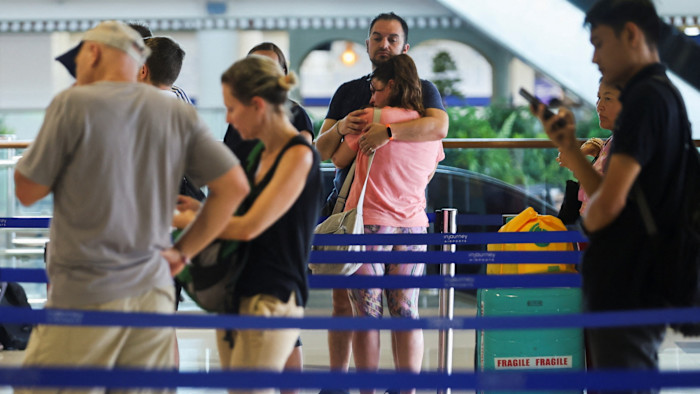
A five-day period of flight annulments throughout the area has resulted in approximately 4 million travellers being marooned, with some located in the Gulf, and others in Asia or Europe awaiting onward journeys, as per insights from data supplier Cirium.

Any interruption to the mechanism that channels air travellers through the Gulf’s enormous aviation centers jeopardizes the operational paradigm of the area’s principal air carriers. For Etihad and Qatar Airways, approximately eighty percent of their patrons are en route to other destinations, rather than touring the locality. At Emirates, this proportion stands at approximately fifty percent.
In addressing this predicament, Gulf-based airlines possess a singular, considerable asset: substantial monetary reserves.
“These nations are expected to implement substantial price reductions, and a considerable multitude of individuals will make their selections primarily based on cost,” commented an aviation sector specialist with experience at multiple prominent air carriers.
“Should one seek a positive aspect, affordable flight fares may be anticipated by the public.”
Even if conflicts subside and passengers resume travel in the forthcoming months, competitors will be afforded an opportunity to capture a portion of the market.
With the Middle East’s evolution into a primary transportation nexus over recent decades, air carriers in other regions curtailed direct services to Asia. Numerous major European airlines are presently making arrangements to inaugurate additional services to Asia within weeks, as reported by senior managers and individuals informed about the carriers’ operational plans, deploying aircraft that would otherwise have been dispatched to the Middle East.

The objective is to draw in travellers who would have otherwise connected via the Gulf. Coordinating personnel positioning, necessary authorizations, and airport slots presents a complex organizational hurdle, yet the air carriers are confident they possess an opportunity to reclaim a portion of the market share they had previously relinquished.
A primary factor for contemplation is the accessibility of aircraft. Multiple years of postponed aircraft handovers from Boeing and Airbus signify that the majority of operators possess scant surplus capability. Diverting fewer planes to the Gulf region liberates resources in other areas.
The alternative prospective recipient of advantage from this upheaval is Istanbul’s aerodrome. This immense central airport, the operational home of Turkish Airlines, has remained untouched by the hostilities. It harbors extensive growth initiatives, with a fifth airstrip already functional and intentions for a total of nine.
On Thursday, Turkish Airlines reported an uptick in requests from travellers who are “marooned and seeking to reach their ultimate stop,” stated its chief financial officer, Murat Şeker.
The persistence of this pattern over the extended period “will necessitate additional time for assessment,” he further noted.
For the immediate future, the interruption continues. Tour operators indicate a sharp decline in reservations for the area subsequent to the weekend, in addition to a surge of voided reservations extending for several months forward. “Certain individuals are apprehensive regarding the remainder of the year, while others inquire if October will be satisfactory,” remarked a travel consultant situated in the UK. The Easter period presents an uncertainty. “A span of three to four weeks is considerable; circumstances might revert to their customary state,” they further commented.
However, not every vacationer has been deterred. On Monday, a travel advisor secured a reservation for a nuptial trip to Dubai scheduled for the subsequent year. The advisor had anticipated inquiries concerning security. Conversely, “it was not even brought up by them.”
Further contributions from Stephanie Stacey and Sylvia Pfeifer in London