
Key Takeaways:
- Innovation Stifled, Valuations at Risk:Proposed legislation banning “superintelligence” and temporarily halting advanced AI development in the U.S. could severely curb R&D investment, impact startup funding, and introduce significant regulatory overhang, potentially leading to re-ratings for AI-centric tech companies and a slowdown in sector growth.
- Geopolitical Headwinds Intensify:A unilateral U.S. pause or ban risks ceding critical technological leadership to China, intensifying the global AI arms race and raising concerns about national security and long-term economic competitiveness, thereby influencing investor sentiment towards U.S. tech innovation.
- Regulatory & Infrastructure Redundancy:The creation of a new Department of Artificial Intelligence (DAI) signals an era of heightened compliance costs and bureaucratic hurdles for tech firms. Concurrently, Rep. Comer’s concerns about energy grid capacity underscore significant infrastructure investment needs, highlighting AI’s growing demand on power utilities and related sectors.
Rep. James Comer, R-Ky., discusses the competitive race between the U.S. and China in artificial intelligence development. He raises concerns about energy grid capacity and highlights regulatory hurdles facing tech firms.
Washington D.C. is signaling a potentially seismic shift in its approach to artificial intelligence, with Sen. Bernie Sanders, I-Vt., and Rep. Greg Casar, D-Texas, introducing sweeping legislation that could reshape the market landscape for one of the most transformative technologies of our era. The proposed bill aims to permanently ban “artificial superintelligence” and impose a temporary halt on advanced AI development, an initiative that, while garnering support from some within the tech industry, immediately raises red flags for investors monitoring the sector’s trajectory and the nation’s competitive standing.
The formal rollout of this legislation, first reported by The Associated Press, carries significant implications beyond the philosophical debate around AI’s future. For the financial markets, it introduces a layer of regulatory uncertainty and potential innovation deceleration that could directly impact venture capital flows, R&D expenditures, and the market capitalization of companies deeply invested in AI. The core of the proposal involves establishing a new Cabinet-level agency, the Department of Artificial Intelligence (DAI), tasked with overseeing advanced AI systems. Under the bill, a moratorium on advanced AI development would be enacted until the DAI finalizes federal safety rules and a comprehensive model review process. Post-establishment, advanced systems would require federal approval before deployment, creating a new bureaucratic hurdle for an industry accustomed to rapid iteration.
Perhaps most striking is the permanent prohibition on the development and deployment of artificial superintelligence, defined as systems surpassing human intelligence or possessing “dangerous capabilities” like the ability to subvert shutdown commands. Violators could face severe penalties, including up to 20 years in prison. This punitive framework would undoubtedly raise the risk profile for deep-tech research and development, potentially chilling the appetite for long-term, speculative investments in frontier AI capabilities. Companies like OpenAI, Google DeepMind, and others pushing the boundaries of AI would face a challenging environment, where the very pursuit of groundbreaking advancements could become a legal liability.
TRUMP REBRANDS AI, REJECTS ‘GLOBALIST SCHEME’ TO CONTROL TECH
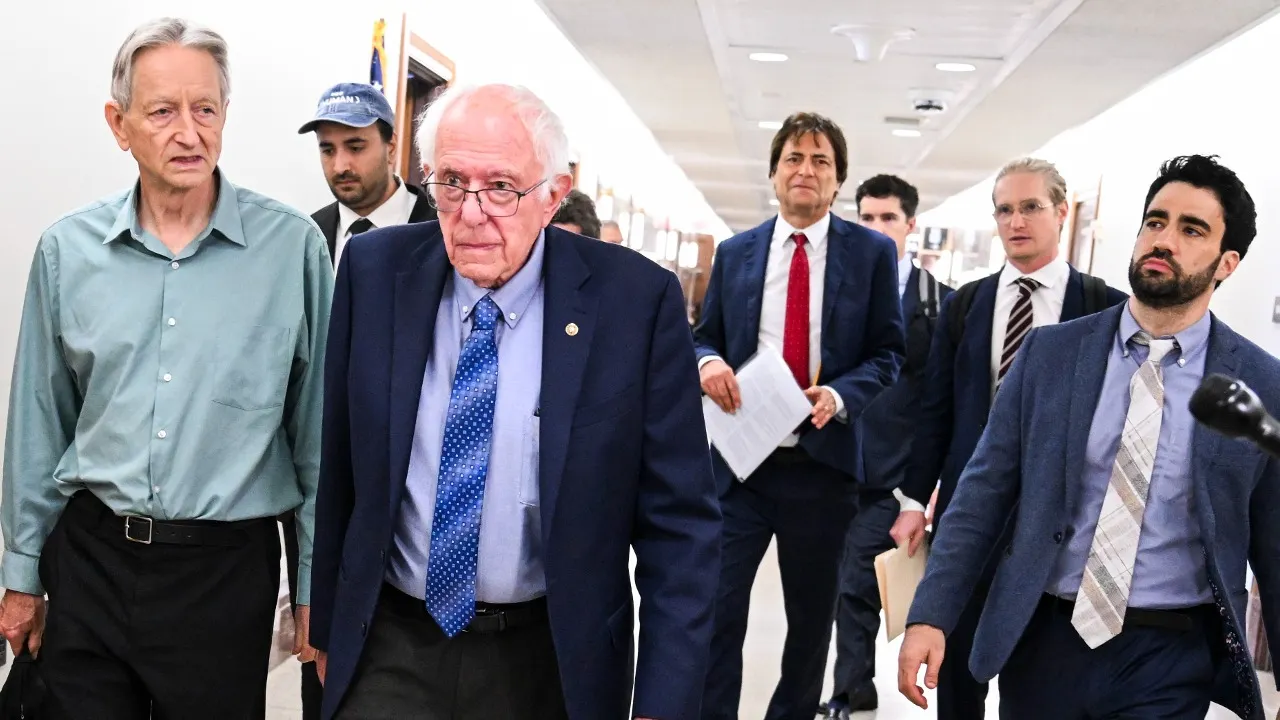
Sen. Bernie Sanders, I-Vt., walks with Geoffrey Hinton and Max Tegmark before an AI briefing for senators on Sept. 16, 2026 at the U.S. Capitol in Washington, D.C.(Roberto Schmidt/Getty Images / Getty Images)
The reported support from employees at leading AI firms, including OpenAI and Google DeepMind, adds an intriguing dynamic. While some insiders, like OpenAI Safety Systems researcher Juan Felipe Cerón Uribe, warn that “Superintelligence could either go extremely right or extremely wrong,” suggesting society “shouldn’t be playing such games,” this internal dissent highlights a growing split within the tech community itself. For investors, this could signal an increasing likelihood of stricter regulatory frameworks, as the industry’s own pioneers vocalize concerns, potentially legitimizing governmental intervention.
This legislative push arrives amidst a broader, heated debate in Washington regarding the necessity of federal safeguards for rapidly advancing AI. On one side, some tech leaders and policymakers advocate for caution, citing potentially catastrophic risks. On the other, President Donald Trump has consistently resisted calls for additional AI regulation, instead emphasizing the critical importance of maintaining U.S. leadership in the sector. During a recent address to the United Nations General Assembly, Trump reiterated his opposition to new AI regulations, suggesting the Justice Department could intervene only if absolutely necessary. This political divergence creates significant investment uncertainty, as the regulatory environment for AI could swing dramatically depending on future electoral outcomes.

U.S. Rep. Greg Casar (D-TX) speaks during the Pro-Human Assembly at the Marriott Marquis Washington on September 15, 2026, in Washington, D.C. Industry leaders, politicians, and community members gathered for a day of discussion around the topic of A(Finn Gomez/Getty Images / Getty Images)
The prospect of slowing American AI development, particularly while China aggressively advances its own capabilities, has emerged as a central concern for opponents of sweeping restrictions. This geopolitical dimension is paramount for financial markets. Any perceived weakening of U.S. leadership in AI could have far-reaching implications for national security, global economic dominance, and the long-term competitiveness of U.S.-based technology companies. Investors increasingly factor a “geopolitical premium” into their valuations, and a unilateral regulatory curb could lead to capital flight or talent migration to less regulated, competing jurisdictions, notably China.
Sanders’ argument for international cooperation, drawing parallels to nuclear arms control during the Cold War, suggests a recognition of the global nature of AI development. His legislation would make it U.S. policy to pursue international agreements, coordination with allies, and other measures to prevent artificial superintelligence development worldwide. While a coordinated global pause would mitigate competitive risks, achieving such a consensus, especially with a rival like China, presents an enormous diplomatic challenge. The market would likely view such aspirations with skepticism given the historical difficulties in achieving widespread international regulatory alignment on complex technologies.

In this photo illustration, a woman browses the OpenAI website on her laptop.(Serene Lee/SOPA Images/LightRocket via Getty Images / Getty Images)
Rep. James Comer’s remarks about energy grid capacity and regulatory hurdles facing tech firms further underscore the practical challenges. The exponential growth of AI models demands enormous computational power, translating into soaring electricity consumption for data centers. This presents both a critical bottleneck and a significant investment opportunity. If AI development continues unabated, it will be a major tailwind for utility companies, renewable energy providers, and infrastructure developers. Conversely, a regulatory pause could temporarily dampen this demand growth, although the underlying need for robust, sustainable energy solutions remains regardless. The creation of a DAI would also inevitably add to regulatory overhead, requiring significant compliance expenditures from tech firms, which could eat into profit margins and R&D budgets.
CLICK HERE TO GET FOX BUSINESS ON THE GO
Market Impact
The introduction of the Sanders-Casar AI legislation is likely to send shivers through the market, particularly impacting companies with high exposure to advanced AI development, such as semiconductor giants (e.g., NVIDIA, AMD), cloud computing providers (Microsoft, Amazon, Google), and AI-centric software firms. A temporary halt on development could immediately slow R&D pipelines, depress venture capital funding for AI startups, and force a re-evaluation of long-term growth projections across the tech sector. Investor confidence in the U.S. as the undisputed leader in AI innovation could be shaken, potentially leading to a de-rating of AI stocks and a shift of investment capital towards less regulated markets or adjacent technologies. The proposed Department of Artificial Intelligence introduces a new layer of regulatory risk and compliance costs, which will be factored into future earnings estimates. Furthermore, the geopolitical implications, especially regarding the U.S.-China tech race, could trigger a broader market re-assessment of national competitiveness and long-term economic dominance, urging investors to seek clarity on the enforceability and international reception of such ambitious legislation.