
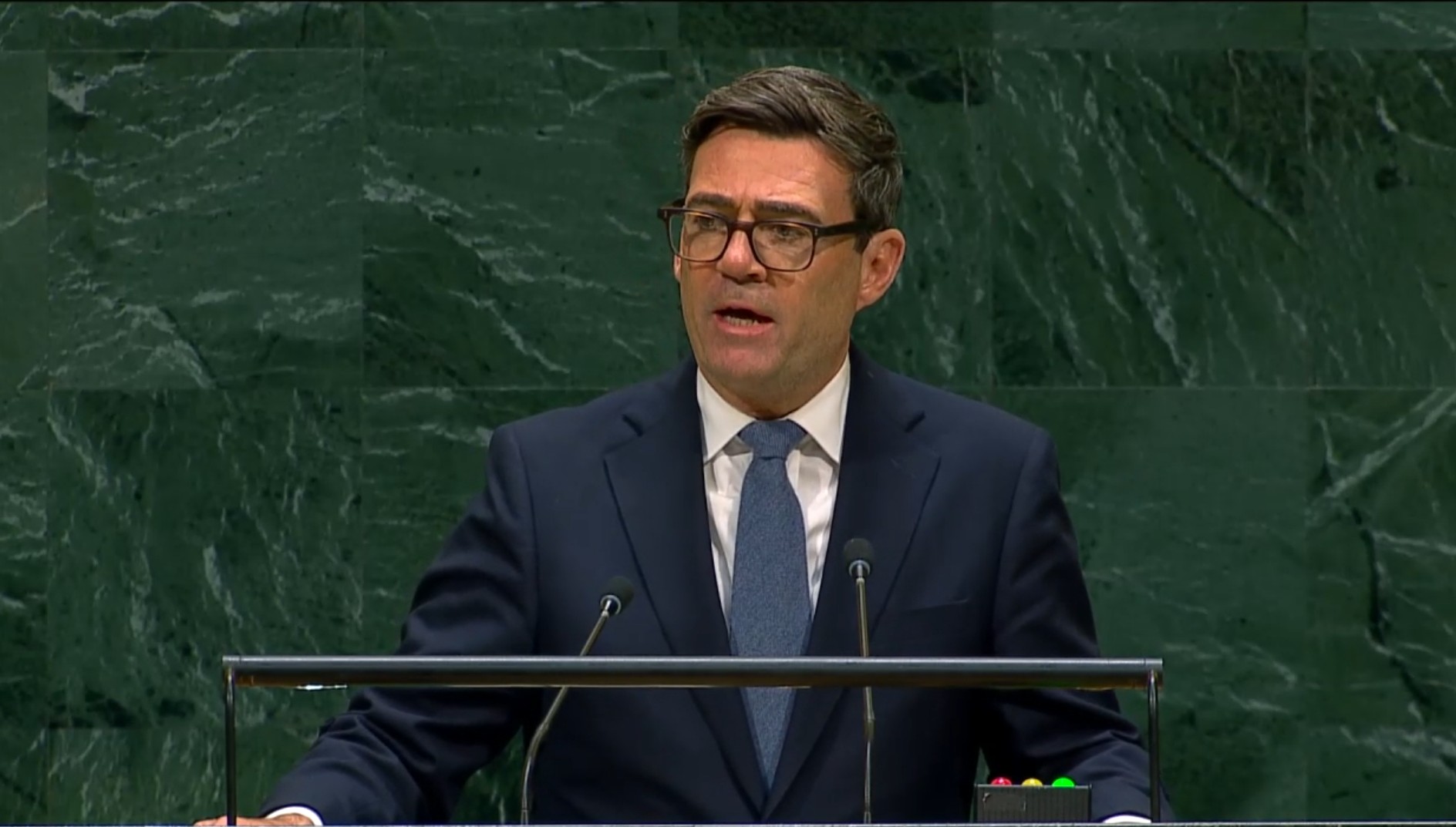
Prime Minister Burnham Accuses Russia of ‘Industrial-Scale’ Information Assault, Announces New UK Defence Centre
New York, United States – Speaking at an assembly in New York on Monday evening, British Prime Minister Andy Burnham delivered a stark assessment of what he described as an “industrial-scale assault” by hostile state actors targeting the information environment in the United Kingdom and its allies. The Prime Minister specifically named Russian agencies as the primary perpetrators of these sophisticated and pervasive campaigns.
In his address, Mr. Burnham detailed a range of tactics allegedly employed by Russian state entities. “Russian agencies have used every means at their disposal to spread lies and disinformation and prey on people’s fears,” he stated. He elaborated on these methods, which reportedly include the deployment of internet bots and fabricated websites, the creation of falsified newspaper articles, and the forging of branding belonging to at least 28 British organizations, including prominent universities and the British Broadcasting Corporation (BBC). The Prime Minister also asserted that these agencies have actively amplified far-right narratives and that evidence exists pointing to attempts to interfere with the 2019 UK General Election.
Beyond electoral interference and the spread of divisive content, Prime Minister Burnham accused Russian agencies of attempting to exploit periods of national trauma. He said they had tried to “stoke tensions and unrest in the wake of what he called horrific events,” adding that while the idea of anyone using such tragedies to their advantage is “repulsive,” it is precisely what these actors do.
Quantifying the scale of this alleged effort, Prime Minister Burnham cited an estimated annual expenditure by the Kremlin of approximately £1.3 billion on information manipulation. He characterized this as “an insidious campaign that reaches into people’s homes and twists what they feel about their own country and community, creating a narrative of decline, stoking division and sowing despair.” The Prime Minister underscored a shift in the UK’s approach, declaring, “We have tiptoed around this for too long. Over the last decade we have given too much ground to those who want to run a negative, corrosive narrative about life in Britain, which bears no resemblance to reality. Well, no more.”
In response to this perceived threat, Mr. Burnham announced the establishment of a new national body. “Today I am tasking our security chiefs to begin work on a new National Centre for Information Defence, to detect, attribute and disrupt these kinds of hostile state information attacks. To support and defend our democracy,” he confirmed. This centre will be built by the UK’s security services and will focus on actively countering foreign disinformation and influence operations.
The Prime Minister acknowledged a general reluctance among governments to publicly identify the sources of information operations, contrasting it with the more frequent attribution of cyber intrusions. He noted that this hesitancy is partly due to the often-circumstantial nature of the evidence for information campaigns and partly because public attribution typically creates an immediate demand for retaliatory action.
Mr. Burnham directly linked the external information threat to domestic vulnerabilities. He argued that individuals experiencing hardship, such as those grappling with the cost of living crisis or young people not engaged in employment, education, or training, are more susceptible to malign influence. He concluded this point by stating that “faced with this information warfare, security starts in every home,” emphasizing a societal-wide approach to resilience against disinformation.
Internationally, the United Kingdom intends to share its insights and strategies with other nations confronting similar challenges. The Prime Minister highlighted Britain’s prior support to Moldova in safeguarding its elections from Russian interference. With numerous elections approaching across Europe, he affirmed the UK’s readiness to disseminate its understanding of how these hostile actors operate and effective countermeasures.
The information campaign was also framed within a broader context of digital threats, with cyber attacks on British companies and institutions cited. Prime Minister Burnham specifically warned that the advent and proliferation of artificial intelligence (AI) technologies are expected to significantly multiply the scale and sophistication of these threats.
This initiative is part of a wider governmental effort to bolster national security and resilience. Ministers have committed to revising the country’s “War Books” by the end of the year under an accelerated Home Defence Programme. Additionally, a national resilience public awareness campaign is slated for launch later this year. The Defence Secretary previously informed the House of Commons this month that he would present plans to Parliament for a comprehensive national conversation regarding the array of threats facing the country.
Why This Matters
The announcement by Prime Minister Andy Burnham signifies a critical shift in how the United Kingdom, and potentially its allies, intend to confront the evolving landscape of global threats. Traditionally, national defense has focused on physical and cyber domains. However, the explicit declaration of an “industrial-scale assault” on the information environment elevates disinformation and hostile influence operations to a core national security concern, placing it alongside conventional and cyber warfare.
Firstly, the direct accusation against Russian agencies underscores the ongoing geopolitical tensions and the nature of “hybrid warfare,” where state actors use non-military means to achieve strategic objectives. This includes undermining democratic processes, sowing discord, and eroding public trust in institutions. The UK’s decision to name and shame suggests a more assertive stance, moving beyond passive observation to active detection, attribution, and disruption, which could escalate diplomatic tensions but also serve as a deterrent.
Secondly, the proposed National Centre for Information Defence represents a significant institutional response. Its mandate to “detect, attribute and disrupt” these attacks highlights the complexity of identifying covert influence operations and the technical and intelligence capabilities required. This move recognizes that defending democracy in the 21st century requires not only protecting ballot boxes but also the integrity of public discourse and citizen perception. The success of such a centre will be crucial in maintaining a well-informed populace and a cohesive society.
Thirdly, the Prime Minister’s linkage of domestic vulnerabilities, such as economic hardship, to susceptibility to disinformation is a vital acknowledgement. It suggests a holistic understanding of national resilience, where societal well-being is intrinsically tied to national security. This approach implies that countering disinformation isn’t solely a task for intelligence agencies but also requires addressing socio-economic disparities and fostering media literacy among the populace.
Finally, the emphasis on international cooperation and the warning about AI’s potential to amplify these threats underline the borderless nature of information warfare. Disinformation campaigns can spread globally in minutes, making a coordinated international response essential. As AI becomes more sophisticated, creating hyper-realistic fake content (deepfakes) and automating influence operations, the challenge for democratic societies to distinguish truth from falsehood will become exponentially harder, demanding innovative defensive strategies and robust international collaboration.