
Unlock the Editor’s Digest for free
Roula Khalaf, Editor of the FT, selects her favourite stories in this weekly newsletter.
**Key Takeaways**
* **Strategic Profitability Amid Headwinds:** Qantas is confidently advancing its “Project Sunrise” ultra-long-haul strategy, projecting an annual profit boost of A$400mn from new direct routes like Sydney-New York, despite a significant A$610mn increase in its financial year fuel bill driven by the ongoing Iran conflict. This resilience is underpinned by robust demand for non-stop services.
* **Premium Market Capture & Yield Optimisation:** The airline’s substantial investment in 12 specially adapted Airbus A350-1000s aims to capture a lucrative premium segment. By offering unique onboard experiences and convenience on these 22-hour flights, Qantas plans to charge higher fares, demonstrating a strategic pivot towards yield optimisation rather than just volume.
* **Geopolitical Advantage & Competitive Re-alignment:** While the broader airline industry grapples with the fallout from geopolitical tensions, Qantas has identified an opportunity. The Middle East conflict has inadvertently redirected some Australia/Asia-Europe traffic away from Gulf hubs, allowing Qantas to capitalize on demand for safer, direct routes and differentiate its offering in a shifting competitive landscape.
***
**Qantas Bets Big on Ultra-Long Haul Profitability Amidst Geopolitical Turbulence**
In a bold move that defies widespread industry challenges, Qantas has affirmed its commitment to making ultra-long-haul flights a significant profit driver, even as persistently elevated jet fuel prices — exacerbated by the Iran war — continue to erode airline margins globally. The Australian carrier is placing a substantial strategic bet on its “Project Sunrise,” anticipating that its groundbreaking 22-hour non-stop services will contribute approximately A$400mn (US$285mn) to its annual profits. This outlook stands in stark contrast to the broader aviation sector, which is navigating a complex environment of rising operational costs and volatile geopolitical risks.
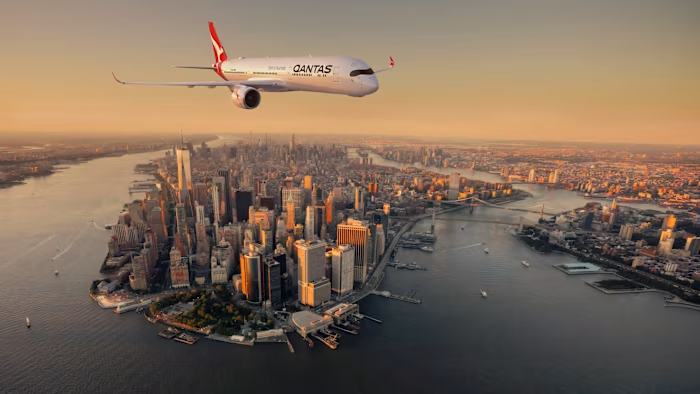
Chief executive Vanessa Hudson’s unwavering confidence stems from a rigorous re-evaluation of the business case, particularly highlighting the “incredibly strong” and sustained demand for direct services. This demand-side strength is critical, as it allows Qantas to implement a premium pricing strategy for these unique routes, offsetting the formidable cost pressures. The airline’s announcement of a Sydney to New York service launching in mid-2028, following the Sydney to London route set for October 2027, marks the progressive rollout of its vision, nearly a decade in the making.
The airline’s ambitious plan involves integrating 12 specially adapted Airbus A350-1000s into its fleet. These aircraft are not merely about endurance; they are designed to enhance the passenger experience on these gruelling journeys, featuring specialised amenities like “wellness areas.” This investment underscores a strategic focus on capturing a premium market segment willing to pay extra for unparalleled convenience and comfort, directly impacting the airline’s revenue per available seat mile (RASM) and overall yield. While exact pricing has not been disclosed, the intention to charge a premium over existing single-stop services is a core tenet of the Project Sunrise financial model.
The current macroeconomic backdrop, however, presents a formidable headwind. The Iran war has sent crude oil prices spiralling, with Brent crude hovering around $100 a barrel, translating directly into a near doubling of jet fuel costs for airlines. This surge has been a crushing blow for many carriers, pushing some, like Spirit in the US and Baltic Air in Europe, into bankruptcy this year. For Qantas, the impact has been tangible, with the Middle East conflict inflating its fuel bill by A$610mn for the financial year, subsequently wiping A$420mn from its earnings even after mitigation efforts.
Yet, Qantas’s confidence is not solely theoretical. It is buttressed by the proven success of its existing non-stop Perth-London route, operational for over eight years. “Even with the fuel price as high as it is, [it] is still the highest performing route on our network,” Hudson noted, providing a crucial, real-world validation of the Project Sunrise business model. This historical performance suggests that the passenger willingness to pay a premium for directness, especially on routes where convenience drastically reduces travel time and complexity, is robust enough to absorb higher operational costs.
Interestingly, the very geopolitical conflict causing financial pain has also opened a unique competitive opportunity for Qantas. With about half of all pre-war Australia/Asia-Europe traffic traditionally transiting through Gulf hubs like Dubai or Doha, the current instability has seen travellers seeking alternative, perceived safer routes. Qantas has capitalised on this shift, offering direct pathways that avoid the conflict zone. Hudson acknowledged this temporary advantage but also expressed a desire for the return of competitor airlines from the Gulf, signalling an expectation that a resolution to the conflict would lead to normalized fuel prices and a more stable operating environment, ultimately beneficial for long-term profitability despite increased competition.
***
**Market Impact**
This announcement from Qantas carries significant implications for the airline industry and its investors. For Qantas (ASX: QAN) shareholders, it signals management’s strong conviction in a long-term strategic growth avenue that could redefine the airline’s market position and profitability profile, potentially leading to increased investor confidence despite near-term cost pressures. It reinforces the idea that strategic investments in premium, differentiated services can create sustainable competitive advantages. For the broader airline sector, Qantas’s success could spur other major carriers to explore or accelerate their own ultra-long-haul capabilities, driving demand for next-generation, fuel-efficient aircraft from manufacturers like Airbus and Boeing. However, the high capital expenditure and operational complexities associated with such routes mean this strategy is likely to remain a preserve of well-capitalised, flag carriers. Ultimately, Qantas’s Project Sunrise represents a calculated gamble that the enduring consumer demand for convenience and a willingness to pay for it will outstrip even severe macroeconomic headwinds, potentially establishing a new benchmark for premium air travel.