
Retirement Income Source partner Jeffrey Small breaks down how megacap tech stocks like Nvidia, Amazon, Meta, and Microsoft are cushioning market losses on The Claman Countdown.
Key Takeaways:
- Strategic Brand Catalyst:Despite CEO Elon Musk’s downplaying its financial impact, the redesigned Roadster serves as a crucial “halo car,” showcasing Tesla’s cutting-edge engineering and maintaining its premium brand perception in a competitive luxury EV market.
- Technological Proving Ground:The extreme performance claims (sub-1 second 0-60 mph) position the Roadster as a testbed for advanced technologies, including those potentially transferable to Tesla’s ambitious AI, robotics, and autonomous driving ventures, rather than just a volume seller.
- Investor Focus Shift:While Roadster sales won’t move the revenue needle, its unveiling reinforces Tesla’s identity as an innovation leader, potentially influencing investor sentiment by signaling continued R&D prowess and long-term vision beyond traditional automotive production.
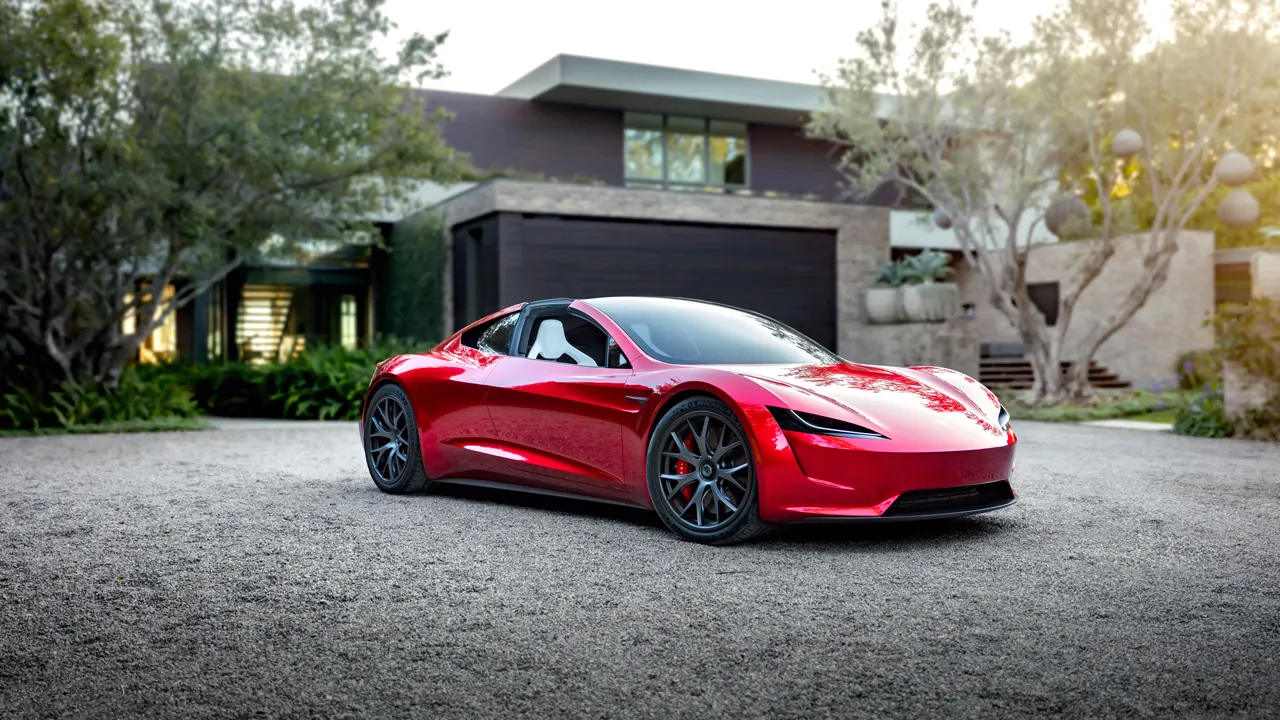
Tesla is poised to unveil the redesigned Roadster on Thursday, marking a significant moment for the electric vehicle pioneer nearly nine years after first teasing its next-generation electric sports car. This unveiling, long-awaited and fraught with delays, transcends the simple launch of a new vehicle; it’s a strategic play in the high-stakes game of market perception, technological leadership, and investor confidence.
First revealed as a prototype in 2017 with a projected $200,000 price tag and promises of 2020 deliveries, the Roadster’s journey has been a testament to the ambitious—and often delayed—nature of Tesla’s product roadmap. Reservations, which command a hefty $50,000 upfront, underscore the exclusivity and speculative demand for this ultra-performance machine. Yet, CEO Elon Musk has consistently tempered expectations regarding its financial contribution, famously calling it a “small potato situation” in 2023 that wouldn’t “move the needle in a major way financially.”
From a purely quantitative financial perspective, Musk’s assessment holds water. Morningstar analyst Seth Goldstein projects annual Roadster sales of around 2,000 units. This figure pales in comparison to the 1.6 million vehicles Tesla sold last year, making its direct revenue contribution marginal. However, the market’s understanding of Tesla extends far beyond quarterly delivery numbers. High-performance luxury sports cars often serve as strategic platforms—”halo cars”—designed to showcase an automaker’s best engineering, push technological boundaries, and, critically, elevate brand perception.
Tesla is set to unveil its next-generation Roadster at an event Thursday night in Texas.(Suzanne Cordeiro/AFP via Getty Images)
As Goldstein noted, “Tesla does not currently have a halo car… The Roadster will be Tesla’s new halo car.” In an increasingly crowded premium EV segment—with competitors like Porsche Taycan, Lucid Air, and forthcoming models from traditional luxury brands—maintaining an image of unparalleled innovation is paramount. A vehicle like the Roadster, with its extreme performance capabilities, serves as a powerful marketing tool, drawing attention, generating buzz, and reinforcing Tesla’s reputation as a technological vanguard, which can indirectly drive sales of its more mass-market Model 3 and Model Y vehicles, or attract top engineering talent.
The performance claims for the new Roadster are nothing short of audacious, designed to capture global headlines and solidify this perception. Musk’s 2017 promise of a 620-mile range (though the car has since been redesigned) and his more recent assertion of a sub-1 second 0-60 mph acceleration redefine what’s possible for production vehicles. He provocatively stated that the acceleration figure was the “least interesting part,” highlighting the deep integration with SpaceX technology, his other visionary enterprise. This collaboration implies a transfer of cutting-edge aerospace engineering and materials science, further cementing Tesla’s narrative of pioneering innovation.
Such extreme specifications are less about the number of units sold and more about the qualitative impact on Tesla’s brand equity and its valuation as a technology company, not just an automaker. Investors often scrutinize R&D expenditures and product innovation as indicators of future growth potential and competitive advantage. The Roadster, in this context, becomes a tangible demonstration of Tesla’s commitment to pushing technological frontiers, justifying its often-premium valuation multiples compared to traditional automotive manufacturers.
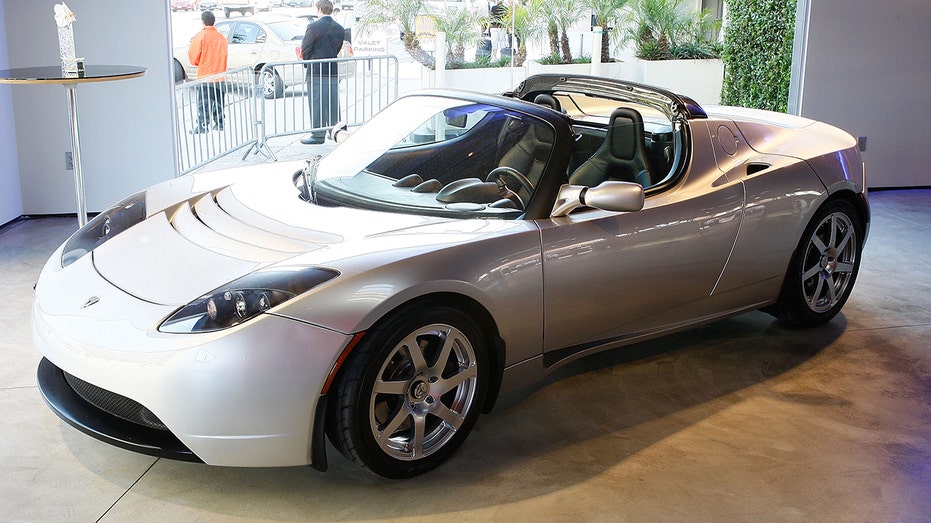
The original Tesla Roadster was released in 2008 and was on sale until 2012.(Vince Bucci/Getty Images)
The reveal also comes at a pivotal moment for Tesla, as the company explicitly shifts its strategic focus beyond mere vehicle production towards artificial intelligence (AI) and robotics. This transition is evident in recent corporate moves, such as stopping sales of Model S and Model X to reallocate production capacity for Optimus humanoid robots, and the unveiling of Cybercab, a two-seater robotaxi designed without manual controls. The Roadster, with its advanced computing power, exotic materials, and sophisticated control systems, can be viewed as a high-fidelity laboratory for technologies that will eventually underpin Tesla’s broader AI and autonomous initiatives. The “SpaceX collaboration” hints at advanced propulsion, energy storage, or structural technologies that could find their way into future robotaxis or even Optimus robots, presenting a long-term growth narrative for investors.
The original Tesla Roadster, launched in 2008 and sold until 2012, was instrumental in establishing the company’s credibility and paving the way for its mass-market models. It leveraged a Lotus Elise chassis, but its electric powertrain was entirely Tesla’s. The second-generation Roadster aims to reprise this role, not just as a fast car, but as a statement of intent—a declaration of Tesla’s continued dominance in electric powertrain technology and its ambitious pivot towards a future defined by AI and robotics. The event itself, held at a SpaceX test site in McGregor, Texas, further blurs the lines between Tesla’s automotive and aerospace ambitions, signaling a unified vision for its technological ecosystem.
| Ticker | Security | Last | Change | Change % |
|---|---|---|---|---|
| TSLA | TESLA INC. | 367.16 | -8.07 | -2.15% |
Market Impact:
The unveiling of the redesigned Roadster, while financially insignificant in terms of direct revenue, carries substantial market implications for Tesla. It is poised to bolster brand equity and reinforce Tesla’s image as a leading innovator, crucial for attracting and retaining investors focused on long-term technological leadership rather than quarterly vehicle delivery volumes alone. The extreme performance claims and the implied transfer of SpaceX technology could reignite investor enthusiasm for Tesla’s R&D capabilities and its ambitious AI and robotics roadmap, potentially leading to a positive, albeit temporary, bump in investor sentiment. In a competitive EV landscape, the Roadster serves as a powerful differentiator, signaling that Tesla remains at the forefront of performance and engineering, thereby strengthening its competitive moat and justifying its premium market valuation. The market will closely watch how this halo product translates into broader interest in Tesla’s future tech ventures, especially its autonomous driving and humanoid robot platforms.
Reuters contributed to this report.