
**Key Takeaways:**
1. **Strategic Differentiation:** Chick-fil-A is deliberately carving a unique market position by prioritizing human interaction in its drive-thrus, contrasting sharply with an industry rapidly adopting AI for efficiency and cost-cutting. This reinforces its premium brand identity and customer loyalty.
2. **Nuanced Technology Adoption:** While rejecting customer-facing AI for order-taking, Chick-fil-A is aggressively deploying back-end technological innovations (like elevated kitchens and conveyor systems) to enhance operational efficiency, speed, and order accuracy without compromising its human-centric service model.
3. **Market Bifurcation & Labor Dynamics:** This divergent strategy highlights a potential bifurcation in the fast-food market – one segment driven by ultra-efficiency and automation, and another by differentiated, high-touch service. It also underscores ongoing debates about labor costs, customer experience, and the long-term competitive advantages of each approach.
Check out what’s clicking on FoxBusiness.com.
**Chick-fil-A Bucks AI Trend, Prioritizing Human Touch in a Digitally Driven Fast-Food Arena**
In a fast-food landscape increasingly defined by the relentless pursuit of automation and artificial intelligence, Chick-fil-A is charting a distinct course, opting to preserve human interaction at its crucial drive-thru touchpoints. This strategic decision by CEO Andrew Cathy, communicated recently to CNBC, stands in stark contrast to industry giants like McDonald’s and Wendy’s, who are aggressively rolling out AI-powered ordering systems to enhance efficiency and mitigate rising labor costs. Chick-fil-A’s stance not only underscores its commitment to a unique brand ethos but also highlights a critical debate within the sector: at what point does technological advancement compromise the customer experience, and what is the true long-term value of human hospitality?
While Chick-fil-A acknowledges the transformative potential of AI and is exploring its applications behind the scenes for operational optimization and supply chain management, Cathy emphasized the brand’s unwavering dedication to personal engagement. “From our experience, we really want that hospitality to be human to human,” Cathy stated. “We’re not going to substitute that interaction with technology, because we feel like that hospitality is so important to create that warm environment for consumers.” This philosophy positions Chick-fil-A as an outlier, banking on its established reputation for exceptional service as a formidable competitive differentiator in a market increasingly commoditized by speed and price.
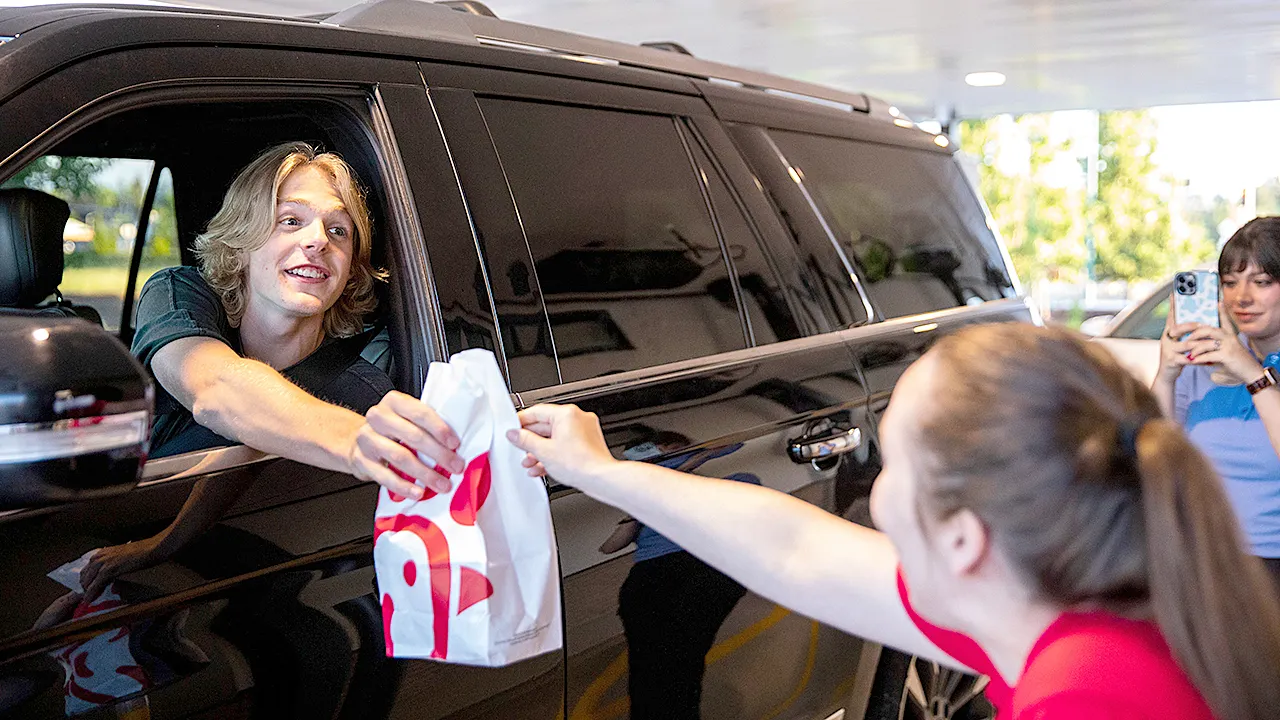
Blake Altman and his friends were the first customers to come through the drive-thru after the official opening of Chick-fil-A on Thursday in Keizer, Oregon.(Abigail Dollins/Statesman Journal/USA Today Network via Reuters)
The broader fast-food industry is in the throes of a technological revolution, primarily driven by the imperative to streamline operations and counteract escalating labor expenses. Rising minimum wages, particularly evident in states like California, where fast-food workers now command a $20 hourly minimum, are compelling chains to seek alternatives to human labor. AI-powered drive-thru systems promise not just cost savings but also enhanced order accuracy, reduced wait times, and the ability to handle peak demand with consistent efficiency. McDonald’s, for instance, is actively testing “Archy,” its proprietary voice AI technology, across five locations, aiming to process orders in both English and Spanish. Similarly, Wendy’s has been deploying its FreshAi drive-thru technology, developed in collaboration with Google Cloud, with stated goals of improving ordering speed, accuracy, and overall consistency. These investments reflect a widespread industry belief that AI is not merely an optional upgrade but a strategic necessity for future viability and profitability.
Yet, Chick-fil-A’s strategy suggests a more nuanced approach to technology integration. Rather than replacing human interaction, the company aims to use technology to augment and elevate it. When unveiling its digitally focused restaurant designs in 2023, Chick-fil-A articulated a clear vision: to leverage technology to “elevate the human touchpoints” while ensuring human interaction remains at the core of the customer experience. This can be vividly observed at its innovative elevated drive-thru restaurant in McDonough, Georgia, which opened in 2024. This cutting-edge facility boasts four drive-thru lanes feeding into an elevated kitchen, utilizing a sophisticated conveyor system capable of delivering a meal to an employee every six seconds. Such a design can accommodate two to three times the vehicle volume of a traditional Chick-fil-A drive-thru, drastically improving throughput and efficiency. Crucially, customers retain the option to order ahead digitally or place their order directly with a Chick-fil-A employee, blending modern convenience with traditional service.
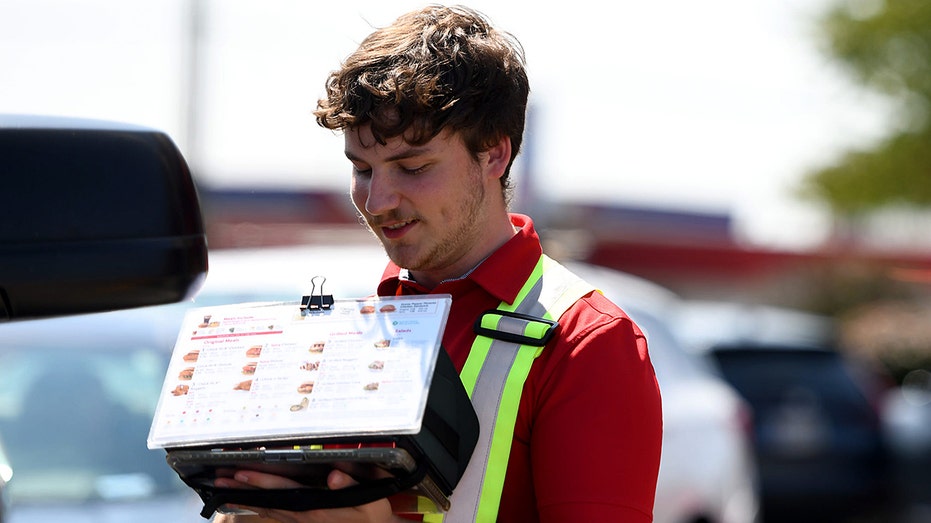
Joshua Bezek takes a customer order in the drive-thru line at Chick-fil-A in Jackson Township, Ohio, Sept. 5, 2024.(Julie Vennitti Botos/Canton Repository/USA Today Network via Reuters)
This distinction comes as restaurant chains grapple with the delicate balance between automation, cost control, and the preservation of brand identity. For Chick-fil-A, whose privately held operations generated an impressive $23.9 billion in U.S. systemwide sales in 2023 (a figure that underscores its considerable scale and market influence), this human-centric approach is not merely an ideological stance but a deeply ingrained element of its successful business model. The company’s legendary customer service, often celebrated through viral anecdotes and its “my pleasure” mantra, has cultivated a fiercely loyal customer base that often tolerates longer lines for the promise of a superior experience.
This strategy suggests that Chick-fil-A views its front-line employees not as a cost center to be minimized, but as vital brand ambassadors and a key value driver. Investing in well-trained, personable staff, even at higher labor costs, may yield greater returns in terms of customer satisfaction, repeat business, and positive word-of-mouth marketing, ultimately justifying the operational expense. While competitors chase marginal gains through AI-driven labor displacement, Chick-fil-A is doubling down on a proven formula that differentiates it in a crowded market.
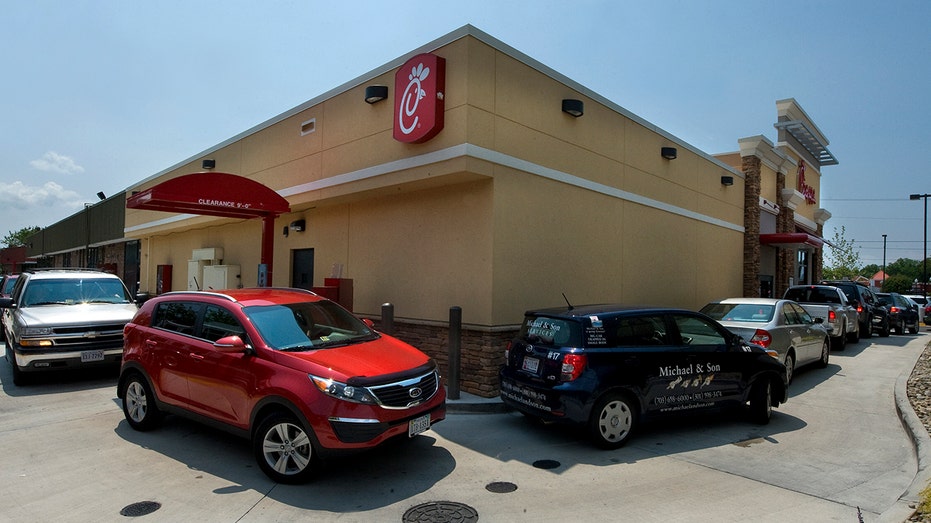
Huge crowds of support for Chick-fil-A at Backlick Center in Springfield, Virginia, Aug. 1, 2012.(Tracy A. Woodward/The Washington Post via Getty Images)
For Cathy, the future of dining is not solely about technological prowess but about understanding evolving consumer preferences and delivering a consistently exceptional experience. “We think about all these new things into the future, about how will people want to receive food in the future?” Cathy reflected. “It’s a fun time in the industry, to think about all the possibilities of what we can do to make a better experience for our guests.” This perspective implies a continuous evaluation of technology’s role, ensuring it serves, rather than dictates, the brand’s core values. In an era where digital fatigue is a growing concern, Chick-fil-A’s commitment to the human element may very well be its most potent innovation.
CLICK HERE TO GET FOX BUSINESS ON THE GO
**Market Impact:**
Chick-fil-A’s deliberate avoidance of customer-facing AI for drive-thru orders sends a powerful signal across the entire service industry, particularly to brands that emphasize customer experience as a core differentiator. This strategy could solidify a bifurcated fast-food market: one segment optimizing for maximum efficiency and cost savings through automation, and another leveraging premium service and human connection to command greater customer loyalty and potentially higher pricing power. For investors, Chick-fil-A’s approach suggests a long-term play on brand equity and customer lifetime value, rather than short-term gains from labor cost reductions. It also challenges competitors to not just implement AI, but to critically assess the *quality* of the AI-customer interaction and its alignment with their brand values. Finally, it raises important questions for the labor market, highlighting that while automation may displace some roles, a premium is still placed on human skills and emotional intelligence in customer-facing positions, potentially creating a demand for higher-skilled, higher-paid service roles in certain segments of the industry.