
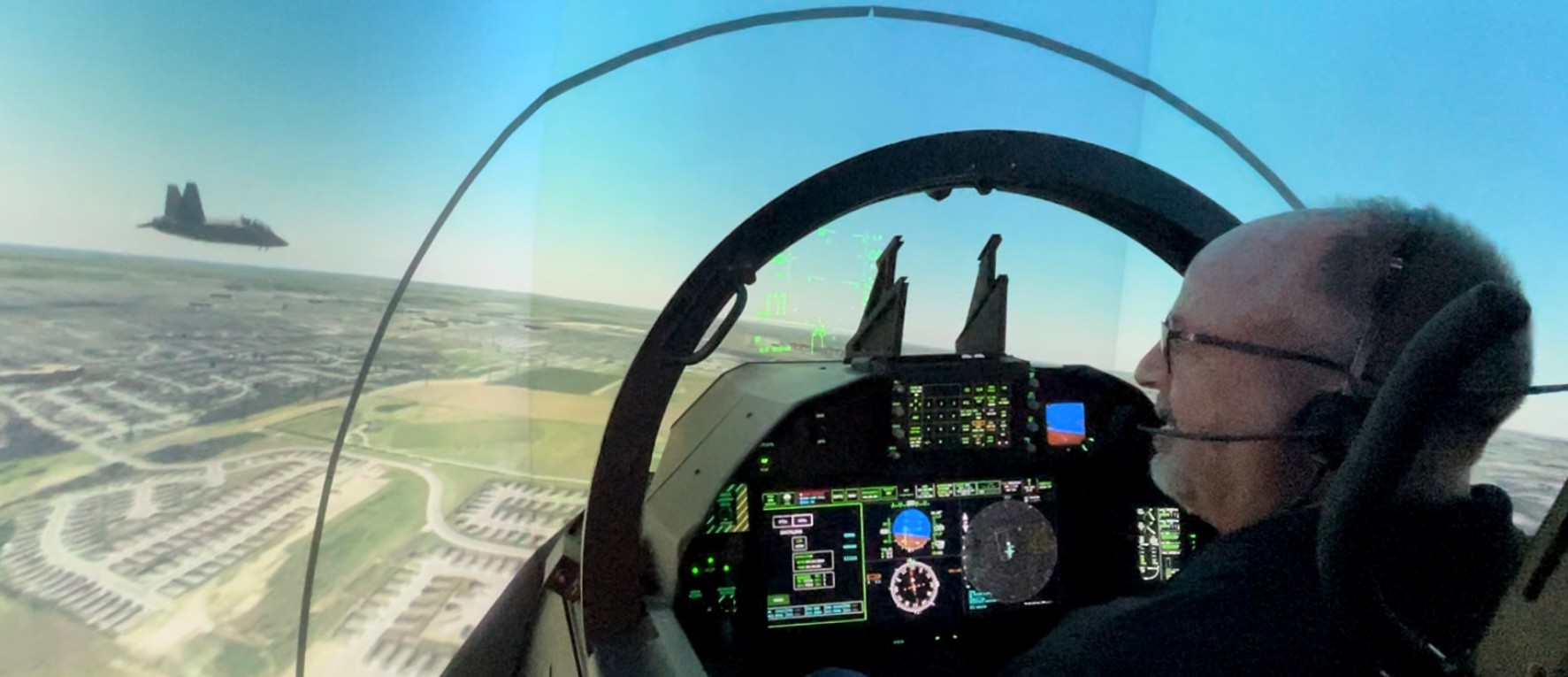
In a significant advancement for military aviation training, the U.S. Air Force recently conducted a demonstration showcasing Live, Virtual, and Constructive (LVC) simulation capabilities for its new T-7A Red Hawk jet trainer. The event, held on September 16 at Joint Base San Antonio-Randolph, Texas, involved a unique scenario where one physical T-7A aircraft flew alongside two virtual counterparts, all operating within a single, shared digital environment. This demonstration marks a foundational step for Air Education and Training Command (AETC) in integrating sophisticated simulation technologies into pilot instruction.
During the exercise, a live T-7A Red Hawk aircraft was airborne, while two additional T-7A jets were simulated by ground-based trainers. Crucially, all three entities—the real aircraft and the two virtual ones—shared a common operating picture, allowing them to interact and collaborate as if they were physically present in the same airspace. This innovative approach effectively merged physical and digital assets into one synthetic environment, enabling real-time communication and coordinated operations.
Steven “Stein” Dobrinski, a Boeing flight simulator design engineer, previously described the concept as a “gaming area.” He explained in a January interview with Air & Space Forces Magazine that with proper programming and data linking, “all the entities, the sims and the airplanes, that are all talking to each other in the same gaming area” can achieve seamless interaction. This integrated system allows for a wide range of training possibilities that extend beyond the limitations of purely physical flights.
The LVC framework facilitates highly realistic and complex training scenarios. For instance, both the physical aircraft and the simulators can operate as if equipped with various armaments, such as missiles, bombs, or specialized pods. When a pilot employs these virtual assets, their effects are “seen” and registered across all participating displays, whether in a cockpit or a simulator. Furthermore, the system can dynamically “inject” adversary aircraft or threats into a scenario, with these simulated threats appearing on every participant’s display, offering immediate and interactive combat training.
The primary objective of the September 16 flight was to rigorously test and validate the underlying “foundational digital architecture” necessary for LVC to function effectively with the T-7A, according to a release from AETC. This validation is crucial for ensuring the reliability and effectiveness of future advanced training modules.
The live T-7A Red Hawk was piloted by Col. Michael Trott and Lt. Col. Phillip Bourquin from the 99th Flying Training Squadron. Concurrently, the ground-based simulators were controlled by civilian instructors from the 12th Training Squadron: Robb Erickson, a retired Air Force colonel, and Ryan Sparkman, a retired Air Force lieutenant colonel. This blend of active-duty pilots and experienced civilian instructors underscores the collaborative nature of developing and implementing these advanced training systems.
AETC’s release highlighted the technical backbone of the demonstration: “Through secure, high-bandwidth tactical data links, ground-based flight simulators communicated directly with the airborne T-7A maneuvering across local military training airspace.” This robust connectivity is essential for maintaining the real-time synchronization required for LVC operations.
Boeing, the manufacturer of the T-7A, and the Air Force consider the T-7A simulator, known as the Ground-Based Training System (GBTS), to be an integral component of the new trainer aircraft. The capability to seamlessly integrate simulators with actual planes and to introduce virtual opponents into complex scenarios represents a significant leap in training capability, far exceeding what legacy trainers like the T-38 Talon could offer.
Looking ahead, officials envision a future where fighter pilots will not only operate their aircraft but also collaborate extensively with manned and unmanned systems, leveraging automation to manage vast streams of information. This advanced operational environment will be critical for confronting high-level threats that are often too dangerous, costly, or logistically impossible to replicate in purely physical training exercises. The T-7A’s LVC capabilities are designed to prepare pilots for this complex future battlespace.
The most advanced iterations of the T-7 GBTS simulator are designed to maximize immersion and realism. They feature an “egg shell” design that provides a 360-degree field of view, cockpit controls that precisely mirror those of the actual T-7A, a seat that moves dynamically in response to user inputs, and even an associated G-suit to simulate gravitational forces experienced during flight.
Col. Michael Trott, commander of the 99th Flying Training Squadron and one of the first Airmen qualified as an instructor pilot on the T-7A, lauded the simulator’s realism. Speaking to Air & Space Forces Magazine, he stated it was significantly more realistic than existing systems for the T-38 and F-15E, both of which he has extensive experience using.
The September 16 demonstration was not the inaugural test of the T-7A’s LVC capabilities. Dobrinski revealed in January that Boeing had conducted a series of test flights the previous year. During one instance, as a T-7A jet flew to Eglin Air Force Base, Florida, for climate testing, Boeing engineers successfully paired it with a simulator located in St. Louis and introduced constructive entities into the flight.
“It worked like a champ on the way out,” Dobrinski recounted. “When it came back, we intercepted it again, and I was in one of [the simulators]. We had a four-ship, so we had four pilots in the sims, and we rejoined on the live aircraft and flew with them until they got sick of us, because we were talking on the radio. And we locked them with the radars, and that worked really, really well.” Subsequent test flights further expanded these capabilities, eventually involving up to a six-ship formation, Dobrinski added.
Training officials consistently emphasize that live, virtual, and constructive training represents the future not only for the T-7A but for a broad spectrum of new military aircraft. The F-35 fighter jet, for example, is progressively incorporating LVC elements through its highly advanced Joint Simulation Environment and the new F-35 Emulated Non-Operational Flight Program Interoperability Experience (FENIX) simulators. Air Force aviators utilized FENIX during Exercise Valiant Shield this past summer, successfully connecting crews across the vast Pacific region, according to a service release, demonstrating the expansive reach and utility of these technologies.
Why This Matters
The successful demonstration of Live, Virtual, and Constructive (LVC) simulation with the T-7A Red Hawk marks a pivotal moment for military aviation training and future warfare readiness. This capability fundamentally alters how pilots are educated and prepared, moving beyond traditional physical-only training to a highly integrated, dynamic, and cost-effective model.
Firstly, LVC addresses the increasing complexity and cost of modern military training. Flying actual combat aircraft, firing live munitions, and staging large-scale exercises are extraordinarily expensive and resource-intensive. By seamlessly integrating virtual and constructive elements with live flights, the Air Force can create highly realistic combat scenarios without incurring the full costs and logistical challenges of purely physical training. This translates into significant savings in fuel, maintenance, aircraft wear-and-tear, and operational expenses, allowing for more frequent and extensive training opportunities within existing budgets.
Secondly, LVC enables pilots to train against “peer” and “near-peer” adversaries whose capabilities are too advanced, sensitive, or dangerous to replicate in live training. Simulators can inject sophisticated threats, advanced electronic warfare scenarios, and complex battle environments that would be impossible to create physically. This prepares pilots for the high-end fight, exposing them to scenarios they might face in future conflicts, ensuring they are proficient in managing information overload, coordinating with unmanned systems, and countering cutting-edge technologies.
Thirdly, this technology enhances pilot readiness and proficiency. The ability to conduct “four-ship” or even “six-ship” formations with a mix of live and virtual aircraft, as demonstrated by Boeing’s earlier tests, allows for comprehensive team training. Pilots can practice complex maneuvers, communication protocols, and tactical decision-making in a shared environment, fostering better cohesion and situational awareness. The T-7A’s advanced Ground-Based Training System, with its high fidelity and immersive design, ensures that skills learned in the simulator directly translate to real-world flight, reducing the learning curve and accelerating pilot development.
Finally, the adoption of LVC is not isolated to the T-7A; it represents a broader paradigm shift across the U.S. Air Force and other branches. As evidenced by the F-35’s integration of similar technologies like FENIX, LVC is becoming a standard for preparing pilots for the integrated, multi-domain operations of the future. It supports the development of pilots who are not just skilled aviators but also adept information managers and team players, capable of operating in highly contested environments. This strategic investment in advanced simulation ensures that the Air Force remains at the forefront of military aviation, capable of projecting power and deterring aggression in an evolving global landscape.