
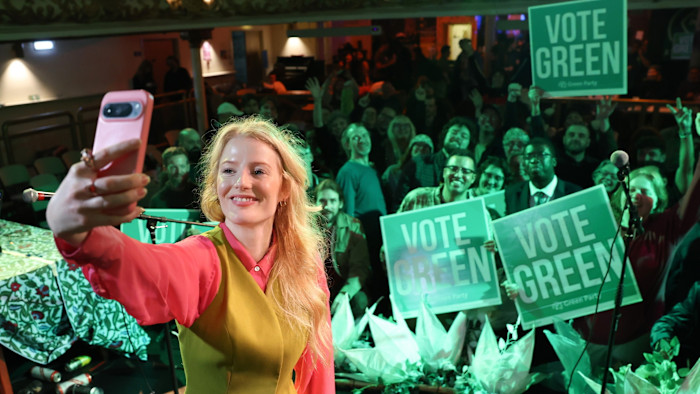
At 4:30 AM on Friday, Green candidate Hannah Spencer’s beaming countenance verified Sir Keir Starmer’s direst apprehensions. The extraordinary win by the 34-year-old tradesperson in the Gorton and Denton special election seemed to represent a pivotal event in the UK’s political arena.
Spencer declared with a wide grin, “To my clientele, I apologize, but I believe I must postpone the engagements you scheduled, as I am now bound for parliament.” Starmer and his advisors found no amusement in the situation.
Certain Labour Members of Parliament had nurtured expectations of retaining this constituency in Greater Manchester, a party bastion for nearly the entirety of the previous century; however, these aspirations were shattered prior to sunrise.
Spencer’s triumph was decisive—securing 41 percent of the ballots in a district where the Greens had previously held no significant presence. Matthew Goodwin of Reform UK secured the second position, with Labour’s Angeliki Stogia concluding in third.
One Labour minister conceded, “A Green triumph represents, without doubt, the most unfavorable result.” Forebodingly for Starmer, this outcome indicates that Labour’s supremacy within “progressive” political circles is jeopardized, and the left-leaning electorate is fragmenting.
Much like the fragmentation of the right-wing vote in the 2024 general election, where Nigel Farage’s Reform chipped away at Conservative Party backing, might Labour soon encounter an analogous destiny at the hands of the ascendant Greens?
A small number of Labour MPs are convinced that the special election outcome will not instigate an instant fresh challenge to Starmer’s leadership, coming only weeks following the prime minister’s successful repulsion of demands for his resignation from Scottish leader Anas Sarwar.
One Labour MP commented, “We’ve peered into the abyss; we have no desire to return.” Not for the present, at any rate. This is because the signal emanating from Gorton and Denton to Starmer’s apprehensive parliamentarians suggests that scarcely any constituency remains secure.
The impending local contests on May 7—where Labour might suffer substantial losses in ballots for the Scottish and Welsh assemblies and numerous English municipal bodies—now appear considerably more precarious for Starmer.
The Green triumph overturns prior presumptions that Labour’s primary rival in the forthcoming election would be Reform. Spencer’s radiant expression underscored that Labour now contends on dual battlegrounds.
A Reform success in Gorton and Denton would have been simpler for Starmer to dismiss. A Labour strategist remarked before the outcome, “Our talking points are prepared. Should Goodwin prevail, our message will be: ‘This demonstrates that a vote for Green delivers Reform. Only we possess the ability to defeat Reform.’’”
However, Spencer’s victory will now enable the Greens to portray themselves as the “anti-Farage” faction across considerable areas of working-class Britain, asserting that casting a ballot for Labour constitutes a “squandered vote.”
This represents merely a single special election, and at Westminster, there persistently exists the risk of solitary outcomes being excessively scrutinized. Nevertheless, Starmer’s apprehension is that in the subsequent general election, anticipated in 2029, a fragmented left-leaning vote could enable Reform to surge through the center, leading to Farage entering Downing Street.

Starmer’s election plan, articulated in his Labour Party conference address in Liverpool last September, posits that Labour is engaged in a momentous struggle to prevent Britain from succumbing to the politics of “disunity,” and that only his party possesses the means to halt Farage.
The underlying implication is that even if established adherents hold little affection for Labour, they could harbor even greater aversion towards Reform UK. This situation becomes increasingly intricate if discontented Labour backers seemingly possess an alternative credible avenue for voicing their dissatisfaction through the Greens.
Luke Tryl, from the More in Common think-tank, stated this week: “It significantly complicates Labour’s ability to employ a ‘Macron approach,’ meaning, ‘regardless of how much progressives may be vexed with us, it is either us or Reform, therefore you must reluctantly endorse us.’”
In the preceding general election, the Greens secured 6.7 percent of the nationwide ballots and four parliamentary positions at Westminster, yet the party achieved second place in 40 electoral districts, with 18 of those located in London. The party trailed Labour in all but one of these constituencies.
Zack Polanski, the compelling Green Party chief, will now leverage Gorton and Denton as a launching pad to endeavor to penetrate urban areas of Britain with his left-leaning agenda, prioritizing the eradication of destitution and condemning Israel regarding Gaza, rather than focusing solely on ecological measures.
“The Green Party experienced an unparalleled shift towards us and vastly augmented our electoral support,” Polanski stated on Friday morning. “If a comparable shift occurs in the subsequent general election, a surge of new Green parliamentarians will appear.”
The municipal elections on May 7 might witness substantial advancements for both Reform and the Greens, while the formerly preeminent Labour and Conservative parties recede, mirroring the political trends observed in numerous other Western nations.

Currently, Starmer might possess a brief respite. His depleted party does not presently harbor intentions of leadership overthrow, and the prime minister along with his confederates have guaranteed that Andy Burnham, Greater Manchester’s mayor and a prospective contender for leadership, remains outside of parliament.
Both the Greens and Reform even conceded that Burnham, a well-liked local personality, would likely have emerged victorious in Gorton and Denton, had Starmer permitted his candidacy.
This demonstrated Starmer’s vulnerability; he opted to hazard defeat in the special election rather than have his competitor closely pursuing him in Westminster. Condemnations regarding that choice are anticipated in the subsequent days.
Starmer and his Chancellor, Rachel Reeves, scheduled to present her Spring Fiscal Report next week, anticipate that more favorable economic tidings from the UK will aid in elevating public mood.
However, that constitutes a distant objective. Subsequent to the Gorton and Denton setback, the peril for Starmer lies in his premiership once more being assessed by Labour MPs in durations of months, rather than years.