
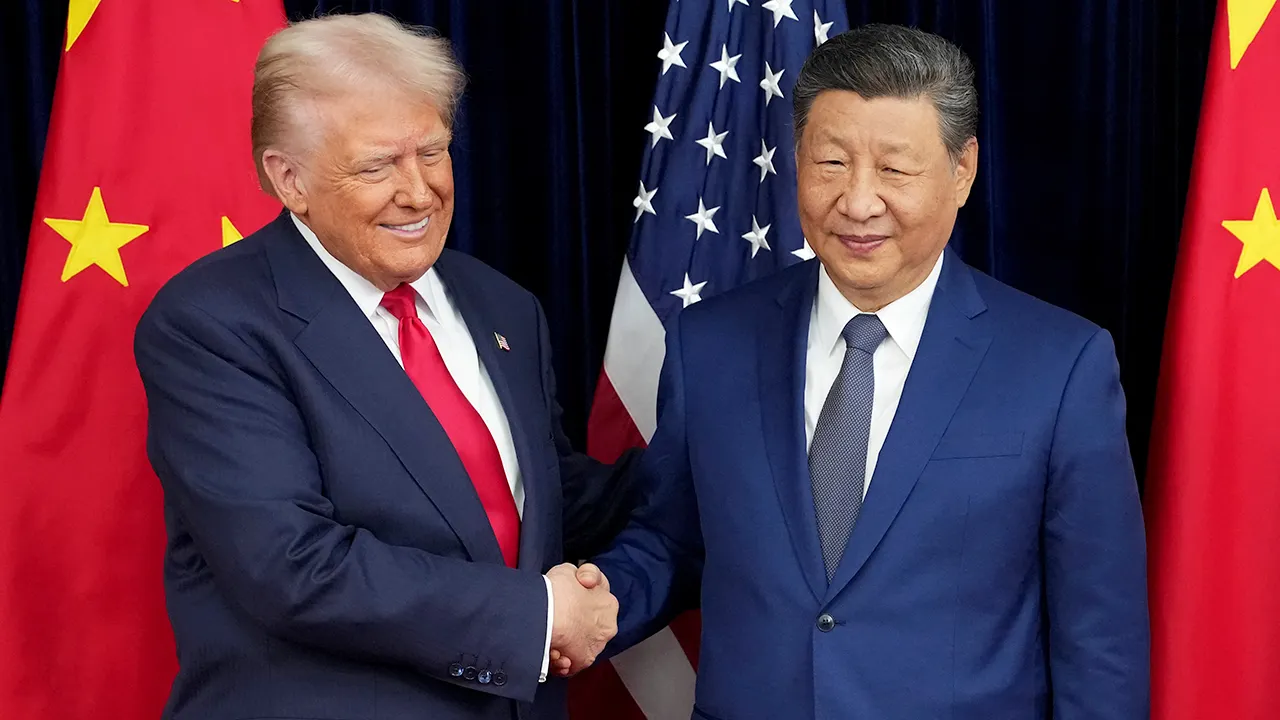
Gatestone Institute senior fellow Gordon Chang joins ‘Mornings with Maria’ to break down President Donald Trump’s Beijing trip, Iran tensions, and rising concerns over China’s economy and surveillance-linked EVs.
Key Takeaways
- High-Stakes Diplomatic & Business Offensive:President Trump’s upcoming China trip, accompanied by a formidable delegation of U.S. corporate titans, signals a pivotal moment for re-engaging with the world’s second-largest economy amidst escalating geopolitical and trade tensions.
- Diverse Corporate Interests at Play:The delegation, spanning technology, finance, industrials, and consumer sectors, highlights the multifaceted reliance of American enterprises on the Chinese market for manufacturing, sales, and investment, even as calls for “de-risking” intensify.
- Geopolitical Headwinds & Market Uncertainty:The visit unfolds against a backdrop of China’s economic slowdown, national security concerns over technology like EVs, and persistent trade friction, creating a complex environment that could significantly sway investor sentiment and sector-specific market performance.
President Donald Trump is slated to visit China this week, a journey that transcends traditional diplomatic protocol by including an unprecedented assembly of America’s most influential business leaders. This high-powered U.S. delegation, featuring figures such as Tesla CEO Elon Musk, Apple CEO Tim Cook, BlackRock CEO Larry Fink, and Goldman Sachs CEO David Solomon, underscores the immense economic stakes and complex interdependencies that define the U.S.-China relationship. Their presence signals a determined effort to navigate the intricate landscape of trade, technology, and national security that has increasingly characterized interactions between the two global superpowers.
The composition of the delegation itself offers a telling snapshot of American commercial interests in China. Beyond the aforementioned luminaries, the roster includes Boeing CEO Kelly Ortberg, Blackstone Chairman, CEO and co-founder Stephen Schwarzman, Cargill Board Chair and CEO Brian Sikes, Citi Board Chair and CEO Jane Fraser, Coherent CEO Jim Anderson, GE Aerospace chairman and CEO H. Lawrence Culp, Jr., Illumina CEO Jacob Thaysen, Mastercard CEO Michael Miebach, Meta President and Vice Chairman Dina Powell McCormick, Micron Chairman, President and CEO Sanjay Mehrotra, Qualcomm President and CEO Cristiano Amon and Visa CEO Ryan McInerney.
This diverse group represents sectors ranging from cutting-edge technology and semiconductor manufacturing to global finance, industrial aerospace, agricultural commodities, and consumer payments. For each executive, the trip represents an opportunity to directly engage with Chinese leadership, advocating for market access, intellectual property protection, and a stable regulatory environment essential for their operations and future growth. The collective weight of these corporate giants on a diplomatic mission highlights the inextricable link between national foreign policy and economic imperatives in the 21st century.
TESLA RECALLS MORE THAN 218K VEHICLES OVER REARVIEW IMAGE ISSUE THAT POSES CRASH RISK
Elon Musk, chief executive officer of Tesla Inc., left, and Larry Fink, chief executive officer of BlackRock Inc., during the World Economic Forum (WEF) in Davos, Switzerland, on Thursday, Jan. 22, 2026.(Krisztian Bocsi/Bloomberg via Getty Images / Getty Images)
The tech sector’s heavy representation, notably with Elon Musk, Tim Cook, and leaders from Qualcomm, Micron, Coherent, and Illumina, speaks volumes about China’s dual role as both a critical market and a strategic competitor. For Apple, China remains a crucial manufacturing hub and a significant sales region, making any trade friction or supply chain disruption a direct threat to its bottom line. Qualcomm, Micron, Coherent, and Illumina represent the cutting edge of semiconductor, photonics, and genomics technology, areas where U.S. policy has increasingly sought to restrict China’s access, citing national security concerns. Their presence on the delegation suggests a delicate balance between safeguarding technological advantage and maintaining lucrative commercial relationships.
Simultaneously, the financial services sector’s strong contingent—including the CEOs of BlackRock, Goldman Sachs, Citi, Mastercard, and Visa—underscores the ongoing efforts to open China’s vast financial markets to foreign participation. While progress has been made, foreign firms still face hurdles in achieving full market access and competitive parity with domestic players. The presence of these leaders indicates a desire to push for further liberalization and to cement their foothold in a market that offers unparalleled growth potential for asset management, investment banking, and payment processing.
“I am very much looking forward to my trip to China, an amazing Country, with a Leader, President Xi, respected by all,” Trump declared in a Monday Truth Social post. “Great things will happen for both Countries!” headded. These statements, while characteristic of his direct communication style, will be scrutinized by markets for any hints of a softening or hardening stance on trade and economic policy.
GORDON CHANG WARNS CHINESE EVS ENTERING US VIA CANADA COULD BECOME ‘ROLLING SPY MACHINES’
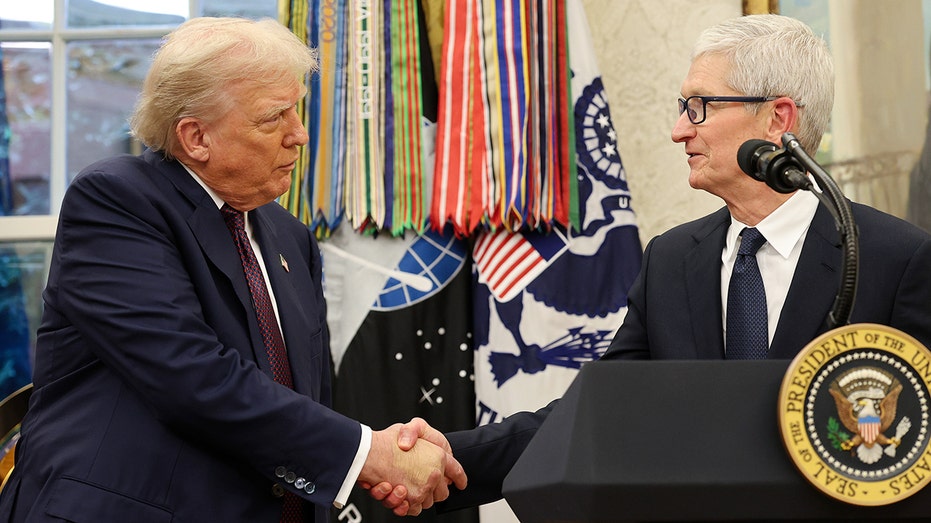
Apple CEO Tim Cook (R) shakes hands with U.S. President Donald Trump during an event in the Oval Office of the White House on Aug. 6, 2025 in Washington, D.C.(Win McNamee/Getty Images / Getty Images)
The visit also occurs amid heightened scrutiny of China’s economic health and its technological ambitions. As Gordon Chang noted on ‘Mornings with Maria,’ concerns over China’s economy, particularly its real estate sector and domestic consumption, cast a shadow over global growth prospects. More acutely, Chang’s warning about Chinese EVs potentially becoming “rolling spy machines” directly impacts companies like Tesla, which has a significant manufacturing presence and sales market in China. The recent recall of over 218,000 Tesla vehicles for a rearview image issue, while distinct from espionage concerns, underscores the technical and regulatory challenges faced by auto manufacturers operating globally, particularly in sensitive sectors.
The broader geopolitical context cannot be ignored. While the original report briefly mentioned Iran tensions, the primary focus for this delegation remains the U.S.-China relationship. This rivalry extends beyond trade deficits to encompass technological supremacy, supply chain resilience, and global influence. The concept of “de-risking” – reducing dependence on China in critical areas without full “decoupling” – is a prevailing theme in Washington and corporate boardrooms alike. The business leaders accompanying Trump are likely to gauge the feasibility and implications of such strategies, seeking clarity on future policy direction.
President Donald Trump met with Chinese President Xi Jinping in October in South Korea, according toReuters. This continuity of engagement, building on his 2017 visit during his first term, suggests a pragmatic approach to managing one of the world’s most critical bilateral relationships, even amidst significant ideological differences and economic competition. The outcomes of this week’s meetings, whether leading to new agreements, renewed dialogues, or simply clearer communication channels, will reverberate across global markets.
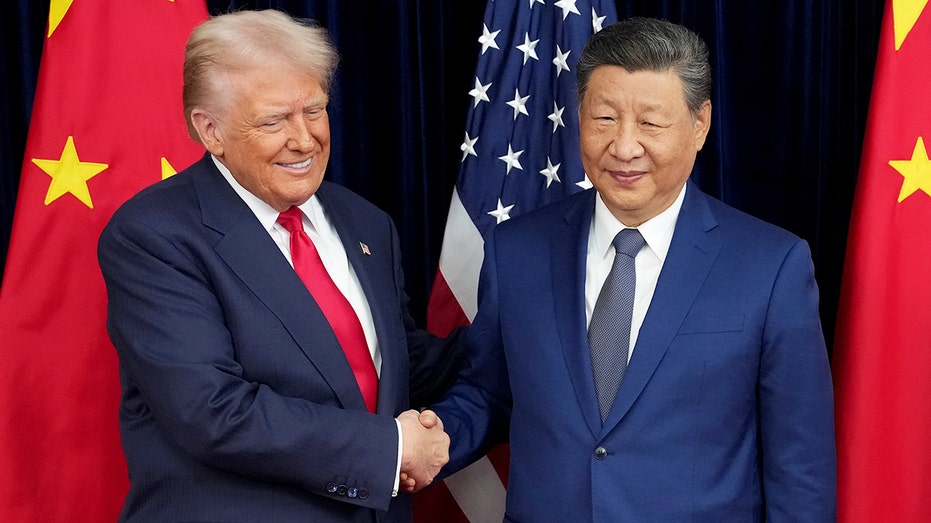
U.S. President Donald Trump greets Chinese President Xi Jinping ahead of a bilateral meeting at Gimhae Air Base on Oct. 30, 2025 in Busan, South Korea.(Andrew Harnik/Getty Images / Getty Images)
CLICK HERE TO READ MORE ON FOX BUSINESS
Market Impact
The implications of President Trump’s China trip and the accompanying business delegation are profound for global markets. Investors will be closely watching for any signs of de-escalation in trade tensions, which could provide a significant boost to export-oriented sectors, particularly industrials like Boeing and agricultural firms like Cargill. Any progress on market access for financial giants like BlackRock, Goldman Sachs, and Citi could drive up valuations for these firms and signal broader confidence in China’s economic trajectory. Conversely, a lack of progress or, worse, a hardening of positions on issues such as technology transfers, intellectual property, or national security concerns (e.g., related to EVs or semiconductor access for Micron and Qualcomm), could trigger sell-offs in tech stocks and raise anxieties about supply chain disruptions. Currency markets, especially the Chinese Yuan and related emerging market currencies, could experience volatility based on perceived shifts in trade policy or economic cooperation. Overall, the visit’s success or failure in fostering predictable and stable bilateral relations will directly influence investor sentiment, capital flows, and the strategic planning of multinational corporations for the foreseeable future, making it a critical event for portfolio managers and economic analysts worldwide.