
**Key Takeaways:**
1. **Geopolitical Scrutiny Intensifies:** The blocking of Meta’s Manus acquisition signals that merely relocating a Chinese-founded tech company to a neutral hub like Singapore no longer provides a reliable shield against national security reviews from either the US or China, particularly in critical sectors like AI.
2. **”Singapore Washing” Under Pressure:** The practice of “Singapore washing” – using the city-state’s domicile to mask Chinese heritage for global expansion or to evade scrutiny – is increasingly unsustainable, forcing companies to re-evaluate their international expansion strategies and domicile choices at much earlier stages.
3. **Cross-Border M&A Risk Premiums Rise:** Investors and acquirers must now factor in significantly higher regulatory and geopolitical risk premiums for deals involving companies with perceived Chinese links, regardless of their official registration, leading to heightened due diligence and potential re-pricing of assets.
***
When AI start-up Manus moved its headquarters to Singapore last year, it was following a well-trodden path carved by hundreds of other Chinese companies. For years, the strategically located city-state, a renowned business and financial hub, has been perceived as a reliable springboard for Chinese firms seeking global expansion, capital, and a degree of geopolitical insulation. However, less than 12 months after its relocation, the landscape dramatically shifted, casting a long shadow over this established playbook. China’s decision to block Meta’s $2 billion acquisition of Manus, asserting that the AI firm remained a Chinese company subject to Beijing’s approval, sends a clear, chilling message to the global investment community and companies navigating the fraught US-China tech rivalry.
This intervention, occurring amidst delicate Beijing-Washington relations and ongoing trade truce negotiations between Chinese leader Xi Jinping and US President Donald Trump, critically questions Singapore’s long-held efficacy as a sustainable and neutral conduit for Chinese corporate ambitions. Beyond merely facilitating global market access, a significant, albeit often unstated, motivation for some Chinese firms moving to Singapore has been to obscure their national heritage and mitigate escalating geopolitical scrutiny – a tactic pejoratively dubbed “Singapore washing.” This maneuver aimed to provide a perceived regulatory buffer against Western, particularly US, national security concerns, while also potentially streamlining access to international capital markets and technologies.
“For foreign companies that want to buy Chinese technology, it’s a stark reminder that incorporating in Singapore is no longer a regulatory shield; it’s merely an address that still requires national security vetting of the target company,” said HK Park, who heads the investment screening practice at Washington-based corporate advisory firm Crumpton Global. This perspective underscores a critical market reality: the “long arm” of national security regulations, particularly from the US, is extending its reach beyond direct ownership or domicile, scrutinizing the ultimate beneficial ownership, technology origins, and potential for data access or transfer, irrespective of the company’s immediate legal address. Simultaneously, China is asserting its sovereignty over what it deems strategic national assets, even if they have attempted to relocate.
The government of Singapore is acutely sensitive to the “Singapore washing” tag, keenly aware of how such perceptions could strain its intricate relationships with both China and the US – two of its most crucial trading partners. In 2024, former prime minister Lee Hsien Loong articulated Singapore’s stance, welcoming companies that are transparent about their origins. “If the Chinese come, they are good companies — they create jobs, they pay well, they bring technology, they bring markets — I say ‘come’,” he stated. “But of course, we would like to know where you come from and what your antecedents are.” This highlights Singapore’s balancing act: attracting valuable foreign direct investment and talent while safeguarding its reputation as a transparent, rules-based business environment.
Singaporean opposition MP Andre Low’s parliamentary comments following Meta’s takeover of Manus captured the sensitive nature of the relocation from a domestic perspective. He voiced concerns that “Singapore’s business environment was taken advantage of opportunistically to achieve certain aims and then now, being cast aside,” questioning whether the government had “any considerations to discourage companies from using Singapore as a flag of convenience, without accruing any benefits to the Singapore labour force?” These remarks reflect a broader market debate about the true economic value proposition of such redomiciling efforts for the host nation versus the strategic aims of the relocating companies.
From the US perspective, the efficacy of the “Singapore-washing template” was already under considerable pressure even before the Manus incident. Park notes, “There were questions about whether the grey area for redomiciling is sustainable, not because of the Chinese government, but because of increasing US scrutiny of companies located anywhere with problematic Chinese links.” This growing scrutiny is driven by heightened national security concerns over critical technologies like AI, semiconductors, and quantum computing, as well as data privacy and intellectual property theft. The US Committee on Foreign Investment in the United States (CFIUS) and other regulatory bodies are increasingly adopting a broad interpretation of what constitutes a national security risk, extending its purview to indirect investments and any corporate structures that could facilitate access to sensitive US technology or data by entities deemed adversarial.
More broadly, Singapore’s enduring position as a neutral, global business hub, characterized by its robust legal framework, political stability, and deep ties to both East and West, has historically made it an overwhelmingly attractive destination for Chinese companies seeking an international footprint. While Hong Kong, as a special administrative region of China, traditionally served as the initial gateway for mainland firms’ international ventures, Singapore offers greater geographical and political distance from Beijing, coupled with a broader global reach, especially in attracting significant US and European capital.
The market has reflected this trend. Last year, Chinese companies surpassed US entities in terms of investment in Singapore. China accounted for just over half of the money spent by businesses in Singapore on operations, a dramatic increase from 15% merely a year earlier. This surge underscores the strategic importance Chinese enterprises place on establishing a presence in the city-state. Several of China’s most prominent tech giants — including Tencent, Alibaba, and Huawei — have established significant operational hubs in Singapore, demonstrating a clear commitment to global diversification.
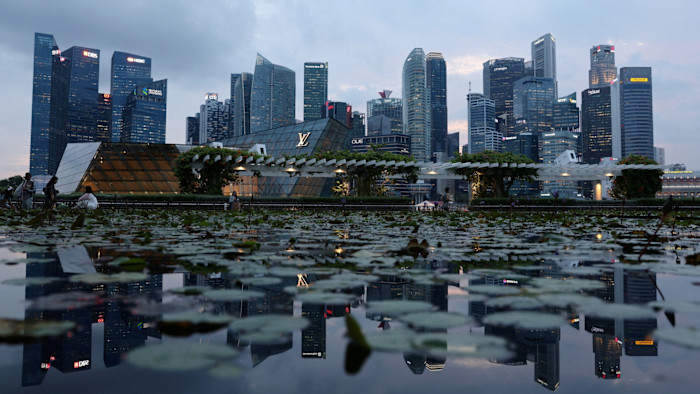
TikTok owner ByteDance, a company caught in the geopolitical crosshairs over its operations in the US, notably occupies multiple floors in One Raffles Quay, a landmark office block in Singapore that prominently displays its corporate logo. Similarly, fast-fashion behemoth Shein utilizes Singapore as a crucial hub for its global business, a strategic move following earlier efforts to “de-Chinafy” its operations that faced pressure from Chinese regulators, ultimately requiring Beijing’s approval for any overseas IPO. These examples illustrate the complex interplay of corporate strategy, regulatory compliance, and geopolitical maneuvering that defines global expansion for Chinese tech firms.
Intense domestic competition and weakening demand within China are compelling more Chinese companies to proactively seek international markets, with Singapore often perceived as the natural and most viable next step. Those that do opt for Singapore find a thriving cottage industry of legal, accounting, and professional services firms ready to support their transition. Several of China’s largest law firms, including Fangda Partners and Han Kun, have established offices in the city-state specifically to cater to their compatriots navigating international expansion and regulatory complexities.
“Singapore is an ideal place for many Chinese firms to go abroad, either for international markets or avoiding US tariffs or China’s domestic regulations on tech,” explained Feng Qu, head of economics at Singapore’s Nanyang Technological University. However, Qu adds a crucial caveat: “The [Singapore-washing] strategy appears to be more effective for small firms but less successful for well-known tech giants.” This distinction implies that larger, more visible, or strategically critical companies are under greater scrutiny from both US and Chinese regulators, diminishing the effectiveness of mere corporate redomiciliation.
The Manus experience is likely to deter established companies in highly sensitive industries such as advanced AI, quantum computing, and biotechnology from adopting similar strategies. Conversely, companies in less geopolitically charged sectors, such as retail, e-commerce, and certain fintech segments, may still find Singapore an attractive destination, according to Matthias Hendrichs, a Singapore-based adviser to AI companies. He suggests that for founders in China seeking global capital and markets for innovative products, alternatives remain limited, placing the onus on startups to undertake such moves at a much earlier stage in their development.
“If you want to go under the radar, you need to leave the mainland at an earlier stage, when you are not as visible or successful,” Hendrichs advises, underscoring a shift in strategy. “That is the future of Singapore washing.” This suggests a pivot towards pre-emptive, early-stage internationalization, long before a company gains significant traction or becomes a high-profile M&A target, as the only viable path to mitigate the escalating geopolitical risks associated with its origins.
***
**Market Impact:**
The Manus blocking heralds a significant re-calibration of risk for cross-border mergers and acquisitions, particularly in the critical technology sectors. Investors, private equity firms, and corporate acquirers will face heightened due diligence requirements, necessitating a deep dive into the ultimate beneficial ownership, technological origins, and supply chain dependencies of target companies, regardless of their declared domicile. This will inevitably increase transaction costs, extend deal timelines, and introduce greater uncertainty, potentially leading to a decrease in viable cross-border tech deals involving companies with perceived Chinese links. Singapore’s role as a neutral financial hub faces sustained pressure, compelling its government and financial services sector to adapt to a new era of geopolitical realism, where economic neutrality is increasingly difficult to maintain amidst escalating superpower rivalries and national security considerations. The precedent set by Manus will likely force Chinese companies to fundamentally rethink their global expansion strategies, potentially accelerating the trend of early-stage internationalization or a complete decoupling from mainland operational structures to truly avoid future regulatory entanglements.