
Key Takeaways
- Geopolitical Risk Re-evaluation:The unprecedented trilateral summit among the leaders of China, the U.S., and Russia signals a potential shift in global power dynamics, prompting investors to reassess geopolitical risk premiums across energy, defense, and emerging markets.
- Trade & Supply Chain Scrutiny:While a visible thaw in US-China relations could alleviate immediate trade tensions, Xi Jinping’s call for “open and integrated” cooperation highlights underlying competition over global economic frameworks, impacting future trade policies and supply chain strategies.
- Commodity Market Volatility:Discussions on Iran and Ukraine directly impact critical commodity sectors, with potential outcomes driving significant price movements in crude oil, natural gas, and agricultural products due to shifts in supply, sanctions, or regional stability.
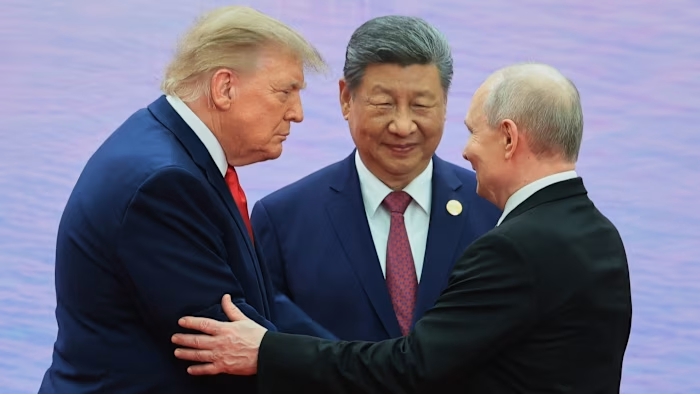
China’s President Xi Jinping is poised to conclude an extraordinary week of high-stakes diplomacy this Thursday, hosting a historic trilateral meeting with U.S. President Donald Trump and Russian President Vladimir Putin in the vibrant southern Chinese city of Shenzhen. This landmark gathering, unfolding on the sidelines of the broader Asia-Pacific Economic Cooperation (APEC) leaders’ summit, has immediately captured global market attention, with investors closely monitoring its potential ramifications for geopolitical stability, international trade, and commodity markets. The confluence of these three global powers at such a critical juncture underscores a fundamental re-alignment of international relations, presenting both opportunities for de-escalation and risks of increased fragmentation.
The agenda for the three leaders is packed, reportedly encompassing crucial discussions on nuclear disarmament, the ongoing conflicts in Iran and Ukraine. However, financial analysts and geopolitical strategists agree that the true significance transcends the immediate topics. Many are already dubbing this confluence “Yalta 2.0,” drawing parallels to the pivotal 1945 conference where Britain, the U.S., and the Soviet Union redrew the postwar global order. For markets, such a profound symbolic shift suggests a potential re-calibration of global power balances, which could have long-term implications for international investment flows, defense spending, and the perceived stability of key strategic regions. Any perceived agreement on these contentious issues could reduce geopolitical risk premiums, potentially boosting investor confidence and encouraging a ‘risk-on’ sentiment across equity and emerging markets.
The trilateral rendezvous is a focal point within the larger 21-member APEC leaders’ summit, which commenced with a plenary session on Thursday morning. Here, regional leaders are expected to address pressing issues of regional development and security. While APEC typically focuses on fostering economic growth and cooperation across the Asia-Pacific, the presence and agenda of the three global heavyweights fundamentally alter the narrative. Market participants will be dissecting speeches for cues on future trade agreements, infrastructure investment initiatives, and regulatory alignment that could impact multinational corporations operating in this economically dynamic region. Specific sectors such as logistics, manufacturing, and technology, which are heavily reliant on seamless regional integration and stable trade policies, will be particularly sensitive to any pronouncements on regional economic frameworks.
Beyond the trilateral framework, bilateral discussions are also anticipated between Trump, Xi, and Putin. These one-on-one engagements offer crucial opportunities to address specific grievances or forge targeted agreements that might not emerge from the broader, more symbolic meeting. For instance, any tangible progress on the U.S.-China trade dispute – particularly regarding tariffs, intellectual property, and market access – could send immediate ripples through currency markets, boosting the Chinese Yuan and strengthening global supply chains. Similarly, fresh dialogue on Russia’s energy exports to Europe or its role in global oil supply could impact crude oil and natural gas futures, influencing the profitability of energy majors and the energy security outlook for key industrial economies.

The highly anticipated Xi-Trump meeting marks their third personal encounter this year, representing a remarkable turnaround from the often-frosty relations that characterized much of the previous decade, when direct, in-person interactions between the leaders of the world’s two largest economies were far less frequent. This perceived thaw was underscored by Xi’s personal greeting to Trump upon his arrival at Shenzhen’s airport on Wednesday, followed by a rare air force jet fly-past – an honour typically reserved for state visits and rarely bestowed on a foreign guest by a Chinese leader in recent memory. From a market perspective, such gestures, while symbolic, can signal a de-escalation of tensions, potentially boosting investor confidence in bilateral trade relations and cross-border investment flows. This is particularly relevant for technology and manufacturing sectors that have been battered by previous trade disputes, with companies like Apple, Qualcomm, and various Chinese tech giants keenly watching for signs of reduced friction that could stabilize their supply chains and market access.
However, this apparent rapprochement is not universally welcomed. US allies, spanning from Japan and Taiwan to Ukraine and the European Union, are watching the proceedings with palpable trepidation. Their primary concern is that Trump might concede crucial ground to Xi and Putin on contentious regional security issues, potentially undermining existing alliances and established international norms. For markets, this apprehension translates into increased uncertainty. Companies with significant exposure to these allied nations, particularly in defense, semiconductors, and advanced manufacturing, might face increased volatility. Any perceived weakening of U.S. security commitments could prompt strategic re-evaluations among allies, potentially leading to shifts in defense spending (benefiting contractors like Lockheed Martin or BAE Systems), diversification of trade partnerships away from reliance on specific powers, and even capital flight from perceived risk zones, impacting foreign direct investment (FDI) decisions across East Asia and Europe.
Amidst the high-level dialogues, President Xi Jinping used his APEC plenary speech to advocate for “open and integrated rather than exclusive or fragmented” cooperation in the Asia-Pacific. This statement is widely interpreted as a direct, albeit subtle, critique of Trump’s protectionist “America First” policies and the broader trade war initiated by Washington. Xi further urged the gathered leaders to “foster an open, fair, just and non-discriminatory environment.” For global trade-reliant industries and multinational corporations, this rhetoric is highly significant. It signals China’s continued commitment to multilateralism, even as the U.S. has increasingly favored bilateral deals. Should China successfully rally support for its vision, it could reshape future trade blocs, investment treaties, and global supply chain architectures, impacting everything from raw material sourcing to consumer market access. Companies reliant on seamless cross-border trade will be keenly watching whether these words translate into concrete policy shifts or renewed impetus for international trade liberalization, potentially easing tariff burdens and non-tariff barriers that have stifled growth in recent years and impacting the profitability of logistics, automotive, and consumer goods sectors.
Market Impact
The outcomes of this unprecedented trilateral summit are set to reverberate across global financial markets. A substantive diplomatic breakthrough on nuclear non-proliferation or de-escalation in regional conflicts like Iran or Ukraine could trigger a ‘risk-on’ rally, boosting equity markets, especially in emerging economies, and potentially softening safe-haven currencies like the U.S. Dollar and Japanese Yen. Conversely, a failure to find common ground or, worse, a perceived alignment that alienates key U.S. allies, could exacerbate geopolitical tensions, leading to increased volatility, a flight to safety, and a premium on defense sector stocks. Commodity markets, particularly crude oil and natural gas, are on high alert, with prices likely to react sharply to any news impacting supply stability in the Middle East or Eastern Europe. Furthermore, the future trajectory of U.S.-China trade relations, directly influenced by these discussions, will dictate sentiment for global technology and manufacturing supply chains, directly impacting semiconductor firms, logistics companies, and consumer discretionary sectors. Investors should prepare for heightened market sensitivity to official statements and diplomatic leaks in the coming days, as the contours of a new global order begin to take shape.