
British Firm Tests Robotic Sailboat Network for Anti-Submarine Surveillance
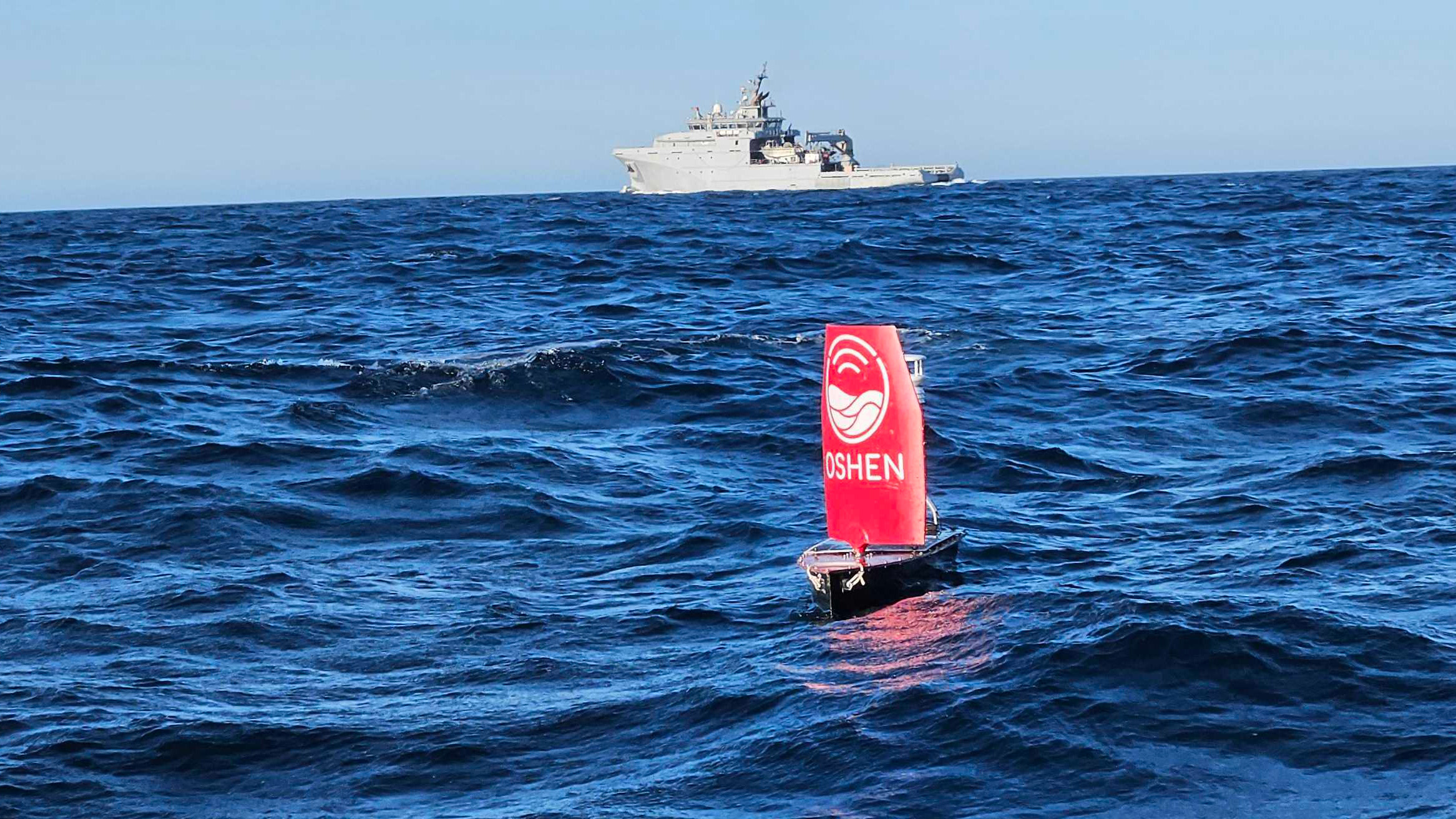
A British maritime technology company, Oshen, is currently testing a novel distributed anti-submarine surveillance network at the multinational REPMUS26 exercise in Portugal. This innovative system comprises six small robotic sailboats, each equipped with a hydrophone, operating in concert to form what the company describes as an “acoustic picket line.” The exercise marks the first time these uncrewed surface vessels (USVs) are being deployed together against live targets, showcasing a significant shift in passive anti-submarine warfare (ASW) strategies.
The C-Star USVs, each measuring 1.2 meters, are designed to spread across a broad expanse of water, establishing a passive listening network. This approach diverges from traditional methods that typically concentrate sensors on a single ship or a long, towed array. According to Oshen, this distributed arrangement offers several tactical advantages. Operators can dynamically adjust the shape and density of the network in response to changing environmental conditions or threat profiles. Furthermore, by gathering observations from multiple positions, the system can more accurately determine the precise location of a submerged contact, rather than merely providing its bearing, which is a common limitation of single-point detection.
Traditional passive ASW systems often rely on extensive towed arrays, which are long cables carrying numerous hydrophones pulled behind surface ships. While these systems provide sensitive local detection and bearing information, they are susceptible to noise generated by the towing vessel itself. Moreover, their effectiveness is inherently tied to the movement and position of a comparatively small number of larger platforms. Oshen’s methodology, in contrast, champions the deployment of a greater number of inexpensive, autonomous sensors over a much wider area. The company posits that a future iteration of this network could be instrumental in monitoring strategically vital maritime areas, such as the GIUK Gap (Greenland, Iceland, United Kingdom gap), and subsequently cueing other anti-submarine assets once a contact is identified.
Each C-Star vessel participating in the REPMUS exercise is fitted with a hydrophone supplied by Systems Engineering and Assessment. Oshen highlights the vessels’ capability to maintain station under sail for extended durations and their robust design, which allows for operations in challenging weather conditions. The company has previously demonstrated the C-Star’s operational resilience by successfully deploying it during a Category 5 hurricane. This small size and low profile of the robotic boats are considered key attributes, as they could make a distributed network considerably more difficult for an adversary to identify, characterize, and disrupt, compared to a smaller number of larger, more conspicuous sensor platforms.
Gordon Jones, Defence and Oceanography Lead at Oshen, underscored the strategic implications of this new paradigm. “A defensive network built from a host of individual hydrophone platforms behaves very differently to one built from a handful of expensive towed arrays,” Jones stated. “It is wider, more resilient and harder for an adversary to characterise. REPMUS is the first real test of that model against live targets, and it points the way to how persistent undersea surveillance can be evolved.”
A significant component of the REPMUS exercise also focuses on command and control (C2). The exercise integrates a diverse array of maritime systems, ranging from small autonomous craft to full-scale crewed warships. This necessitates efficient data exchange and tasking capabilities between equipment developed by different companies and nations. Oshen reported that its engineers collaborated closely with naval personnel prior to the exercise to integrate the C-Star command software with existing NATO systems. Efforts were also made to optimize and limit the volume of data transmitted across communication networks, ensuring operational efficiency. Sensor information collected by the vessels is fed into a central database, from which processed intelligence is then disseminated to participating forces.
Anahita Laverack, CEO of Oshen, emphasized the broader vision behind their technology. “REPMUS embodies what our technology is designed to do: take a capability that normally depends on a handful of expensive assets and turn it into something that can be deployed at scale, cheaply and continuously,” Laverack commented. “There are many potential applications, including an acoustic picket line to help protect the GIUK Gap.”
Based in Plymouth, Oshen is already engaged in three projects with the Royal Navy, including initiatives through the UK Defence Innovation accelerator programme. The company also holds a Cooperative Research and Development Agreement with the US Navy, specifically covering single-beam sonar applications. Looking ahead, Oshen plans to deploy eight C-Stars to the Maritime Big Play exercise in San Diego next month, where the same acoustic picket-line concept will undergo further testing and evaluation in a US operational setting.
Why This Matters
The development and testing of Oshen’s distributed anti-submarine surveillance network represent a pivotal moment in naval warfare and defense technology. This innovation holds significant implications for national security, international alliances, and the future of maritime surveillance.
Evolution of Naval Warfare:For decades, anti-submarine warfare (ASW) has relied on a combination of active and passive sonar systems, often deployed from large, costly naval vessels or specialized aircraft. Oshen’s approach signifies a shift towards a more distributed, autonomous, and potentially more resilient paradigm. By deploying numerous small, inexpensive uncrewed vessels, navies could establish persistent surveillance over vast areas without committing high-value assets. This enhances the ability to detect and track increasingly quiet and sophisticated modern submarines, which pose a significant threat to sea lines of communication and naval fleets.
Geopolitical Context and Strategic Choke Points:The mention of the GIUK Gap is particularly significant. This stretch of ocean between Greenland, Iceland, and the United Kingdom is a critical maritime chokepoint, historically and currently vital for NATO’s defense posture against potential adversaries, particularly Russia. Renewed Russian submarine activity in the North Atlantic has heightened the strategic importance of this region. A persistent, hard-to-detect acoustic picket line could provide early warning of submarine movements, bolstering NATO’s ability to defend its flanks and protect transatlantic shipping routes. This technology could provide a cost-effective means of maintaining surveillance in such vital areas, freeing up traditional naval assets for other missions.
Technological Advancement and Autonomy:This initiative underscores the growing role of autonomous systems in defense. The C-Star vessels exemplify how small, adaptable platforms can integrate advanced sensor technology to perform complex missions with minimal human intervention. The focus on integrating these autonomous systems into existing NATO command and control structures, while managing data flow, highlights the challenges and necessity of interoperability in modern multinational defense operations. This also points towards a future where AI and machine learning will likely play a greater role in processing vast amounts of sensor data from such networks to identify and classify threats more effectively.
Cost-Effectiveness and Scalability:The concept of deploying “cheaply and continuously” at scale is a game-changer for defense budgets. Traditional ASW assets are expensive to build, maintain, and operate. A network of smaller, less costly autonomous vessels could offer a more economical way to achieve comprehensive and persistent surveillance. This could enable smaller navies to enhance their ASW capabilities, and larger navies to augment their existing fleets, thereby democratizing access to advanced maritime domain awareness.
International Cooperation and Interoperability:The REPMUS exercise itself is a testament to the importance of multinational collaboration in developing and integrating new defense technologies. The need to seamlessly transfer data and commands between systems from different nations and companies is crucial for effective coalition warfare. Oshen’s efforts to integrate its C-Star software with NATO systems are a practical demonstration of how industry and military alliances are working together to achieve greater interoperability and collective security in an evolving threat landscape.