
Unlock the Editor’s Digest for free
Roula Khalaf, Editor of the FT, selects her favourite stories in this weekly newsletter.
Key Takeaways:
- Geopolitical Risk Premium Rises:Escalating Houthi attacks introduce a significant geopolitical risk premium to Saudi assets and regional investments, directly challenging the kingdom’s efforts to diversify its economy and attract foreign direct investment (FDI) under Vision 2030.
- Business Continuity & Investment Dilemma:Global financial and energy titans face a delicate balance between strategic engagement in a critical market and robust corporate risk management, with travel warnings and insurance complications forcing reassessments of attendance at flagship conferences.
- Energy Market Volatility & Supply Chain Concerns:While direct energy infrastructure has not been hit, attacks near major transit hubs in the world’s largest oil exporter inevitably inject uncertainty into global energy markets and highlight vulnerabilities in regional logistics, potentially impacting futures and freight costs.
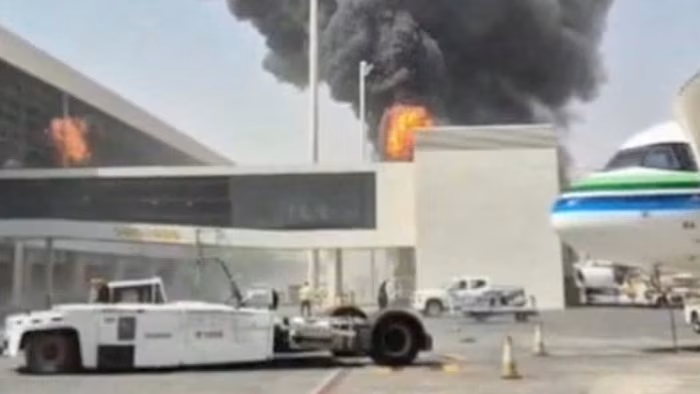
A fresh wave of Houthi missile and drone attacks is casting a long shadow over Saudi Arabia’s meticulously planned calendar of high-profile international gatherings, notably the World Petroleum Council Energy Congress and the flagship Future Investment Initiative (FII), dubbed “Davos in the Desert.” These security incidents, which saw six fatalities in strikes on Saudi airports this week, are sending jitters through global boardrooms and prompting a critical reassessment of market risk in a region vital to the world economy.
The immediate fallout has been palpable: executives from some of the world’s largest companies and investment banks are scrambling to evaluate their travel plans. The UK’s decision to issue a travel warning for parts of Saudi Arabia, including Riyadh, coupled with several carriers suspending flights to the capital, has introduced a tangible layer of operational and financial risk. The latest Houthi salvo on Riyadh’s international airport, which tragically killed three Saudi citizens and damaged a Saudia aircraft, underscores the heightened threat perception just days before the energy congress and two weeks ahead of the FII.
This escalating insecurity directly threatens the ambitious objectives of Saudi Arabia’s Vision 2030 economic transformation plan. Spearheaded by Crown Prince Mohammed bin Salman, Vision 2030 aims to pivot the kingdom away from oil dependency, fostering new industries, tourism, and attracting an influx of foreign direct investment. However, repeated security breaches, following years of challenges from fluctuating oil prices and significant expenditures on mega-projects, erode investor confidence and complicate the narrative of a stable, modernizing economy.
The World Petroleum Council Energy Congress, a critical forum for energy ministers and industry leaders, is immediately impacted. Italy’s energy minister has already opted for a video link instead of in-person attendance at a ministerial energy meeting, signaling a cautious approach from international delegates. While the FII organizers have confirmed the event will proceed, the atmosphere is undoubtedly fraught. An executive from a firm scheduled to attend FII encapsulated the sentiment: “We have no idea what’s going on. They want to go ahead with the show. But let’s see what happens. It’s a very dicey situation.” This uncertainty translates directly into hesitations over capital commitment and long-term strategic planning for firms eyeing Saudi opportunities.
The FII, set against the opulent backdrop of the King Abdulaziz International Conference Centre, boasts a speaker roster that reads like a who’s who of global finance, including BlackRock CEO Larry Fink, JPMorgan CEO Jamie Dimon, and Bridgewater founder Ray Dalio. Their attendance, or lack thereof, serves as a crucial bellwether for international investor sentiment towards Saudi Arabia. The dilemma faced by these titans is acute: maintaining strategic relationships and access to Saudi capital and projects versus fulfilling fiduciary duties and ensuring the safety of their personnel in an increasingly volatile environment.
For the legions of management consultants, bankers, and corporate advisers who routinely fly into the kingdom, the attacks have already disrupted business travel. One consultant recounted a near 12-hour drive from Riyadh to Dubai after flights were halted, highlighting the logistical nightmares and increased operational costs. Other firms have outright cancelled travel or restricted it to senior partners, indicating a significant tightening of corporate risk protocols. The UK’s updated travel advice, cautioning against “all but essential travel” to parts of Saudi Arabia, further complicates matters for banks and corporations, potentially impacting insurance coverage for staff and raising questions of corporate liability.
Despite the risks, a segment of foreign energy executives expresses a commitment to attend the WPC, citing the principle that “the Saudis remember who their friends were in bad times.” This highlights the complex, long-term strategic relationships that often override short-term security concerns in the high-stakes world of global energy. However, for many, the calculus is shifting. Phil Miles, associate managing director at Kroll, a risk advisory firm, notes that while executives are reluctant to withdraw from such significant events, companies are “deferring decision-making” until the last minute. The stark reality, as Miles puts it, is that “You are sending your people into an environment where ballistic missiles are flying.”
The situation presents a microcosm of broader geopolitical risk assessment challenges for global capital. Senior bankers in the Middle East anticipate a reduced foreign attendance at FII. While one senior banker wryly remarked that this would be “great for us! Less competition for face time,” the underlying concern for overall participation and the caliber of dialogue remains. Organizers of the FII and Saudi authorities will undoubtedly closely monitor the WPC as a “bellwether” event, with security paramount. “The final decision depends on the state security’s confidence that the airports, the venue and hotels are sufficiently protected from cruise missiles,” a person familiar with their thinking stated.
This is not the first time security concerns or geopolitical events have impacted Saudi Arabia’s efforts to engage the international community. Budgetary constraints and security fears have previously led to the cancellation or postponement of major entertainment events, such as the Red Sea International Film Festival. More significantly, several bank chief executives, including JPMorgan’s Dimon and BlackRock’s Fink, famously withdrew from the FII in 2018 following the killing of journalist Jamal Khashoggi by Saudi agents. This historical precedent underscores how quickly investor confidence and corporate participation can be eroded by perceived instability or reputational risk, making the current wave of attacks a critical test for the kingdom’s ability to project stability and security to global markets.
The FII and the Ministry of Energy did not immediately respond to a request for comment.
Additional reporting by Verity Ratcliffe, Ortenca Aliaj and Harriet Agnew
Market Impact:
The heightened security concerns in Saudi Arabia are poised to inflict several market impacts. Firstly, they will likely lead to an increased geopolitical risk premium for Saudi Arabian assets, potentially raising borrowing costs for the government and state-owned enterprises, and demanding higher returns for foreign investors. This directly jeopardizes the FDI inflows critical for Vision 2030 projects, as global firms factor in elevated operational costs, insurance premiums, and safety liabilities. Secondly, while direct energy infrastructure has not been targeted, the proximity of attacks to key transit hubs in the world’s largest oil exporter injects volatility into global energy markets, potentially leading to speculative spikes in crude oil futures and higher freight costs due to perceived regional instability. Finally, the disruption to major conferences and business travel reflects a broader erosion of investor confidence, signaling to the market that Saudi Arabia’s ambitious economic diversification may be more susceptible to regional conflicts than previously priced in, thereby challenging its long-term growth narrative and potentially impacting its standing in emerging market portfolios.