
Access the White House Watch bulletin without cost
An overview of the implications of Trump’s subsequent tenure for governmental affairs, commerce, and global matters
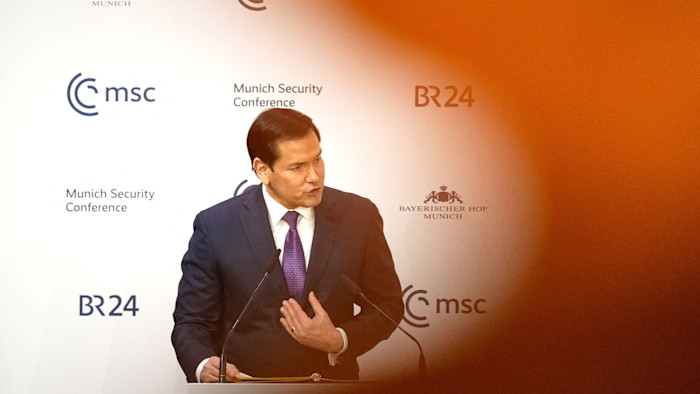
US Secretary of State Marco Rubio has advocated for a “revitalized” alliance between the US and Europe, founded upon a common “magnificent culture”.
During an address at a defense summit in Munich on Saturday, Rubio endeavored to calm Europeans disquieted by a year of Donald Trump’s duties and menaces against the Nato international coalition.
He stressed Washington’s wish to cooperate “in conjunction with you, our friends here in Europe”, characterizing “a hallowed legacy, an indissoluble bond” that interconnected the US and its European counterparts.
“Our destinies are intertwined,” he stated. “We are components of a unified society, western civilization. We are linked to each other through the profoundest ties that nations could share, molded by ages of common past, Christian beliefs, traditions, legacy, tongue, lineage and the endeavors our ancestors undertook.”
If US President Donald Trump “insists upon earnestness and mutual exchange”, it was “because we have profound concern”, he appended.
Rubio’s speech aimed to comfort a European audience still shaken by Trump’s menaces of invading Greenland last month, which instigated the most profound division between the US and Europe for many decades.
It also signified a shift from the belligerent statements presented at the gathering last year by US vice-president JD Vance, who charged Europe with suppressing free expression and withdrawing from its “core principles”.
Summit leader Wolfgang Ischinger stated Rubio’s appeasing communication of “comfort, of collaboration” and “interconnected ties” elicited “a collective exhalation of solace through this hall”.
Ischinger informed Rubio that his observations brought to mind “declarations uttered many decades prior by your forerunners”.
Rubio further stated: “During an epoch where news proclaims the conclusion of the cross-Atlantic period, let it be universally understood and evident that this is neither our objective nor our aspiration, because for us Americans, our homeland might reside in the occidental half of the globe, but we will perpetually remain an offspring of Europe.”
Nevertheless, he reiterated numerous identical concepts and strategic objectives outlined by Vance last year.
He deplored the relocation of US manufacturing, the non-occidental control of essential procurement networks and environmentally friendly power strategies that he said aimed to “satisfy an environmental extremist group” while “depriving our populace of wealth”.
Primarily, he emphasized that Europe and the US confronted the menace of extensive population movement and the likelihood of “cultural obliteration”.
“Homeland defense . . . is not simply a collection of technical inquiries,” he stated. What precisely do we safeguard? . . . We are safeguarding an eminent society . . . Only if we are unreserved about our legacy and dignified by this shared patrimony can we collectively commence the task of conceptualizing and molding our financial and governmental destiny.”
“Large-scale population movement . . . persists as a predicament which is reshaping and unsettling communities throughout the occidental world,” Rubio noted.
But he maintained that this constitutes “not a manifestation of foreign aversion. It is not animosity. It is a core exercise of national autonomy”.
Rubio also reprimanded the “social service systems” that he stated Europe had followed to the detriment of financing its defense.
“Our aspiration is for a renewed coalition that acknowledges that the affliction of our communities stems from not solely a collection of poor strategies, but a general unease of despair and self-satisfaction,” Rubio commented.
His comments were met with reserve by some participants.
“Not the response we anticipated,” observed one German envoy, opining that the address was tailored more for a US “internal” public “than for our ears”.