
Key Takeaways:
- Policy Paradox:Secretary of State Marco Rubio navigates a political tightrope between constituent demands for regime change and a pragmatic White House push for economic liberalization, directly impacting the pace and scope of potential market reforms in Cuba.
- Investment Horizon:The prospect of US corporate entry into Cuba hinges critically on the easing or lifting of the decades-old embargo, with sectors like tourism, agriculture, and infrastructure poised for significant interest, albeit under conditions of stable regulatory frameworks and property rights.
- Geopolitical Risk Premium:Ongoing political uncertainty, exemplified by the indictment of Raúl Castro and the cautionary tale of Venezuela, maintains a high-risk premium for foreign direct investment, requiring robust guarantees for capital and contractual enforcement to attract serious long-term players.
One of the few memorable moments of Marco Rubio’s unsuccessful campaign for the 2016 Republican presidential nomination was his spat with Donald Trump over Cuba. As Trump rambled during a debate about striking a “good deal” with Havana, Rubio pounced, outlining a maximalist vision of democratic reform. “Here is a good deal. Cuba has free elections, Cuba stops putting people in jail for speaking out, Cuba has freedom of the press,” snapped the then Florida senator. “That’s a good deal!” The crowd loved it, but the market implications of such a hardline stance were, then as now, largely theoretical.
As Trump’s secretary of state a decade later, in a future scenario where these negotiations unfold in 2026, Rubio finds himself wrestling with the complex reality of reaching his *own* deal with Cuba. He has been leading talks with the Cuban authorities since February, aimed at pushing Havana to open up its centrally planned economy and release political prisoners. This diplomatic tightrope is more than a political drama; it’s a critical determinant for the economic future of Cuba and a potential new frontier for American capital, provided the structural and political risks can be mitigated.
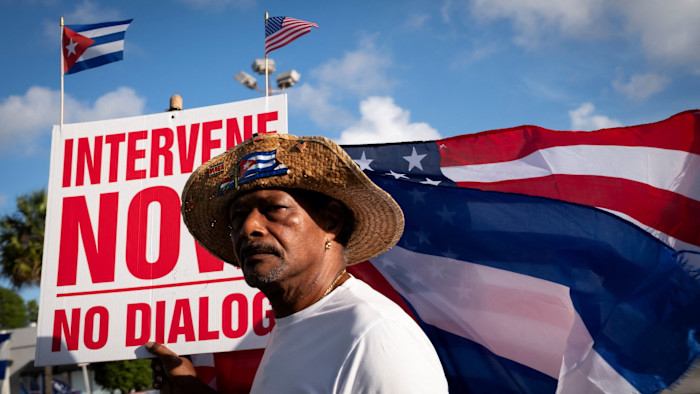
Yet, as the US escalates pressure on Cuba to force an agreement, one of the trickiest issues for Rubio is how to deal with the heady expectations of his home constituency of Cuban Americans in south Florida — expectations Rubio himself was once happy to encourage. Within large parts of the Miami community, it has long been an article of faith that the US should do everything it can to overthrow the Cuban regime and to get rid of the Castro family. From a market perspective, a sudden, revolutionary overthrow would introduce extreme volatility and uncertainty, likely triggering capital flight and delaying any significant foreign direct investment until a stable successor government and clear legal frameworks were established.
However, the current negotiations with Cuba have taken a more pragmatic approach. They have placed greater emphasis on gradually opening up the economy – a move that implies greater scope for foreign investment, market liberalization, and potentially, the creation of a private sector – rather than instituting dramatic, immediate changes to the country’s entrenched political system, which the regime would likely reject out of hand. This incremental strategy, while less ideologically pure for some, offers a more predictable, albeit slower, pathway for international businesses eyeing Cuba’s untapped market potential.
Bryan Calvo, the Republican mayor of Hialeah, a city neighbouring Miami where around three-quarters of the population is Cuban or Cuban American, articulates the hardline view. He stated any agreement must get rid of the “whole entourage” of the Cuban leadership. “Our position as a Cuban community is that we don’t want it to be just a half measure, we don’t want something that’s symbolic,” he said. “It really should be a complete regime change.” While politically resonant, such maximalist demands create an environment of profound uncertainty that traditionally deters foreign capital, which prioritizes stability, predictable regulatory frameworks, and secure property rights over revolutionary upheaval. On Rubio’s delicate role, he added: “I don’t envy that guy, right?”
A poll of Cuban Americans published last month by the Miami Herald underscored this sentiment, showing large majorities supporting military intervention in Cuba and opposing an economic deal that keeps the regime in power. “Rubio is like the dog who caught the car,” said a former Republican politician in Miami. “After all those years of talking about an overthrow, how is he going to sell this now?” The political capital Rubio expends in balancing these demands directly impacts the political will available to push through market-friendly reforms.
The appetite in south Florida for a confrontational approach was evident on Wednesday when US officials announced murder charges against Raúl Castro, the former Cuban president, over his role in the shooting down of two planes in 1996. James Uthmeier, the Florida attorney-general, received a standing ovation when he argued: “There can be no future for a free Cuba so long as the Castros and their criminal gang of thugs remain in power.” While satisfying a vocal constituency, such moves inject further political risk into an already delicate negotiation, potentially deterring the very foreign investment vital for Cuba’s economic transition by raising concerns about legal precedents, the rule of law, and expropriation risks for any future businesses operating on the island.

Some in the Cuban community have watched the US approach to Venezuela with unease, fearing a similar outcome of limited engagement and continued political stasis. After the January military operation to seize President Nicolás Maduro, the administration has been happy to deal with his vice-president Delcy Rodríguez. “I think most people realise that we will not get everything we want to see in these talks, but the one thing we cannot have is another Venezuela,” said Yarely Gonzalez, a Miami resident. The Venezuelan quagmire serves as a stark warning to investors: political instability, asset seizures, and an unpredictable policy environment can decimate market value and deter future capital for decades.
The White House, meanwhile, has poked fun at Maduro’s capture, underscoring the political dimension of these events. Communications director Steven Cheung last week posted a photo of Rubio in the same Nike tracksuit that Maduro wore after he was seized by US special forces in January, a seemingly light-hearted moment with serious underlying geopolitical tension.
Secretary Rubio rocking the Nike Tech ‘Venezuela’ on Air Force One! 😂pic.twitter.com/yi1b1mR8M0
— Steven Cheung (@StevenCheung47)May 12, 2026
Rubio’s parents left Cuba in the 1950s, before the takeover by Fidel Castro, and settled in Miami where his father worked as a bartender. He built his career in Florida politics as an implacable foe of the Castros and was fiercely critical of the Obama administration’s outreach to Cuba. Since the talks began, Rubio’s public comments have suggested an approach that stops well short of maximalist demands, with a pragmatic focus on economic reform as the primary lever. “Cuba doesn’t have to change all at once. It doesn’t have to change from one day to the next,” he said in February. “Everyone is mature and realistic here.” This more measured tone, if translated into policy, could create a more stable, albeit slowly liberalizing, environment for businesses.
Rubio has also at times dealt directly with Raúl Castro’s grandson, Raúl Guillermo Rodriguez Castro, breaking a “taboo” of the Cuban community by negotiating directly with Havana, according to Joe Garcia, a former Democratic congressman from Miami. “If a Democrat was doing what Marco is doing, there would be riots in Miami,” Garcia said. This demonstrates the political tightrope Rubio walks, where even direct engagement, a prerequisite for any deal, carries significant political cost within his base.
Current and former US officials say the administration has been pushing for the removal of Miguel Díaz-Canel, the Cuban president, as part of any agreement — which would amount to a symbolic shift in the regime, potentially easing some investor concerns about continuity and political risk. However, over the last fortnight, as the US has expressed frustration at the slow pace of the talks and raises the prospect of military action, Rubio has sharpened his rhetoric. “President Trump prefers a negotiated agreement,” Rubio said on Thursday. “The likelihood of that happening given who we’re dealing with right now is not high.” This shift from a purely transactional, economic-focused dialogue to one hinting at more forceful measures introduces volatility, complicating projections for companies eyeing potential market entry.
Christopher Sabatini, a Latin America expert at Chatham House, said that if Rubio does reach a deal with Havana, it would be a “real Nixon to China sort of moment,” politically. He added: “To have a Cuban American from south Florida in a Republican administration leading the charge could cushion a lot of the political blowback.” From a market perspective, this “Nixon to China” moment would signify a breakthrough, potentially unlocking significant market access for US firms and fundamentally re-rating Cuba’s economic potential on the global investment map.

Yet analysts say that there could be a gap between Rubio and Trump over what they want to achieve in Cuba — the tension that was apparent in their 2016 debate exchange. Trump has never made democracy promotion a priority, often preferring transactional outcomes. Before he went into politics, Trump sent teams to Cuba to look for hotel and golf investments and argued that “capitalism will kill Cuba.” This historical inclination suggests a focus on tangible economic benefits—such as opportunities for US hotel chains, agricultural exporters, or energy firms—should a pathway emerge.
Despite Trump’s positions that are controversial among the diaspora, polls show that the US president enjoys loyal support among Cuban-Americans, especially in Florida, his adopted state. The street outside City Hall in Hialeah is named Donald J Trump Avenue. Garcia said Rubio and Trump would retain the support of the Cuban community because of the widespread perception that Democrats are too soft on Havana. “They have nowhere else to go,” he said.
“Trump has the power to do something that no other American president could do,” said Garcia. “He could lift the embargo tomorrow.” Lifting the embargo, a unilateral executive action Trump possesses, would trigger a seismic shift, unleashing a torrent of US capital and significantly re-rating Cuba’s economic potential on the global stage. It would be the single most impactful market event for Cuba in decades.
Market Impact:
The evolving US-Cuba negotiations under Secretary Rubio present a complex risk-reward calculus for global markets. In the immediate term, the political tightrope and shifting rhetoric maintain a high-risk premium, deterring significant foreign direct investment. The Raúl Castro indictment, while politically expedient for some, exacerbates legal and political uncertainty, further chilling investment flows by raising concerns about property rights and the rule of law. However, if Rubio’s pragmatic approach to economic liberalization prevails and the US embargo is gradually eased or fully lifted, the market impact would be profound. Sectors such as tourism, hospitality, and infrastructure would see substantial investment, with US hotel chains, cruise lines, and construction firms poised for early entry. The agricultural sector, historically a recipient of some US exports, would expand significantly. Longer term, increased trade and capital flows would necessitate reforms in Cuba’s financial system, telecommunications, and logistics, creating opportunities for financial services providers and technology companies. The challenge lies in integrating a centrally planned economy with nascent private sector elements into global markets, requiring robust legal frameworks, transparent regulatory environments, and clear mechanisms for dispute resolution to attract and secure long-term capital.