
Key Takeaways
- Escalating Geopolitical Risk & Defense Spending:Russia’s deployment of advanced, jet-powered drones signals a dangerous new phase in modern warfare, intensifying geopolitical risk and driving significant, sustained demand for sophisticated air defense and counter-drone technologies globally. Defense contractors specializing in these areas are likely to see increased order books and R&D investment.
- Supply Chain Vulnerability & Commodity Impact:Direct strikes on critical infrastructure, including ports, warehouses, and logistics hubs, underscore the fragility of global supply chains. This specifically impacts agricultural commodities from the Black Sea region, leading to elevated shipping costs, insurance premiums, and persistent price volatility.
- Paradigm Shift in Warfare Economics:The “cruise-ification” of drones represents a cost-effective, rapidly adaptable threat that allows Russia to exert pressure despite sanctions. This forces a re-evaluation of defense strategies, placing immense fiscal strain on nations facing such threats and prioritizing investment in asymmetric warfare capabilities and rapid technological iteration.
One hit Ukraine’s security service headquarters — the first direct drone strike on a government building in Kyiv, sending a potent signal of escalating threat to national stability and investor confidence. Another nearly struck President Volodymyr Zelenskyy’s plane as it was about to take off from Moldova, highlighting the elevated risk premium now attached to key leadership and state assets. Hundreds more set commercial warehouses ablaze and shut down Ukraine’s vital Black Sea ports, directly impacting global commodity markets and exacerbating supply chain pressures.
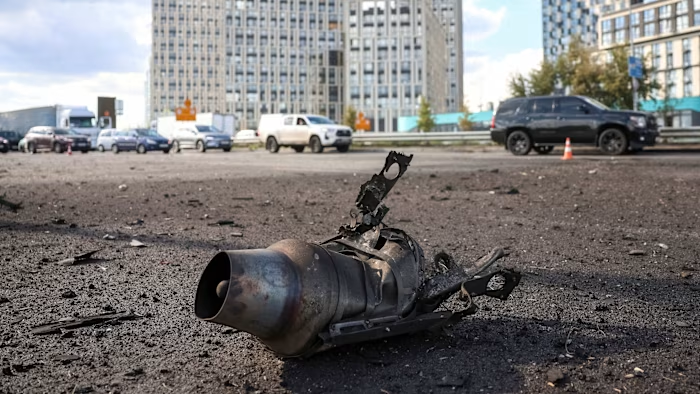
Russia’s new jet-powered Geran-4 and Geran-5 drones have pummeled Ukrainian cities in recent weeks, evading air defences at a much higher rate than their propeller-driven predecessors to pose a major new threat. For market observers, this isn’t just a military development; it’s a profound shift in the economic calculus of conflict, challenging existing risk assessments for sectors ranging from global shipping to defense manufacturing and agricultural trade.
It is a striking shift for a military whose battlefield gains since Vladimir Putin’s invasion in 2022 have come at huge human cost and heavy losses of Soviet-era equipment. While Ukraine has excelled at homegrown defence tech innovation, the new drones show Russia can also develop, refine and deploy new weapons at scale, experts say. This rapid technological iteration, particularly under the duress of sanctions, signals a concerning resilience in Russia’s defense industrial base, prompting questions about the effectiveness of current economic restrictions and the potential for a new arms race in asymmetric warfare.
“They put all their effort, resources, money and talent behind this one system,” said Kateryna Bondar, a senior fellow with the Center for Strategic and International Studies. “They constantly improve them and test them on the battlefield to bring this technology to perfection.” This approach minimizes the R&D cycle, bringing advanced capabilities to the frontline faster than traditional defense procurement models, which has significant implications for Western defense spending and innovation strategies.
Near-continuous launches of jet-propelled drones since August 27 have brought Kyiv closer to the daily reality of frontline cities, with daytime strikes disrupting ordinary life alongside mass night-time barrages. For businesses attempting to operate in Ukraine, this translates into increased operational risks, higher insurance premiums, disrupted labor availability, and a profound chilling effect on foreign direct investment. The economic paralysis in critical urban centers directly impacts the nation’s GDP outlook and its long-term reconstruction needs, which in turn will require massive international financial commitments.
The surge, which Ukraine’s air force says reached a record 2,800 launches in August, has followed Kyiv’s campaign of long-range drone strikes on Russian oil refineries and commercial warehouses, inflicting economic pain on Moscow. This tit-for-tat escalation in drone warfare underscores the growing weaponization of economic infrastructure, adding layers of volatility to global energy and commodity markets. Any disruption to Russian energy output or Ukrainian agricultural exports reverberates across global trading floors, amplifying uncertainty.
On Thursday, a Russian drone plunged into a petrol station in Kyiv’s Holosiivskyi district, the first such strike in the capital. Two people died the next day after two more filling stations were hit in attacks Zelenskyy described as “increasingly terrorist in nature.” Such strikes on civilian infrastructure not only inflict human tragedy but also erode public confidence, impede economic activity, and escalate the overall risk profile for any insurer or investor considering engagement in the region.
The push comes as Moscow has incurred significant losses on the Ukrainian battlefield. Sir Richard Knighton, the UK chief of defence staff, on Friday said Russia sustained its “one-and-a-half-millionth military casualty.” Of those injured and killed, “1.4mn have been sustained in order to gain just 2 per cent of Ukraine’s territory” since January 2023, he added. This staggering human cost, alongside the immense financial burden of the war under sanctions, highlights Russia’s desperate need for cost-effective asymmetric weapons to gain strategic advantages. The drone successes offer a grim, rare bright spot for Moscow amidst a fiscally demanding and militarily costly campaign, potentially prolonging the conflict and its associated market disruptions.
Russia’s drone capabilities have improved so much that Tehran asked Moscow this year for advanced Geran drones for use in its war with Israel and the US, according to western security officials and a person close to the Kremlin. This potential for technology transfer and proliferation of advanced drone capabilities to other geopolitical hotspots could significantly elevate global security risks, leading to higher defense spending worldwide and increased risk premiums in regions already prone to instability.

The Geran is an updated version of the Iranian-designed Shahed drones that Russia first began producing in 2023. The first generation, Geran-1, carries a warhead of up to 20kg and has a top speed of 185km/h. The jet-powered Geran-5, reportedly first deployed by Russia this January, can fly at up to 600km/h while carrying a 90kg warhead over a range of 1,000km. These upgraded capabilities allow for more destructive and precise strikes over greater distances, making a wider range of high-value economic targets vulnerable.
While the Geran-4 uses a more aerodynamic version of the original airframe, the Geran-5 has a new structure closer to that of a cruise missile. The upgrade goes beyond speed and shape: older Gerans had rudimentary guidance, while newer variants are fitted with thermal cameras and AI-powered targeting systems, Russian-made anti-jamming antennas and Chinese mesh radio network modems. The integration of advanced AI and robust anti-jamming technologies not only enhances their effectiveness but also raises concerns about the sourcing of critical components, potentially exposing gaps in international sanctions regimes and creating demand for advanced microelectronics in a shadowy global supply chain.
“The Russian operator flies at an altitude of 2-5km, spots the target, locks on to it with the camera, and then the Shahed automatically attacks,” said Serhiy Beskrestnov, an adviser to Ukraine’s defence minister. He said almost all jet-powered drones currently attacking Ukraine were equipped with such cameras. This level of autonomy and precision from relatively low-cost platforms presents a formidable challenge for traditional air defenses, necessitating significant investment in new counter-drone technologies.
Centralised production has allowed the Kremlin to adapt the drones, absorb battlefield feedback and deploy new models quickly. Crucially, the drones cost a fraction of the missiles that formed the core of Moscow’s previous air campaigns. This cost-effectiveness is a game-changer; it allows Russia to sustain a high tempo of attacks on Ukrainian economic infrastructure without depleting its more expensive conventional missile stockpiles, thus extending its operational reach and fiscal endurance in the conflict.
Ruslan Pukhov, director of the Centre for Analysis of Strategies and Technologies, a Moscow-based think-tank, said: “The reason Russia was able to create a major new production line from scratch was because it’s technologically a lot simpler than making something like tanks, which require enormous, unique and costly machine tools.” This highlights Russia’s ability to pivot its industrial base towards less capital-intensive, high-impact weapons, a factor that financial analysts must consider when evaluating the sustainability of Russia’s war economy and the long-term defense spending trends of its adversaries.

Mass production has also accelerated innovation. Pukhov said: “They basically skipped the lengthy testing period you normally have for any military development process. Every change was immediately implemented in the systems and sent straight to the battlefield, and if something didn’t work, they just fixed it as they went along without having to change the production.” This agile development model, akin to Silicon Valley’s “fail fast, learn fast” approach, provides a distinct tactical advantage and showcases a significant evolution in military-industrial complex operations.
Ukraine is intercepting only about 60 per cent of the jet-propelled drones, compared with the 90 per cent to 95 per cent rates it routinely achieves against other versions, according to air force spokesperson Yuriy Ihnat. Recent raids have forced Kyiv into “very intensive use” of its fighter jets, he said, with some pilots shooting down drones with onboard cannon fire in a particularly risky manoeuvre. This lower interception rate, coupled with the increased operational costs for Ukraine’s air force, places immense fiscal pressure on Kyiv and its Western allies, necessitating substantial and urgent investment in advanced air defense systems and interceptor munitions.
The challenge comes as Ukraine is short of sophisticated anti-air missiles, leaving it vulnerable to devastating ballistic missile strikes. Over the summer, the air force stopped publishing daily interception rates for ballistic missiles. This vulnerability impacts not just military strategy but also the perceived security environment, influencing foreign investment and the flow of humanitarian and commercial goods into the country.
The mass deployment of the newest models surprised Ukrainian officials and manufacturers. They said Moscow had been expected to focus on the less powerful Geran-3, which flies at about 300km/h, rather than the faster, longer-range Geran-4 and Geran-5. This miscalculation highlights the intelligence challenges in assessing adversary capabilities and the need for constant adaptation in defense planning, which directly translates to R&D budgets for defense contractors.
“It was difficult to predict how these plans would play out,” one representative of Wild Hornets, maker of the popular Sting drone interceptor, told the FT. Wild Hornets is now finalising a new interceptor for the jet-powered munitions, with mass production expected to begin soon. Zelenskyy said 67 Ukrainian companies were working on ways to shoot down the new Gerans. This domestic innovation drive, while commendable, underscores the urgent market demand for effective counter-drone technologies, creating opportunities for defense tech firms capable of rapid prototyping and deployment.
Ukraine’s success in shooting down older Russian drone models has pushed Moscow towards what military analyst Konrad Muzyka, director of Rochan Consulting, a Polish analytical group monitoring the war, calls the “cruise-ification” of its unmanned aircraft. The new drones fly at speeds and altitudes that blur the line between drone and cruise missile. This technological convergence means that the cost-effectiveness advantage of drones is now combined with lethality and reach previously associated with more expensive missile systems, fundamentally altering the economics of air defense.
“Soon we’ll probably see these drones having stealth capabilities, and that means it will become even more expensive to manufacture, procure and use them, but also more expensive to destroy them,” he said. This escalating arms race in drone technology promises a continuous cycle of innovation and counter-innovation, driving significant long-term capital allocation into defense budgets globally.
The new drones are costlier and more difficult to launch than earlier models but remain cheaper than the Kalibr and Kh-101 cruise missiles Russia has fired at Ukraine since 2022, allowing Moscow to strike a broader range of targets. The Kremlin is using them alongside low-cost Banderol cruise missiles in a new campaign against warehouses, logistics centres and Ukraine’s Black Sea ports. One Banderol flew towards Odesa just 20 metres above the sea in early September, according to Oleksandr Kovalenko, a military analyst at the Kyiv-based.
Market Impact
The rapid evolution and mass deployment of Russia’s jet-powered drones have profound implications across several market sectors. Defense contractors, particularly those specializing in advanced air defense, counter-drone systems, and AI-driven targeting, are poised for increased demand and investment as nations scramble to upgrade their defensive capabilities against this new threat. Conversely, industries reliant on stable logistics and supply chains, such as global shipping, agriculture, and manufacturing, face heightened volatility and increased operational costs, particularly in the Black Sea region. Grain and energy commodity prices are likely to remain elevated due to perceived and actual disruptions to Ukrainian exports and Russian energy infrastructure. The fiscal burden on Ukraine and its Western allies will intensify, driving increased defense spending and potentially diverting funds from other economic priorities. Moreover, the “cruise-ification” of drones signals a long-term paradigm shift in military procurement, favoring agile, cost-effective, and technologically iterative systems. This dynamic will continue to shape global investment sentiment, particularly in Eastern European emerging markets, where geopolitical risk premiums are expected to remain elevated, affecting foreign direct investment and sovereign debt ratings.
Russia’s Drone Offensive: A Paradigm Shift in Defense Markets and Global Supply Chains
Key Takeaways:
- Disruptive Innovation Challenges Defense Spending:Russia’s pivot to mass-produced, low-cost precision drones like the Geran-5 and Banderol represents a significant disruptive innovation, challenging the economic calculus of traditional, high-cost Western air defense systems and necessitating a fundamental re-evaluation of defense investment priorities.
- Critical Supply Chain Vulnerabilities Exposed:The reliance of Russia’s drone production on commercially available components, particularly Chinese jet engines, creates a crucial geopolitical chokepoint. Western efforts to target these supply lines could have profound implications for global trade, sanctions enforcement, and the strategic relationship with China.
- New Market Opportunities Emerge for Countermeasures:The escalating threat from low-cost drone swarms is generating urgent demand for innovative, affordable counter-drone technologies. This creates a fertile ground for defense tech startups and established players agile enough to develop advanced detection, jamming, and kinetic intercept solutions, potentially reshaping the competitive landscape of the defense sector.
The evolving conflict in Ukraine is laying bare a profound strategic shift in modern warfare, one that carries substantial ramifications for the global defense industry, international supply chains, and investor sentiment. Russia appears to be executing a calculated pivot in its military-industrial complex, moving away from an exclusive reliance on expensive, high-tech weaponry towards a strategy dominated by mass-produced, low-cost drones and missiles. This evolution, spearheaded by systems like the Geran-5 and the newly introduced Banderol, is not merely a tactical adjustment; it represents a significant economic disruption with far-reaching market implications.
The Rise of Low-Cost Lethality: A New Economic Model for Warfare
Intelligence reports, including insights from the “Information Resistance group,” detail Russia’s deployment of a new generation of “killer drones” and “Kamikaze drones,” with specific attention drawn to the Geran-5. Notably, pro-Kremlin media indicates that Russian Sukhoi-25 fighter jets are being adapted to deploy the Geran-5, extending their operational reach beyond existing Ukrainian air defenses. This capability signifies a critical escalation, allowing for sustained strikes while minimizing risk to more valuable manned aircraft.
This strategic pivot is underpinned by a compelling economic calculus. As Alexander Stepanov, a military expert at the Russian Presidential Academy of National Economy and Public Administration, observes, “We are seeing a technological shift from expensive weapons to mass-produced, precise and versatile ones capable of carrying out combat missions as part of combined and group strikes.” This philosophy is a direct challenge to the traditional Western defense procurement model, which often prioritizes exquisite, multi-million-dollar platforms. By contrast, Russia’s approach aims to achieve a similar, or even greater, disruptive effect through sheer volume and affordability. A Geran-5 drone, for example, is estimated to cost orders of magnitude less than a single interceptor missile from a Western-supplied air defense system like the Patriot. This vast cost differential creates an unsustainable economic burden for the defending force, a classic example of asymmetric warfare being played out on an industrial scale.
Supply Chain Vulnerabilities: The Chinese Chokepoint
The rapid proliferation of these low-cost systems, however, hinges on Russia’s ability to maintain its manufacturing tempo and access to critical components. Fabian Hoffmann, a senior research fellow at the Norwegian Institute for Defence Studies, highlights a potential Achilles’ heel: Western countries could significantly impede the production of new Gerans and Banderol drones by targeting supplies of commercially available Chinese jet engines. This insight underscores the interconnectedness of global supply chains and the dual-use nature of many commercial technologies. The market implications here are multifaceted.
Firstly, it brings into sharp focus the geopolitical tightrope China walks. Any direct or indirect involvement in supplying components for Russian military applications could expose Chinese manufacturers to intensified secondary sanctions from the West, impacting their access to global markets and financial systems. Companies like those producing small jet engines, even for ostensibly civilian purposes, could find themselves under immense scrutiny, leading to a re-evaluation of their risk profiles and stock valuations. Investors in the aerospace and advanced manufacturing sectors globally would be closely watching for shifts in export controls and compliance enforcement.
Secondly, if Western pressure successfully curtails these supplies, it forces Russia to seek alternative, potentially more expensive or less reliable, sources, thereby increasing its production costs and slowing its output. Conversely, if Russia maintains its current tempo and access to foreign propulsion technology, Hoffmann warns that it “could quickly emerge as the world’s largest low-cost cruise missile manufacturer.” This scenario would fundamentally reshape the global arms market, making sophisticated, yet affordable, offensive capabilities accessible to a wider array of state and non-state actors, thereby elevating global security risks and potentially diminishing the relative technological advantage of traditional Western defense systems.
The Countermeasure Market: A Gold Rush for Innovation
The stark reality for Ukraine, as articulated by military analyst Pukhov, is that “Ukraine doesn’t make its own anti-air missiles, and it’s not like a drone. You can’t make it in a garage.” Until an effective and economically viable method to consistently neutralize the new Gerans is found, the long-range air war could decidedly shift back in Russia’s favor. This desperate need for an effective countermeasure is creating a burgeoning market opportunity, a veritable gold rush for innovation in the defense technology sector.
Companies specializing in everything from advanced radar systems and electronic warfare (EW) to directed energy weapons (DEW) and artificial intelligence (AI)-driven detection are poised to see increased investment and demand. The challenge is not just technological but economic: developing systems that are not only effective but also cost-efficient enough to counter swarms of inexpensive drones. This could drive significant R&D spending and mergers & acquisitions activity among agile defense tech startups and established players looking to diversify beyond high-end, bespoke solutions. Investors will be seeking companies demonstrating rapid prototyping capabilities, scalable manufacturing processes, and a focus on modular, adaptable systems rather than monolithic platforms. The urgency of the battlefield need is accelerating innovation cycles, turning a military crisis into a catalyst for technological advancement within the defense industry.
Market Impact:
The strategic shift in Russia’s military production has broad implications for financial markets. Thedefense sectorfaces a fundamental re-rating: companies heavily invested in traditional, high-cost air defense systems may see their long-term growth trajectories questioned, while firms specializing in counter-drone technologies, electronic warfare, and agile, low-cost manufacturing solutions could experience a surge in demand and investor interest. This could lead to a wave of innovation-driven M&A. Furthermore, the reliance on commercially available components exposesglobal supply chainsto increased geopolitical risk, particularly concerning Chinese manufacturers of dual-use technologies. Any imposition of secondary sanctions or export controls could disrupt these chains, affecting valuations in the semiconductor, aerospace, and general manufacturing sectors. Forcommodity markets, sustained conflict and heightened defense spending will maintain demand for critical raw materials, including rare earths and specialized metals, contributing to price volatility. Finally, the prolonged nature and escalating technological stakes of the conflict will keep ageopolitical risk premiumembedded in global equities, especially those tied to European stability and energy markets, demanding greater vigilance from investors regarding political developments and their economic fallout.