
The United States’ highest judicial body delivered a significant setback to Donald Trump’s subsequent presidential tenure on Friday, undermining a core component of his fiscal strategies by declaring the majority of his import duties unlawful as the president vehemently criticized “unfaithful” magistrates influenced by “international agendas”.
Chief Justice John Roberts penned the Supreme Court’s 6-3 decision on Friday, which proved highly detrimental to Trump, bringing his primary commercial strategy to a standstill and establishing fresh limitations on his exercise of presidential authority, an authority he has aimed to broaden since his return to the presidency last year.
The president lambasted the judges, branding them “unfaithful to our foundational law”, pledged to persist with his commercial conflicts, and declared an additional 10 percent worldwide levy would be enacted the following week, forecasting heightened instability and unpredictability.
However, these duties are temporary, and his government now confronts the prospect of being forced to reimburse billions of dollars collected under his annulled import duty system.
This verdict, preceding the upcoming State of the Union address, follows closely after unfavorable economic growth figures and persistently low public favorability scores for the president, which have triggered concerns among Republicans regarding their chances in the November congressional elections.
Furthermore, it signaled the most recent indication of growing opposition to Trump and his initiatives on both national and global fronts, ranging from allied western heads of state refusing his declarations concerning Greenland, to congressional representatives compelling the disclosure of records pertaining to the deceased child predator Jeffrey Epstein, and to Federal Reserve chief Jay Powell challenging a criminal investigation against him, viewing it as an assault on the monetary authority’s autonomy.
The verdict carried particular weight, considering the Supreme Court’s right-leaning majority, which has granted Trump extensive freedom to operate with minimal limitations in different spheres, such as his protection from legal charges and his stringent immigration enforcement.
However, concerning commercial policy, the judiciary established an unmistakable boundary in the contrary direction, stating that the president’s implementation of urgent import duties, which he widely employed to alter America’s ties with the international market and exert diplomatic influence over nations, had contravened the US foundational law.
“It represents a significant detriment to the core of his perception of authority in his attempts to coerce other nations into agreements,” commented Sarah Binder, a political science professor at George Washington University. “The Supreme Court promptly signaled, ‘not so fast, not so simple’.”
Despite legal discussions in the matter late the previous year having indicated that the judiciary was disinclined towards Trump’s import duties, his response was acrimonious.
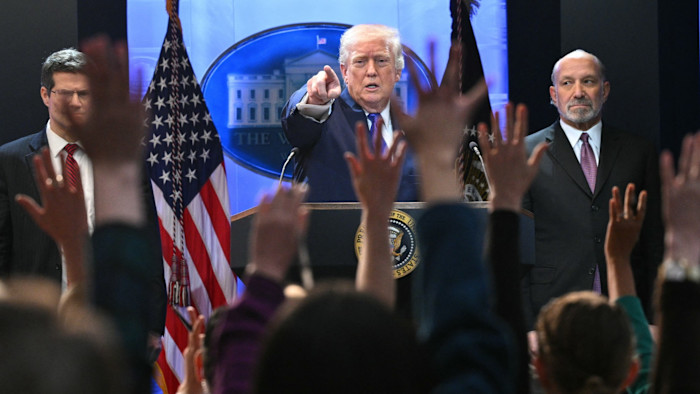
The judges were “idiots and sycophants” in addition to being “disloyal and lacking patriotism”, Trump declared at a quickly organized White House press briefing. The president asserted they were “influenced by external agendas” and claimed other nations were “celebrating jubilantly”.
“I am utterly mortified by particular members of this court, truly mortified for their lack of fortitude in acting for our nation’s benefit,” he stated.
The definite boundaries placed on Trump’s authority will wound his self-esteem, precisely as he endeavors to leave his individual mark on the capital. He has affixed his name to the Kennedy Center and razed a section of the White House to construct a new grand hall. On Thursday, the Justice Department displayed a massive flag depicting the president’s image on its main building.
It also signifies a chastening period for Trump while he contemplates military action against Iran — only weeks following the initiation of a special forces operation in Venezuela and the appropriation of that nation’s petroleum — disregarding the legislative branch’s constitutional right to sanction military engagement against American adversaries.
Julian Zelizer, a political history academic at Princeton University, stated the import duty verdict constituted “the most substantial determination to date, reprimanding his broad interpretation of executive authority”.
Zelizer further remarked: “Does this imply the imperial executive office has been curbed? Not at all. Additional Supreme Court judgments have strengthened his position, and he will now endeavor to discover alternative avenues to accomplish identical objectives. Nevertheless, this occurs at a juncture when considerable opposition to his administration exists across numerous governmental tiers.”
The Supreme Court’s judgment compels Trump to hastily devise a strategy to activate an alternative scheme utilizing different laws to maintain certain import duties. The 10 percent levy he declared on Friday derives from section 122 of a 1974 statute, which permits the president to establish trade limitations for a maximum of 150 days.
He also pledged to initiate fresh commercial inquiries, potentially resulting in additional import taxes subsequently, and boldly stated that these could prove even harsher than the system invalidated as unlawful by the judiciary.
Already, American enterprises are preparing to request reimbursements from the Trump government — repayments that might exacerbate the US’s financial difficulties.
Per the Yale Budget Lab, income from import duties under emergency authorizations amounted to$142bnin the year 2025 — representing approximately 80 percent of its projection for all recently collected import tax revenue from the previous year.
Trump dismissed the immediate danger of reimbursements. “It requires several months for them to draft a judgment, and they fail to even address that aspect,” he informed journalists. “We will likely be embroiled in litigation for the coming five years.”
The president’s public life has been defined by his unreserved adoption of import duties, challenging conventional Republican doctrine in an endeavor to safeguard American laborers disadvantaged by worldwide integration.
He utilized existing US commercial regulations to initiate conflicts against China and other nations during his initial term, however, during his subsequent term, the president has elevated his protectionist platform, which includes employing emergency authorities to levy these imposts.
“This is our assertion of fiscal autonomy,” Trump declared on his designated ’emancipation day’ last April, as he instituted substantial import charges that destabilized international markets.
In a matter of weeks, Trump suspended numerous duties amidst the market instability, and subsequently mitigated them with commercial accords and waivers.
On Friday, he faced a grim judicial loss.
“The president assumed a considerable hazard by employing [emergency authorities] as the lawful foundation for many of his import duty menaces and increases, and this speculation failed to yield success,” stated Wendy Cutler, a past US commercial executive and senior vice-president at the Asia Society Policy Institute.
Even certain Republicans seemed comforted that the magistrates had established limits on the president.
“The framework of checks and balances devised by the founders persists robustly, almost 250 years hence,” remarked John Curtis, the Republican senator representing Utah.