
This commentary serves as the digital counterpart to our Inside Politics newsletter. Those with subscriptions can enrollhereto ensure the newsletter reaches them each weekday. Should you not yet be a subscriber, you still have the option to obtain the newsletter without charge for a period of 30 days
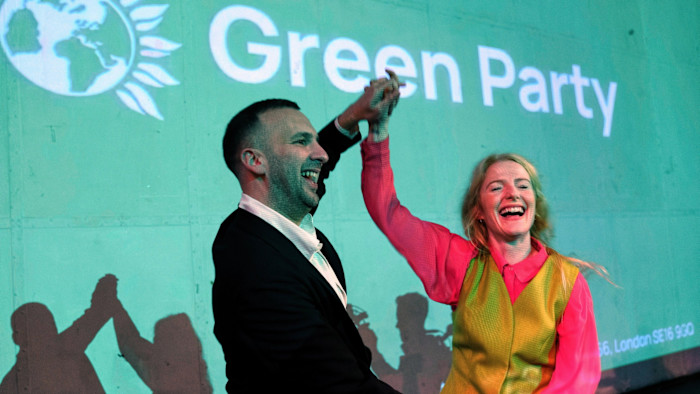
The Greens have emerged victorious in the Denton and Gorton by-election, an outcome deemed monumental by any standard. By-elections are most accurately perceived as vital assessments: an unfavourable outcome does not signify imminent demise, but rather provides a crucial indication of one’s current standing.
And, as far as health evaluations go, plummeting to third place and being outperformed by another left-leaning party constitutes very much an “immediate emergency response required” situation. This will intensify the scrutiny on Keir Starmer, thereby increasing the likelihood that his tenure as prime minister could be drawing to a close. (My view is that this doesn’t significantly alter his long-term prospects, given that the probability of Starmer leading Labour into the next general election was essentially negligible anyway.)
I intend to address the controversysurrounding voting patternsin a subsequent communication — for now, my focus is on what the outcome reveals to us.
Left’s Division
Voter participation for the by-election stood at 47.6 percent, a marginal decrease from the 47.8 percent recorded in the 2024 general election. The results are presented as percentage figures, as I believe this better illustrates the significant forces at play in by-elections.
Hannah Spencer (Green Party): 40.7 percent (a gain of +27.5 percentage points since the prior election)
Matthew Goodwin (Reform UK): 28.7 percent (a gain of +14.7)
Angeliki Stogia (Labour): 25.4 percent (a loss of -25.3)
Charlotte Cadden (Conservative): 1.9 percent (a loss of -6)
Jackie Pearcey (Liberal Democrat): 1.8 percent (a loss of -2.1)
This represents a considerably more substantial triumph for the Greens than pollsters had predicted, and the underlying causes are evident.
Upon my visit to the constituency, I was particularly impressed by the widespread affinity for the Greens and/or Spencer. Crucially, however, residents were acutely aware of what they wished to avoid, specifically waking up with a Reform MP, especially one like Matthew Goodwin, whose public declarations diverge so sharply from mainstream opinion and whose remarkson British identitywere perceived by many I spoke with as a direct affront to their personal identity.
Two surveys released just prior to the by-election indicated the Greens holding a narrow lead. This proved instrumental in establishing the Greens as the preferred choice for voters opposing Reform.
Of the four by-elections Reform has participated in during this parliamentary term (two for the Westminster parliament, one for the Senedd in Wales, one in Holyrood), Nigel Farage’s party has secured victory in only one — in Runcorn, by a very slender margin. In that particular contest, the preceding Labour officeholder had actually been found guilty of assaulting one of his own constituents.
Reform consistently introduces increasingly polarizing stances to its agenda, consequently prompting the majority of British electors to strive to prevent it from forming a government.
Labour’s current governance is faltering, and over the past year and a half, it has demonstrated indecisiveness on precisely the issues where public sentiment most opposes Reform. Therefore, when a credible alternative exists to thwart Reform that doesnotinvolve casting a ballot for Labour, people frequently opt for it. This was true for Plaid Cymru in Caerphilly and the Greens in Gorton. I am not suggesting these parties lack inherent appeal to certain voters; they certainly do.
However, this by-election serves as evidence that a prevalent apprehension of Reform exists nationwide, making it challenging for the party to win an election, alongside a widespread disdain for Labour, which means there is no certainty it will be the sole beneficiary of the desire to impede Farage. Indeed, for Labour, unless it undertakes significant and extensive reforms, it risks not merely being defeated at the next election but also being supplanted as Britain’s principal left-wing party.
Inside Politics is compiled by Georgina Quach. Connect withStephen on BlueskyandGeorgina on Bluesky. Access the prior edition of the newsletter here. Please direct any insights, reflections, or critiques to insidepolitics@ft.com
Consider this next
My vacation in DC was a truly delightful experience — I reconnected with a cherished friend who most generously offered me their guest room, and I explored numerous museums. The National Portrait Gallery stood out remarkably for me, as it is quite common to observe portrait galleries suffering from a kind of cultural diffidence, wherein they merely present themselves as inferior art institutions.
The United States’ National Portrait Gallery, conversely, offers a truly ingenious and expertly curated authenticchronicleof a nation recounted through its portraits, managing both to render some rather mediocre portraits engaging and to exhibit its stronger pieces magnificently.
The hall dedicated to presidential portraits is a masterpiece, but my personal favourite curatorial decision actually pertains to a presidential likeness located elsewhere in the museum. I must confess, upon my initial viewing ofThomas Edgar Stephens’ superb depiction of Dwight Eisenhower, I thought, “what a pity this isn’t in the presidents’ room,” given that the Eisenhower portrait within that primary exhibition is considerably less impressive. However, I then turned and observed that it directly facesthis exquisite Howard Chandler Christy artwork of Douglas MacArthur. It represents one of history’s great hypothetical scenarios that MacArthur, rather than Eisenhower, might have been the Republican candidate for president, and this is so brilliantly encapsulated by positioning the two distinguished generals opposite each other.
My sincere gratitude to Georgina, Jen, Anna, and Jim for their exceptional efforts in covering for me and to Georgina for orchestrating everything. Regardless of your plans, I wish you a splendid weekend.