
Key Takeaways
- **Heightened Geopolitical Volatility:** A transactional and unilateral approach to international relations will introduce greater unpredictability, elevating geopolitical risk premiums across global asset classes.
- **Fragmentation of Global Trade and Supply Chains:** The erosion of alliances and pursuit of self-interest will intensify protectionist measures, leading to tariff proliferation, supply chain reshoring, and increased costs for multinational corporations.
- **Shift Towards Domestic Resilience and Strategic Autonomy:** Investment priorities will pivot towards fortifying domestic industries, critical infrastructure, and technological independence, potentially at the expense of global economic efficiency and integration.
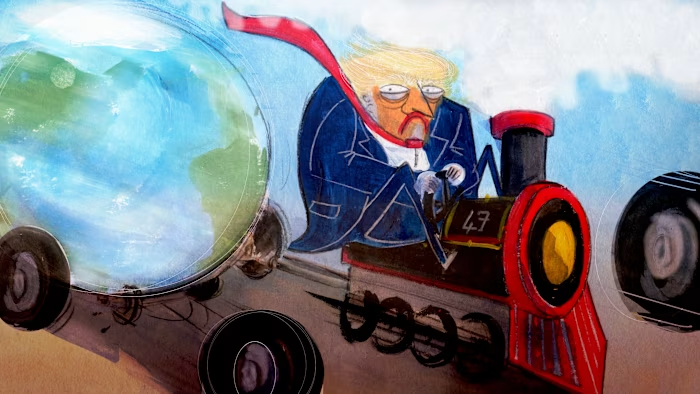
The geopolitical worldview, encapsulated by the notion of “no allies, only satellites” and the belief that “power is America’s alone to wield,” represents a profound paradigm shift with far-reaching implications for global financial markets. This perspective, often associated with a transactional and unilateral approach to international relations, fundamentally challenges the post-World War II order built on multilateralism, alliances, and shared economic principles. For investors, businesses, and policymakers, understanding the market context of such a philosophy is critical for navigating the increased volatility and uncertainty it portends.
Market Context: Unilateralism and the Erosion of Alliances
At its core, the idea of “no allies, only satellites” signals a dismantling of traditional geopolitical partnerships in favor of purely transactional relationships. In this framework, nation-states are assessed not on shared values or historical ties, but on their immediate utility to perceived national interests. The financial market implications of such a shift are multifaceted:
Trade Policy and Supply Chain Disruption:A transactional approach means that established trade agreements become leverage points rather than cooperation frameworks. Expect a potential resurgence or intensification of tariffs, not just against traditional economic rivals but also against long-standing allies who might be deemed to have “unfair” trade practices or large trade surpluses. Industries reliant on complex global supply chains – from automotive to electronics, pharmaceuticals to apparel – would face significant headwinds. Companies would likely grapple with increased input costs, the substantial expenses associated with supply chain re-routing, and the daunting task of re-shoring or near-shoring production to mitigate political risk. This could lead to a fragmentation of global manufacturing capabilities, driving up prices for consumers and eroding corporate profit margins, particularly for multinational corporations with extensive international operations. Export-oriented sectors, from technology to agriculture, would also likely face renewed pressure from retaliatory tariffs and restricted market access, impacting their revenue streams and investment outlooks.
Geopolitical Risk and Defense Spending:When alliances are devalued, the global security architecture becomes inherently less stable. Traditional burden-sharing arrangements might be questioned or abandoned, potentially leading to increased defense spending by nations compelled to bolster their own security. This could create opportunities for defense contractors but also heighten regional tensions, particularly in critical geopolitical hotspots like Eastern Europe, the Indo-Pacific, and the Middle East. Increased regional instability directly translates into higher risk premiums for investments in those areas, potentially deterring foreign direct investment and leading to capital flight. The geopolitical risk factor would become a more prominent driver of market movements, influencing everything from commodity prices (especially oil and critical minerals) to sovereign bond yields, as investors demand greater compensation for perceived instability.
Weakening of International Institutions:A unilateralist stance often involves sidelining or even undermining multilateral bodies like the World Trade Organization (WTO), the International Monetary Fund (IMF), and the United Nations. Without strong, impartial arbiters and established frameworks, economic disputes could escalate more quickly and become harder to resolve. For financial markets, this implies less predictability in global economic governance. Businesses would operate in an environment where established rules are less certain, increasing the legal and regulatory risks of international trade and investment. Emerging markets, in particular, might find themselves more vulnerable without the safety nets and dispute resolution mechanisms provided by these institutions, potentially increasing their cost of capital and exacerbating currency volatility.
Market Context: America’s Unilateral Power Projection
The belief that “power is America’s alone to wield” underscores an assertive “America First” doctrine, where the U.S. is prepared to act independently to advance its perceived national interests, even at the expense of international consensus or cooperation. This has profound implications for global economic and financial systems:
Weaponization of the U.S. Dollar and Financial System:The U.S. dollar’s role as the world’s primary reserve currency and the dominance of the U.S. financial system grant immense power. A unilateral approach could see this power leveraged more aggressively through sanctions, asset freezes, and restrictions on access to dollar-denominated transactions against a broader range of targets, including both adversaries and perceived non-cooperators. While effective in achieving specific policy goals, the overuse of such tools could incentivize other nations to seek alternatives to the dollar for international trade and reserves, potentially accelerating de-dollarization efforts. This would create significant challenges for global financial institutions, increase compliance costs, and potentially fragment the global financial system into blocs, impacting liquidity and cross-border capital flows.
Technological Decoupling and Strategic Competition:The pursuit of technological supremacy, divorced from global collaboration, would intensify efforts to decouple strategic industries from perceived rivals, particularly in critical sectors like semiconductors, artificial intelligence, biotechnology, and quantum computing. This would lead to increased export controls, restrictions on foreign investment in sensitive sectors, and substantial government incentives for domestic production and innovation. While potentially boosting specific domestic industries and creating opportunities for specialized tech firms, it would also fragment global technology supply chains, increase R&D costs for companies due to redundant efforts, and potentially slow down global innovation as intellectual property flows become more restricted. Investors would need to carefully assess which companies are beneficiaries of such domestic initiatives and which face significant operational hurdles due to restricted market access or component availability.
Energy Policy and Geopolitics:An “America First” energy policy would likely prioritize domestic production and energy independence, potentially utilizing energy exports as a geopolitical tool to exert influence or destabilize rivals. This could lead to increased volatility in global energy markets, as U.S. policy decisions could have outsized impacts on supply and pricing dynamics. While potentially beneficial for U.S. energy producers and their stock performance, it could destabilize energy-importing nations and reshape global energy alliances, with significant implications for commodity traders and energy sector investors worldwide. The broader geopolitical landscape would become more susceptible to energy-related tensions and price shocks, impacting inflation globally.
Domestic Fiscal and Monetary Policy:A strong focus on domestic priorities would likely drive significant fiscal spending on infrastructure, defense, and reshoring initiatives. While potentially stimulating specific sectors of the U.S. economy and boosting employment, such policies, if not carefully managed or financed, could exacerbate inflationary pressures and contribute to a widening national debt. The Federal Reserve’s independence might also face political pressure to align monetary policy with these nationalistic goals, leading to greater uncertainty about interest rate trajectories and the broader financial environment. Investors would need to closely monitor fiscal policy announcements and their potential impact on inflation, interest rates, and the dollar’s relative strength against other major currencies.
Market Impact
The overarching market impact of this worldview would be a pronounced shift from a relatively predictable, globally integrated system to one characterized by increased fragmentation, protectionism, and geopolitical volatility. Investors would face a higher “geopolitical risk premium” across asset classes, demanding greater returns for equivalent risk. Equity markets, particularly for multinational corporations with extensive foreign exposure, would likely experience greater swings due to trade policy uncertainty, supply chain disruptions, and shifting regulatory landscapes. Bond markets would reflect increased sovereign risk in certain regions and potential inflationary pressures from reshoring efforts and expansive fiscal spending. Commodity markets, especially energy and industrial metals, would be subject to greater volatility driven by supply chain shifts, export restrictions, and geopolitical tensions. Currencies would also become more volatile as nations react to trade imbalances and the potential weaponization of financial tools, leading to increased hedging costs. Companies would need to build greater resilience into their operations, diversify supply chains, and navigate an increasingly complex regulatory and political landscape, prioritizing domestic stability and strategic independence over global efficiency and frictionless trade, fundamentally reshaping investment strategies and long-term capital allocation.