
Unlock the White House Watch newsletter for free
Your guide to what Trump’s second term means for Washington, business and the world
**Key Takeaways for Investors:**
1. **Political Polarization Fuels Policy Uncertainty:** Heightened rhetoric about a “communist menace” ahead of midterms signals deep ideological divides that could lead to significant shifts in regulatory policy, fiscal spending, and trade relations, directly impacting sector-specific valuations and broader market stability.
2. **Economic Headwinds Persist:** Stubbornly high inflation and soaring energy prices, exacerbated by geopolitical conflicts like the Iran war, continue to erode consumer purchasing power and corporate profit margins. This challenging macro environment demands careful evaluation of earnings forecasts and sector resilience.
3. **Midterm Elections as a Market Catalyst:** The upcoming midterm elections are poised to be a critical determinant of future economic policy. A shift in congressional control could usher in new approaches to taxation, environmental regulation, and social programs, creating both opportunities and risks for various industries.
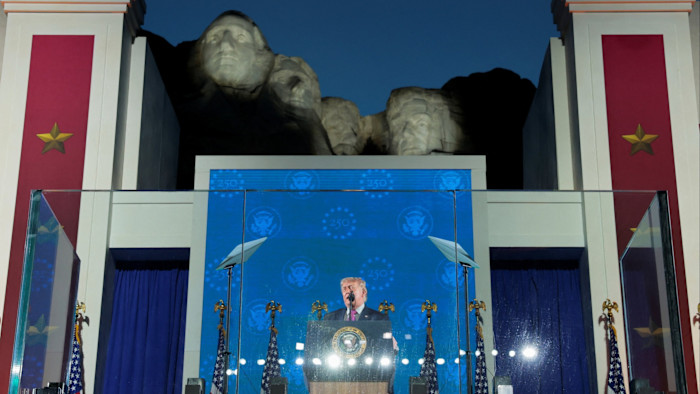
Donald Trump’s recent address at Mount Rushmore, delivered on the eve of America’s 250th anniversary of independence, resonated with a stark warning to the nation’s financial community: the “resurgence of the communist menace in our land.” This declaration, equating the perceived threat to historical crises like world wars and 9/11, is more than just political rhetoric; it signals a potential hardening of ideological lines with significant market implications, especially as Republicans seek to tie Democrats to the rise of Democratic Socialists ahead of crucial midterm elections.
For investors, such pronouncements introduce a layer of policy uncertainty that can impact valuations across sectors. The branding of a political opposition with terms like “communist” suggests a potential for radical policy shifts should the balance of power swing. Industries perceived as vulnerable to increased government intervention, such as healthcare, energy, and certain technology sectors, could face heightened scrutiny or even calls for nationalization if the political narrative gains traction and translates into legislative action. Conversely, sectors favored by a more capitalist-oriented, deregulatory agenda might see tailwinds.
Trump’s assertion that “America will never be a communist country and we can only lose the midterms if we allow ourselves to lose the midterms” underscores the high stakes of the upcoming electoral cycle. The outcome of these midterms will dictate the legislative landscape for the next two years, influencing everything from corporate tax rates and infrastructure spending to environmental regulations and trade policy. A divided government typically fosters gridlock, which can be seen by some investors as a form of stability, preventing drastic policy changes. However, a decisive shift in power could unleash a wave of new legislation, requiring companies to rapidly adapt their business models and investment strategies.
His superlative praise for American exceptionalism, describing the nation’s founding as the “best and most incredible thing ever to happen on this planet by human hands, ever,” while politically charged, also hints at a nationalistic economic policy. This could translate into continued protectionist trade measures, ‘America First’ industrial policies, and potentially increased tariffs, all of which have direct implications for global supply chains, multinational corporate earnings, and international trade relations. Businesses heavily reliant on globalized production or export markets must carefully monitor these geopolitical currents.
The backdrop to these political statements is a challenging economic environment. As energy prices have soared in the wake of the Iran war, pushing crude oil benchmarks higher and impacting refined product costs, and inflation has remained stubbornly high, consumer purchasing power has been significantly eroded. The latest Pew Research Center poll, revealing a gloomy outlook on the economy and the country’s trajectory, serves as a critical indicator for market participants. Declining consumer confidence typically translates into reduced discretionary spending, affecting retail sales, hospitality, and other consumer-facing sectors. Furthermore, persistent inflation often prompts central banks to maintain or even accelerate monetary tightening, which can raise borrowing costs for businesses and consumers, dampening investment and economic growth.
In stark contrast to Trump’s rhetoric, New York City mayor Zohran Mamdani’s speech celebrating immigrant contributions and righteous dissent highlights the deep ideological chasm within the country. While seemingly cultural, this polarization can lead to policy paralysis or even social unrest, both of which introduce risk premiums into asset prices. The perceived “hijacking” of national celebrations by a partisan group further exemplifies this division, suggesting that political battles are extending beyond policy debates into symbolic territory, potentially impacting national cohesion and investor sentiment regarding long-term stability.
Even localized events carried market implications. The cancellation of the Independence Day Parade due to an extreme heatwave in Washington D.C., along with the temporary closure and sparse attendance of the Great American State Fair, underscores the growing economic costs of climate-related events. Such extreme weather can disrupt local economies, impact tourism and retail, strain public services, and raise insurance costs. While seemingly minor, these incidents serve as micro-examples of broader climate risks that require greater attention from investors evaluating long-term sustainability and operational resilience.
Trump’s planned “really long speech” on the Mall, despite soaring temperatures, and the subsequent fireworks display, touted as the largest in history, also carry a nuanced financial undertone. The allocation of significant resources to such events, particularly when juxtaposed against warnings of declining air quality and calls for attendees to assess health risks, highlights a potential trade-off between public spectacle and public welfare. For investors, this can signal varying priorities in government spending and a potential disregard for environmental externalities, which could affect ESG (Environmental, Social, and Governance) considerations and related investment flows.
The broader context remains one of political volatility coinciding with economic headwinds. Trump’s continued influence, demonstrated by his ability to secure control of national celebrations and his ongoing self-branding efforts (e.g., TrumpRx, passports), suggests a political landscape where personality and populist messaging significantly shape policy discussions. This unpredictability can keep risk premiums elevated, particularly for assets sensitive to political shifts.
**Market Impact:**
The immediate market impact of Trump’s rhetoric and the broader political climate is likely to manifest as continued volatility, particularly in sectors sensitive to policy changes such as energy, healthcare, and technology. Investors should anticipate increased scrutiny of corporate exposure to potential regulatory shifts post-midterms, with defensive sectors potentially outperforming amidst economic uncertainty. The confluence of high inflation, elevated energy prices, and a gloomy consumer outlook points to persistent pressure on corporate earnings and a cautious stance from the Federal Reserve, potentially leading to further interest rate hikes. Geopolitical risks stemming from an assertive foreign policy stance will keep a premium on safe-haven assets. Furthermore, the deep political polarization may hinder effective governance, leading to policy stagnation on critical economic issues and potentially weighing on long-term investor confidence. Companies with strong balance sheets and diversified revenue streams will be better positioned to navigate this turbulent environment, while those heavily reliant on specific government policies or consumer discretionary spending may face significant headwinds.