
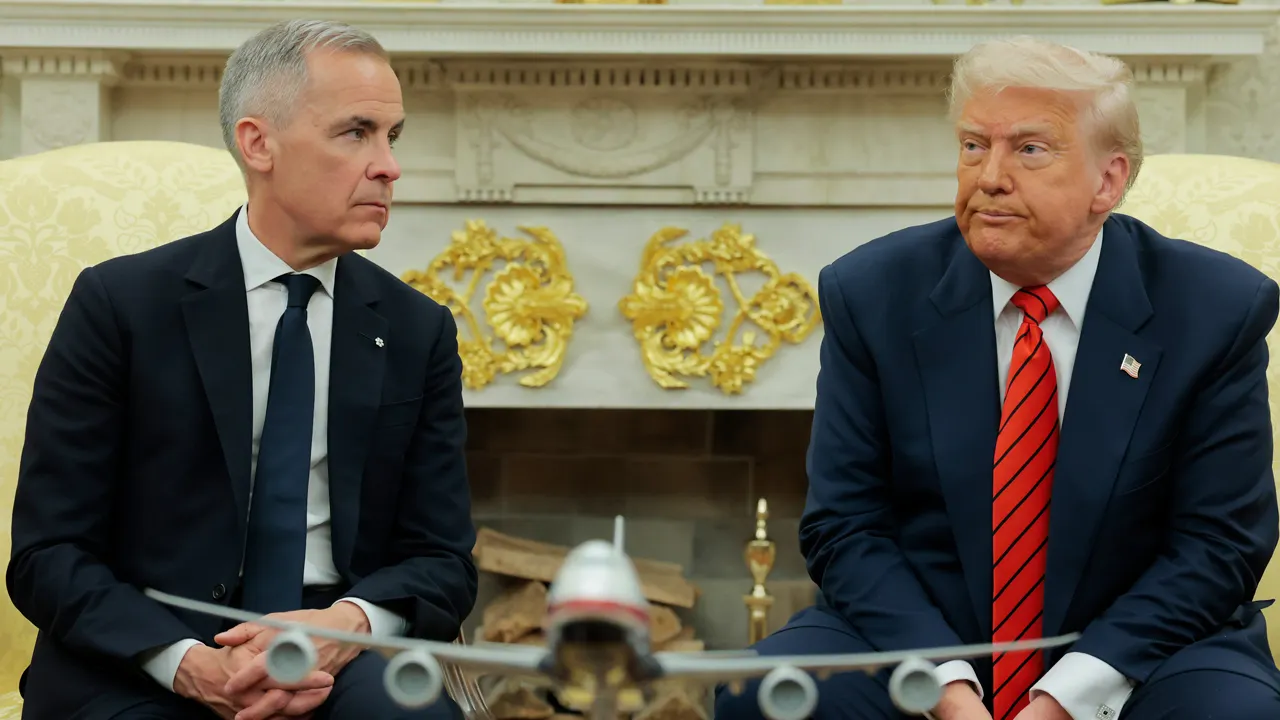
Canadian prime minister says U.S. sought to restrict Canada’s ability to strike trade deals with other countries.
**Key Takeaways for Investors:**
* **Heightened Market Volatility & Sectoral Shocks:** The collapse of US-Canada trade talks and implementation of reciprocal tariffs signal increased uncertainty, particularly for industries with deeply integrated supply chains like automotive, steel, and agriculture. Investors should anticipate localized profit margin pressures, potential stock price volatility, and re-evaluation of cross-border investment strategies.
* **Inflationary Pressures & Supply Chain Disruptions:** Tariffs act as a direct tax on imports, inevitably leading to higher input costs for businesses and elevated prices for consumers. This trade dispute risks disrupting established North American supply chains, potentially fueling inflation and creating operational headaches for companies reliant on seamless cross-border flow of goods.
* **Erosion of Trade Norms & Investment Uncertainty:** The US demand to restrict Canada’s independent trade agreements reflects a broader shift towards protectionism and economic nationalism. This challenges the established multilateral trading system, creating a less predictable global trade environment that could deter foreign direct investment and slow economic growth across North America.
President Donald Trump lashed out at Canada early Sunday in his first public comments since trade negotiations between the two countries collapsed, accusing Ottawa of wanting the “benefits of being a State, without being one.” This incendiary rhetoric, delivered via Truth Social, signals a significant escalation in the ongoing trade dispute between two of the world’s largest trading partners, sending ripples of concern through financial markets.
“Canada wants the benefits of being a State, without being one!!!” Trump wrote. “They have also charged our great farmers, for many years, massive amounts of Tariffs. No more!!!” Such strong language from the White House typically introduces a new layer of uncertainty for businesses and investors, as it suggests a hardening of positions with potentially far-reaching economic consequences. Trump’s reference to “massive amounts of Tariffs” on U.S. farmers, while lacking specific context in his statement, broadly highlights long-standing grievances related to Canada’s supply management system for dairy and poultry, a key sticking point in past trade negotiations.
The comments come a day after Canadian Prime Minister Mark Carney suspended negotiations with the U.S. and ordered Canada’s trade team back to Ottawa as Trump’s 50% tariffs on roughly $20 billion worth of Canadian imports took effect early Saturday. This immediate imposition of tariffs on Canadian goods, including steel, aluminum, and potentially other sectors, represents a direct cost increase for U.S. manufacturers and consumers. Companies in sectors like automotive, construction, and durable goods, which rely on Canadian raw materials or components, are now facing increased input costs that will either squeeze profit margins or be passed on to consumers, potentially fueling inflationary pressures.
**CANADA’S CARNEY SAYS US MADE LAST-MINUTE ‘POWER PLAY’ AS TRADE TALKS COLLAPSE; RETALIATORY TARIFFS IN PLACE**
For its part, Canada has vowed to retaliate. Carney said Friday that Ottawa plans to match the U.S. tariffs “dollar for dollar,” with the levies targeting multiple sectors, including steel, dairy, appliances, agricultural equipment, pulp and paper, and electronics. The duties are set to take effect the Tuesday after Labor Day, Sept. 8. This tit-for-tat tariff escalation is a textbook example of how trade disputes can spiral, creating a lose-lose scenario for both economies. Canadian tariffs on U.S. goods will hurt American exporters, particularly those in agricultural states and manufacturing hubs, potentially leading to job losses and reduced sales. For consumers, the price of everyday goods, from refrigerators to tractors, could climb on both sides of the border.
The prime minister on Saturday accused Washington of making a last-minute “power play,” saying the U.S. sought to restrict Canada’s ability to negotiate trade agreements with other countries. “It’s a power play,” Carney said. “It becomes a question of sovereignty.” This particular demand from the U.S. side introduces a significant geopolitical dimension to the trade dispute. For Canada, limiting its ability to strike deals with other nations (such as those in Asia or Europe) would severely constrain its economic diversification strategy and potentially make it overly reliant on the U.S. market. From an investment perspective, this perceived overreach can deter foreign direct investment into Canada, as companies may view the nation’s trade policy as being unduly influenced by a third party, thereby increasing political risk.
According to Carney, trade talks broke down after the U.S. introduced new demands involving Canada’s other trading relationships, its auto sector, and protections for Canadian culture and the French language. “In short, they asked too much, and they offered too little,” Carney said. The inclusion of the auto sector is particularly critical. The North American automotive industry operates on highly integrated supply chains, with parts and finished vehicles crossing the U.S.-Canada border multiple times before final assembly. Tariffs or trade barriers in this sector could cause significant disruptions, leading to higher production costs, potential factory slowdowns, and ultimately, more expensive cars for consumers. Estimates suggest that auto tariffs could lead to hundreds of thousands of job losses across the continent and billions in lost economic output.
The Trump administration has disputed Carney’s version of events, arguing that Canada walked away from terms the two countries had already agreed to. “Our interest is in protecting American workers and protecting American supply chains. We’ve been offering to bring the Canadians along on that path, really to cut the tariffs on them on steel, on autos, even lumber, things that are sensitive for them,” U.S. Trade Representative Jamieson Greer said Saturday on “Fox & Friends Weekend.” “And they’ve always had the best deal, and they still would have an even better deal, but they didn’t want that,” he continued. This narrative clash underscores the deep mistrust and divergent priorities currently characterizing US-Canada trade relations, creating a challenging environment for any future negotiations.
Greer said no additional trade negotiations with Canada have been scheduled. This lack of a clear path forward is perhaps the most unsettling aspect for financial markets. Prolonged uncertainty tends to dampen business investment, as companies delay expansion plans or reconsider supply chain logistics until there is more clarity on trade policy. The Canadian dollar (CAD) could come under pressure against the U.S. dollar (USD) as market participants factor in potential economic headwinds for Canada, while U.S. equities in exposed sectors might see downward revisions in earnings forecasts.
**TRUMP ALLOWS 300,000 METRIC TONS OF TARIFF-FREE BEEF IMPORTS IN BID TO CUT PRICES, DRAWING RANCHER BACKLASH**
The broader implications extend beyond specific tariffs. The dispute highlights a growing trend of protectionism that threatens the stability of the global trading system, which has underpinned decades of economic growth. Businesses that have invested heavily in cross-border operations and supply chains now face the daunting task of re-evaluating their strategies to mitigate tariff risks, which could involve costly reshoring or diversification of suppliers. Small and medium-sized enterprises (SMEs), often with thinner margins and less capacity to absorb tariffs, are particularly vulnerable to these disruptions.
**Market Impact:**
The escalating trade conflict between the U.S. and Canada introduces significant headwinds for North American financial markets. Investors should brace for increased volatility in equity markets, particularly for companies with substantial cross-border operations in the affected sectors like automotive (OEMs and parts suppliers), steel producers, agricultural exporters, and appliance manufacturers. Currency markets are likely to see sustained pressure on the Canadian dollar as economic uncertainty weighs on investor sentiment. Bond yields could react to shifting inflation expectations, as tariffs act as a direct cost to consumers and businesses. Furthermore, the absence of scheduled talks implies a prolonged period of uncertainty, which could deter foreign direct investment into both countries and temper overall economic growth forecasts. Companies must actively reassess their supply chain vulnerabilities and pricing strategies to navigate this complex and unpredictable trade landscape.
**GET FOX BUSINESS ON THE GO BY CLICKING HERE**
FOX Business’ Brittany Miller and Fox News Digital’s Madison Colombo contributed to this report.