
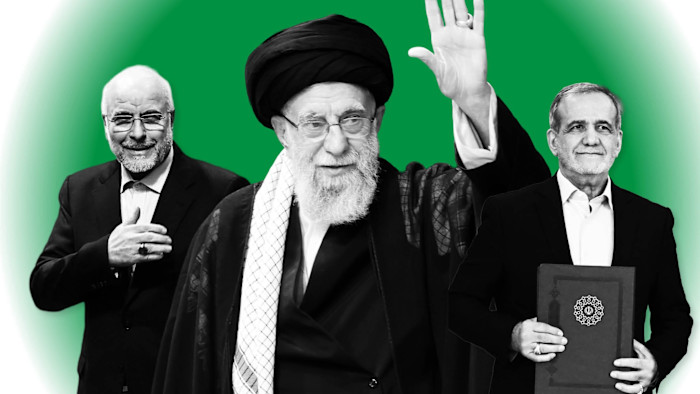
Through various challenges, from external incursions and domestic uprisings to assaults against its leadership, Iran’s religiously-governed system has endured for nearly five decades amidst innumerable predicaments and overseas interference.
Consistently, and often despite adversity, the Islamic Republic demonstrated its capacity to adjust amidst strain and employ merciless strategies when necessary — highlighting the resilience of an intricate governing framework intentionally constructed upon contending power bases.
The president, the clerical establishment, and the Revolutionary Guard all contend for authority beneath the leadership of the nation’s Paramount Leader, Ali Khamenei. This yields a system that compartmentalizes policymaking, yet decisively strengthens the Ayatollah’s supremacy.
What defines the paramount authority and what is the scope of his influence?
Khamenei, at 86, is in the concluding phase of his almost forty-year tenure. In 1989, he took over from Ayatollah Ruhollah Khomeini, the architect of the Islamic uprising, and has since transformed into a unique personality, possessing exceptional clerical power that reaches across the majority of governmental mechanisms.
He functions as the supreme commander of the armed forces, oversees the legal system, and designates the leaders of pivotal government entities, including the Guardian Council, a constitutional guardian controlled by conservatives that scrutinizes all aspirants for official posts.
His private bureau has frequently been alleged to function as Iran’s shadow government, orchestrating webs of religious scholars, entrepreneurs, and security personnel that have developed into an alternative authority — one commonly embroiled in claims of government-backed malfeasance.
This year, Khamenei has also confronted the most lethal and fierce demonstrations subsequent to the 1979 upheaval. Although the regime eventually suppressed the turmoil this month following a harsh repression that resulted in thousands of fatalities, it emphasized the intensity of popular resentment towards the clerical order and its rulers.
What has influenced Iran’s external strategy?
During his many years in authority, Khamenei has fostered an ideology of “calculated forbearance”. This merges opposition overseas with controlled disagreement domestically — all to guarantee the system’s persistence.
However, much of that effort has been severely damaged over the past two years since Hamas initiated the October 7 assaults on Israel, igniting a conflict across the region. Iran’s leader found himself with his army consultants and mentees slain, and his allied groups throughout the area considerably debilitated.
As a staunch traditionalist who has consistently resisted weakening the Islamic Republic’s doctrines, Khamenei has steadfastly defied demands for reform from within upper echelons of authority, analysts observed.
In effect, this has signified he has supervised a multi-year initiative, assisted by the Guard, to strengthen conservative dominance over governmental bodies.
Conservatives, originating from traditionalist religious groups and strongly associated with the Revolutionary Guard, champion strict doctrinal adherence and opposition to occidental impact. They have historically regarded progressive aspirations with distrust or complete animosity.
What became of the advocates for change?
Advocates for change have striven for gradual alteration in Iran, yet within constraints. They have aimed to ease societal limitations, tackle financial discontent, and at times have indicated willingness for diplomatic rapprochement with the West.
However, throughout the recent decade, the progressive impetus has significantly diminished. Advocates for change are permitted to engage in politics, but only to the extent that they do not jeopardize the fundamental concerns of the religious hierarchy or dispute the supremacy of the paramount leader and his traditionalist supporters.
President Masoud Pezeshkian, who became the nation’s initial progressive head of state in twenty years, embodies the temperate aspect of Iran’s political system.
As a cardiac physician and previous minister of public health, Pezeshkian’s unexpected victory was met with guarded hope — both among fatigued Iranian citizens and international commentators who perceived in him a potential resumption of negotiations.
However, he is fundamentally a government adherent who has explicitly stated his allegiance to Khamenei. Practically speaking, his presidency functions as a controlled compromise, a release outlet designed to calm agitation and not revolutionize the order.

Who are the rigid conservatives?
A quintessential example is Mohammad Bagher Ghalibaf, an ex-commander of the Revolutionary Guard and the present parliamentary speaker. Previously the mayor of Tehran, Ghalibaf represents the blend of martial rigor and administrative drive that characterizes Iran’s traditionalist upper class.
Though frequently perceived as an opponent to Pezeshkian, Ghalibaf’s genuine loyalty lies in safeguarding the Islamic Republic’s authority framework. He is a realist — prepared to collaborate with advocates for change when advantageous, but always for the purpose of ensuring governmental unity.
No other body more effectively demonstrates the system’s resilience than the Revolutionary Guard.
Formed following the 1979 revolution to safeguard it against domestic and foreign adversaries, the Guard has transformed into Iran’s preeminent body, commanding extensive segments of the economy — from construction to purported illicit trade to telecommunications. As well as supervising Iran’s atomic initiative, the Guard wields significant sway in external affairs through its specialized Quds contingent and the web of affiliated militant factions in Lebanon, Syria, Iraq, and Yemen.
Its command, chosen for devotion to Khamenei, contributes to guaranteeing the paramount leader’s power stays undisputed.

Could American military actions alter Iran’s power equilibrium?
Iran’s system was created for endurance rather than efficacy. Authority is intentionally decentralized: the president rules beneath the influence of the paramount leader; the legislature enacts laws
under the disapproval of the Guardian Council; the armed forces are subordinate to the Revolutionary Guard, which reports exclusively to Khamenei.
This intricate network of interconnected bodies guarantees that no individual, not even a progressive president, possesses the power to dismantle the existing order from within.
Even if American military actions impair defense facilities, they are improbable to lessen the Guard’s sway. Traditionally, this body has leveraged external dangers to fortify its position, thereby legitimizing suppressions and inciting patriotic zeal.
Some observers contend that military actions might inadvertently bolster the Guard’s function, possibly paving the path for the rise of a realistic authoritarian leader prepared to abandon the Islamist ideology for a modern Persian patriotism.
However, the Revolutionary Guard is not a unified entity, and this organization possesses an extensive past of internal rivalries. While these have been primarily suppressed during Khamenei’s tenure, any significant turmoil within Iran could expose those disputes publicly.

Regarding the dissenting factions?
The absence of a cohesive, trustworthy, and organized resistance, following decades of suppression and displacement, rendered Iranian demonstrators solitary. The displaced heir of the previous monarch, Reza Pahlavi, is once more presenting himself as the potential head of those advocating for a shift in governance.
Even with indications that his popularity might be increasing, this is in part due to the fact that distraught citizens of Iran perceive limited alternatives.
Khamenei’s administration has previously endured multiple economic penalties, targeted killings, and insurrections. Iran’s leaders, divergent in outlook but cohesive in their quest for perpetuation, have consistently adjusted by means of resilience.
Nevertheless, on this occasion, the armed offensive against the governance might compel arduous decisions, propelling the structure towards choices that could alter its trajectory.