
Access the White House Watch newsletter without cost
An overview of what Trump’s subsequent tenure signifies for Washington, commerce, and the globe
The United States has no plans to draw down crude from its national oil stockpile, indicating Washington anticipates any sharp increase in costs subsequent to its strike against Iran would be contained.
An Energy Department representative informed the Financial Times that there had been “absolutely no talks regarding the SPR,” when questioned about measures the Trump government had undertaken to avert a sharp rise in crude costs that might harm the economy and elevate consumer expenses.
Crude costs are anticipated to soar this Sunday once trading resumes at 6pm in New York, with merchants responding to worries the conflict might interrupt petroleum provisions across the Middle East. Brent, the global standard, concluded at $72.87 per barrel on Friday.
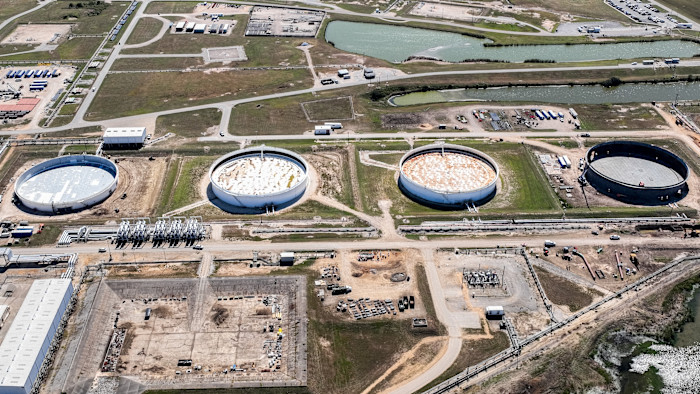
America’s emergency stockpile contains approximately 415 million barrels of crude, some of which might be utilized to stabilize markets, similar to what occurred in 2022 when Russia’s incursion into Ukraine inflated costs.
Although the Strategic Petroleum Reserve serves as a crucial instrument capable of helping stabilize global markets during an emergency, it might not avert a sudden price surge should Iran block the Strait of Hormuz — a constricted waterway through which one-fifth of global petroleum shipments transit.
State-affiliated Iranian news outlets on Saturday stated the passage had been “virtually” shut, subsequent to the nation’s premier Revolutionary Guards cautioning certain ships that traversing it posed hazards.
Even though ships have persisted in navigating the channel since hostilities commenced earlier today, tracking information from MarineTraffic indicates the movement of significant commercial vessels undertaking the voyage is diminishing, especially for vessels proceeding westwards into the Gulf.
Kevin Book, head of research at ClearView Energy Partners, a consulting firm based in Washington, stated: “America’s emergency oil reserve still possesses ample crude to release during a crisis, however, regarding national stockpiles, longevity is crucial. Magnitude is equally important. A complete Hormuz emergency might exceed the mitigating effects offered by strategic reserves in the United States and member nations of the International Energy Agency.”
Nations within Opec+, the collective of oil producers, might opt to substantially boost their production, seeking to stabilize the markets, according to analysts and individuals acquainted with the deliberations.
A gathering slated for Sunday was broadly anticipated to sanction a rise of 137,000 barrels daily for April, however, an individual allied with Opec+ indicated participants might authorize an increment of triple or quadruple that amount.
Book remarked: “We had already foreseen the eight Opec+ nations engaging in voluntary output reductions to reintroduce supply to the market at their planned convention tomorrow, and current conflicts might prompt a greater augmentation.”
Michael Alfaro, principal investment executive at the hedge fund Gallo Partners, specializing in energy and industrial sectors, further stated that, “I believe we will witness a sharp surge in petroleum costs, but it will not exceed $100, as Opec is poised to declare urgent supply augmentations.”
Washington established the national oil stockpile subsequent to the 1973-74 petroleum ban, when Arab Opec nations ceased provisions to Western states backing Israel amidst the Yom Kippur conflict. The ban led crude costs to nearly surge fourfold and propelled the worldwide economy into a downturn.
Further contributions from Chris Cook, Jamie John, Malcolm Moore and Verity Ratcliffe from London