
Key Takeaways
- Geopolitical Risk Premium Soars:The sudden collapse of the US-Iran ceasefire and subsequent retaliatory strikes have instantly reignited a significant geopolitical risk premium in global commodity markets, particularly for oil and gas.
- Strait of Hormuz Threat Amplified:Renewed military actions directly targeting infrastructure and vessels near the Strait of Hormuz, a critical global energy chokepoint, signal heightened threats to maritime navigation and global supply chain stability.
- Market Volatility and Uncertainty:President Trump’s bellicose rhetoric, coupled with the unpredictable nature of the conflict, is fostering extreme market volatility, with investors repricing assets amidst fears of broader regional destabilization and inflationary pressures.
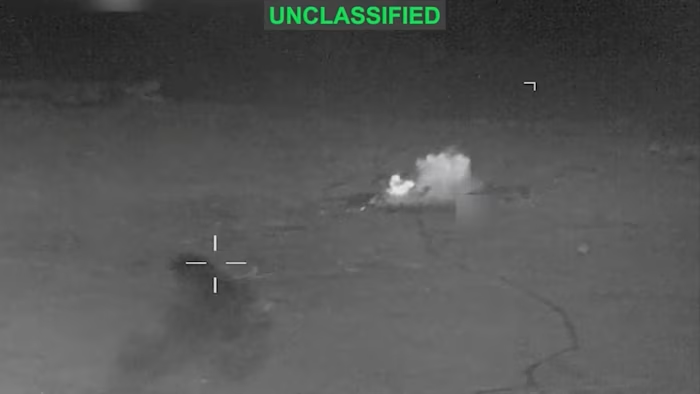
The global financial markets are bracing for a period of heightened volatility following the US military’s confirmation of a second day of strikes against Iran, a move that abruptly shatters a fragile ceasefire and sends a ripple of uncertainty through international trade and energy sectors. Hours after President Donald Trump declared the truce “over,” American forces escalated their offensive, targeting Iranian military assets to “further degrade their ability to threaten freedom of navigation in the Strait of Hormuz,” according to a statement from US Central Command (Centcom).
This latest round of strikes, which followed Tuesday night’s attack on more than 80 Iranian military targets in retaliation for alleged assaults on three commercial ships in the critical strait, immediately sent shockwaves through commodity markets. Trump’s fiery declaration on Truth Social, “This is in retribution for yesterday’s bombing of ships by Iran. If it happens again, it will get much worse!” underscored the severity of the situation, accompanied by a stark image of burning buildings.
The renewed clashes have not only fractured a ceasefire that had offered a brief respite and the promise of reopening the Strait of Hormuz to unimpeded oil shipments but have also sharply elevated global energy prices. The momentary stability that had seen a slight easing of the geopolitical risk premium has evaporated. Brent crude, the international benchmark, surged by 1.4 per cent to $79.09 a barrel as Asian markets opened on Thursday, having already breached the $80 mark on Wednesday—its highest level in over two weeks. This upward trajectory reflects immediate market fears of supply disruptions and the re-emergence of a substantial risk premium now baked into oil futures.
Adding to the market’s unease, President Trump’s statements from Air Force One, where he claimed Iran had “called a little while ago, they want to make a deal so badly,” were quickly tempered by skepticism. “I just don’t know if they are worthy of making a deal. I don’t know that they’re going to honour the deal. That’s the problem,” he remarked, en route from the Nato summit. This inconsistent messaging amplifies market uncertainty, as investors struggle to discern the likelihood of a diplomatic off-ramp or further escalation.
Earlier in Ankara, at the Nato summit, Trump’s rhetoric had been even more confrontational, labelling Iran’s leaders “scum” and “sick people” and vowing further strikes. His blunt assertion, “As far as I’m concerned, it’s over,” regarding the ceasefire, effectively closed the door on immediate de-escalation. While he also expressed doubt about a return to “full-blown war,” stating, “I don’t think it’s going to start again… I think anything that happens is going to be over very quickly,” the market interprets these statements through the lens of heightened risk, rather than reassurance.
The economic implications extend beyond merely the price of a barrel of oil. Trump revealed that Tuesday’s strikes targeted Iran’s Kharg Island, a pivotal export hub through which approximately 90 per cent of the country’s oil is shipped. His reiteration of a threat to “take over” this hub is a direct challenge to Iran’s economic lifeline and, by extension, a threat to a portion of global oil supply. Furthermore, US forces also struck numerous Iranian fast boats, underground missile facilities, and coastal defense, radar, and surveillance sites, all integral to Iran’s ability to control or disrupt maritime traffic.
In the early hours of Thursday, Iranian state media reported a flurry of air strikes along the southern coast, including the port city of Bushehr, home to a Russian-operated nuclear power plant—a target with potentially far-reaching geopolitical and environmental consequences. Attacks also reportedly damaged two docks and the maritime traffic control tower in Chabahar, disrupting vital port operations and cutting power to parts of the city, according to Tasnim, a semi-official news agency. Such attacks on critical infrastructure carry an implicit threat to global trade routes and the insurance markets that underwrite them, potentially leading to soaring premiums for vessels traversing the region.
Since the mid-June ceasefire, the Strait of Hormuz has been a flashpoint, with Iran accused of attacking five vessels, including tankers belonging to Saudi Arabia and Qatar. Given that roughly a fifth of the world’s oil and gas previously transited this narrow waterway, any sustained disruption poses a significant threat to global energy security and could trigger broader inflationary pressures across economies reliant on affordable energy. Vice-president JD Vance’s resolute statement, “The president has said to them . . . the Strait of Hormuz is going to be open. That means oil and gas is going to flow to the American people… If they shoot at ships, we’re going to knock the hell out of them,” signals a determined, non-negotiable stance that underpins the current military actions.
In a counter-narrative, Iran’s Revolutionary Guards claimed their forces retaliated on Wednesday with missile and drone strikes targeting 85 sites at US military facilities across the Middle East. This tit-for-tat escalation underscores the dangerous trajectory of the conflict, prompting investors to scrutinize regional stability and potential knock-on effects for other US allies and energy producers in the Gulf.
While many Nato leaders remained publicly circumspect at the summit, the alliance’s secretary-general Mark Rutte deemed the strikes “absolutely necessary” to penalize Iran for breaching the ceasefire, indicating a degree of international backing for the US position. Despite the underlying tensions, Trump concluded the Nato meeting declaring it “very successful,” praising the “tremendous love in that room.” Yet, his closing remarks left a narrow aperture for diplomacy, noting that his negotiating team, including Vance, special envoy Steve Witkoff, and son-in-law Jared Kushner, might still pursue talks, even as he expressed personal reservations about a deal. This precarious balance between bellicosity and a faint glimmer of negotiation will likely keep markets on edge, reacting sharply to every statement and military maneuver.
Market Impact
The re-escalation of US-Iran tensions is poised to significantly impact global financial markets. Energy prices, particularly Brent crude, will remain highly sensitive to further developments, with any perceived threat to the Strait of Hormuz driving substantial risk premiums. Higher oil prices translate directly into inflationary pressures globally, potentially compelling central banks to maintain tighter monetary policies for longer, impacting growth forecasts and equity valuations. Safe-haven assets like gold and US Treasury bonds are likely to see increased demand as investors flee risk. Equity markets, especially those exposed to consumer discretionary spending and manufacturing, could face headwinds from rising input costs and reduced consumer purchasing power. Conversely, defense contractors and energy producers might see short-term gains. Furthermore, shipping and logistics companies operating in the Middle East will contend with elevated insurance premiums and potential rerouting, disrupting supply chains and adding to global trade costs. The unpredictable nature of the conflict, fueled by high-stakes rhetoric, ensures that market volatility will persist, demanding constant monitoring from investors and policymakers alike.