
Unlock the White House Watch newsletter for free
Your guide to what Trump’s second term means for Washington, business and the world
**Key Takeaways:**
1. **Labor Market Volatility & Cost Pressures:** Escalating immigration enforcement is tightening labor markets, particularly in sectors like agriculture, construction, and hospitality, leading to potential labor shortages, wage inflation, and increased operational costs for businesses.
2. **Policy Instability & Business Risk:** President Trump’s direct interventions, overriding agency attempts to mitigate controversy, introduce significant policy unpredictability, hindering long-term business planning and elevating regulatory risk for employers.
3. **Fiscal Burden & Social Friction:** The rising costs of detention and enforcement, coupled with mounting public opposition and potential social unrest, contribute to fiscal strain and introduce a heightened political risk premium into the economic outlook ahead of critical midterm elections.
The escalating crackdown by US Immigration and Customs Enforcement (ICE) under President Donald Trump is not merely a social or political issue; it is rapidly morphing into a significant economic variable, injecting volatility into labor markets, imposing direct costs on businesses, and contributing to a palpable sense of policy uncertainty for investors. With a record 43,138 people — an average of nearly 1,400 a day — sent to ICE detention centres in June, and July on track to surpass 50,000 so-called “book-ins,” the scale of this enforcement surge carries profound implications across multiple sectors of the American economy.
This unprecedented surge directly impacts the supply side of the labor market. Industries like agriculture, construction, hospitality, and specific segments of manufacturing, which have historically relied on immigrant labor, are now facing increased operational risks. The removal of a significant portion of this workforce, even if undocumented, can lead to labor shortages, upward pressure on wages, and ultimately, higher input costs for businesses. This dynamic is particularly acute when considering that some 40 per cent of book-ins since October last year were neither convicted criminals nor facing pending charges, suggesting a broader dragnet that affects economically active individuals contributing to various industries. Companies, especially small and medium-sized enterprises (SMEs) with tighter margins, may struggle to adapt to these sudden disruptions, potentially impacting their profitability and solvency.
The surge has coincided with an uptick in aggressive and sometimes deadly tactics, with ICE agents killing two people in recent weeks. This not only generates mounting public outrage but also introduces considerable reputational and operational risk for companies. Businesses operating in areas affected by these sweeps may face disruptions, public relations challenges, and increased scrutiny regarding their hiring practices and supply chains. For investors, these incidents raise Environmental, Social, and Governance (ESG) concerns, particularly regarding human rights and ethical labor practices, potentially influencing investment decisions and corporate valuations.
“There’s only one solution to this problem for ICE,” said Juliette Kayyem, a former assistant secretary at the Department of Homeland Security (DHS). “And that is to stop playing the numbers game.” This “numbers game” directly translates into an economic externality, as the pursuit of quotas overrides considerations for economic stability or community impact.
Trump’s immigration surge reached a tipping point earlier this year, when federal immigration officers in Minnesota shot and killed two US citizens: Renée Good, a 37-year-old mother, and Alex Pretti, a 37-year-old intensive care nurse. Outrage at the killings, which were caught on video, quickly spread across the nation, and Kristi Noem, Trump’s controversial homeland security secretary who had spearheaded ICE’s heavy-handed tactics, was fired and replaced by Oklahoma senator Markwayne Mullin.
During his confirmation hearing in March, Mullin said his “goal in six months is that we’re not in the lead story every single day”. The agency shifted tactics, picking up immigrants in lower-profile settings, such as courts or at traffic stops instead of provoking protests by carrying out high-profile mass sweeps. While this might have momentarily reduced public visibility, it did little to alleviate the underlying labor market pressures or the uncertainty for businesses whose employees might be apprehended during routine activities, far from any border. Such policy gyrations – from aggressive sweeps to lower-profile tactics and back again – embody the kind of policy instability that financial markets dislike, hindering long-term business planning and increasing regulatory risk.
In one sense, Trump’s push to stop illegal immigration has been a victim of its own success. John Sandweg, a former acting director of ICE, said the agency was “completely overwhelmed by the border” in 2024, but since Trump took over, those numbers have dropped “next to zero”. Without this “low-hanging fruit”, the agency has turned away from border enforcement to rooting out undocumented immigrants and criminals to meet demands for higher numbers. This strategic pivot means chasing “higher-hanging fruit” within established communities, leading to more contentious encounters and increased operational costs for ICE itself.
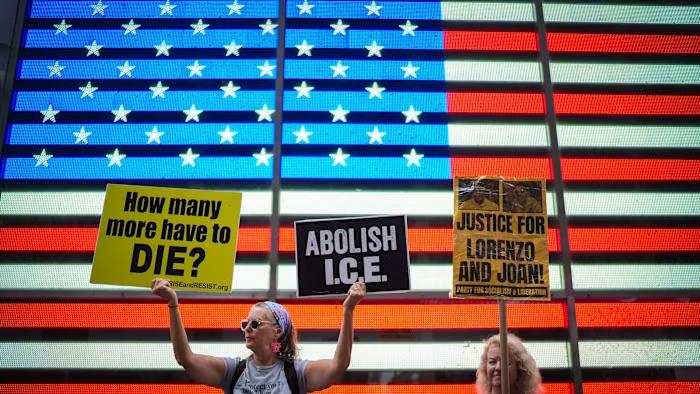
The two men recently killed by ICE agents — Lorenzo Salgado Araujo, a Mexican immigrant in Houston, and Joan Sebastian Durán Guerrero, a Colombian man killed in Maine — were fatally shot as the agents attempted to stop their vehicles. In the wake of those incidents, Mullin suspended the use of traffic stops to arrest immigrants. But Trump reversed his directive, saying that it would be “playing right into the criminals’ hands”.
“I.C.E., be judicious, fair and smart, and go back and do your very important job,” Trump said in a social media post last week. “Keep those Crime Stat Records coming!” This episode starkly underscores the profound level of political intervention and unpredictability. For businesses and investors, such governmental inconsistency typically translates into a higher risk premium, as the direct impact of political will on operational policies creates an environment of constant flux for labor, regulatory, and social factors. Companies cannot reliably forecast costs or risks when executive directives can override internal agency policies at a moment’s notice.

A recent FT poll shows Americans are sharply divided on Trump’s immigration agenda. Some 44 per cent of registered voters disapprove of the president’s handling of immigration, while a similar share approve. Attitudes towards the crackdown had become less negative in recent months as Mullin kept the agency out of the headlines and outrage over last winter’s killings faded. Back in March, some 62 per cent of registered voters disapproved of Trump’s handling of immigration but by June, before the latest shootings, the proportions who approved and disapproved were roughly even. The president’s standing on the issue remains one of his strongest with voters, even as his overall approval ratings have plummeted to new lows in recent months.
However, an Economist/YouGov poll this week found that the recent shootings by ICE may have increased support for abolishing the agency, with 58 per cent of Americans who had heard about the killings somewhat or strongly supporting the dismantling of the agency. This shift in public sentiment, if sustained, could translate into significant political pressure, potentially leading to legislative challenges or agency restructuring post-election, further adding to policy uncertainty.
Mullin now faces the challenge of returning to low-key enforcement to avoid more public outrage. The administration’s strategy ahead of the midterm elections in November is to stay out of the headlines while meeting deportation targets, said Gil Kerlikowske, a former CBP commissioner. “It’s not because they want to change. It’s not because they don’t want the numbers. It’s because they’re worried about the midterm elections,” he said. This candid assessment reveals that immigration policy, with its direct economic ramifications, is being driven by immediate political expediency rather than long-term economic strategy, a dangerous precedent for market stability.
_Data visualisation by Nolan Shaffer, Ian Hodgson and Michael Taffe_
**Market Impact:**
The ongoing ICE crackdown is generating discernible ripples across financial markets, creating a measurable “Trump immigration premium” in investor models. This premium reflects the heightened risk of labor market dislocations and operational challenges for businesses in labor-intensive sectors. Companies heavily reliant on immigrant labor, particularly those without robust contingency plans for workforce retention and replacement, may experience increased stock volatility and downward pressure on valuations. Conversely, private detention facility operators, often publicly traded, might see a short-term boost from increased demand for their services, though this comes with heightened ESG scrutiny and potential long-term reputational risks. The broader economic sentiment is likely to be dampened by the perception of increased social instability and policy unpredictability, potentially impacting consumer confidence, discretionary spending, and foreign direct investment. Furthermore, the substantial fiscal burden associated with increased enforcement, detention, and legal proceedings could strain federal budgets, adding to the national debt and potentially limiting funds for other economic initiatives. Investors are bracing for continued uncertainty, with the outcome of the midterm elections serving as a critical juncture that could either solidify or significantly alter the trajectory of these economically impactful immigration policies.