

Previous American Secretary of Trade, Wilbur Ross, participates in Making Money to delve into the High Court’s decision concerning Trump’s levies and what they entail.
FedExdeclared on Thursday its intention to reimburse any tariff repayments it might obtain to its clientele who bore those charges, while simultaneously pursuing recompense from the national administration for duties previously settled but later deemed unlawful.
The colossal logistics firm conveyed in an announcement its aim to give back any duty repayments to the consignors and patrons who covered the expense of these levies. This action comes after the High Court’s decision last week, where a vital component of President Donald Trump’scommercial policy—namely, his import taxes levied under the International Emergency Economic Powers Act (IEEPA)—was invalidated as unlawful.
“Our primary focus continues to be aiding our clients as they adjust to recent policy alterations, and we’ve initiated a formal measure to safeguard our claim to reimbursements for IEEPA duties for both our customers and FedEx itself,” the corporation stated.
“Our objective is clear: should reimbursements be granted to FedEx, we will, in turn, provide them to the consignors and purchasers who initially incurred those expenses. The timing of this, along with the precise method for soliciting and distributing these repayments, will partially hinge on forthcoming directives from the authorities and the judiciary,” FedEx’s declaration further elaborated.
FEDEX SUES TRUMP ADMINISTRATION FOR FULL TARIFF REFUNDS AFTER SUPREME COURT RULING ON IEEPA
FedEx communicated its plan to reimburse any duty repayments it obtains to the cargo forwarders and clientele who bore those costs.(Kevin Carter)
“Our commitment to openness is firm, and we will plainly disclose information as more guidance emerges from the American administration and the judiciary,” FedEx further stated, simultaneously guiding clients to a devoted web page about tariffson the firm’s platform, which will feature the most current updates on this matter.
The High Courtinvalidated the IEEPA duties, having determined that the legislation referenced by Trump for enacting the import taxes did not empower the chief executive to levy such duties, thereby rendering the charges unconstitutional.
This decision did not impact duties imposed by the Trump government under distinct legal frameworks. The Presidential Residence has indicated its intention to introduce alternative levies to compensate for the IEEPA duty income, and Scott Bessent, the Secretary of the Treasury, announced last month that the Treasury Ministry possessed the requisite capital for possible duty reimbursements—though he cautioned that this could be a lengthy undertaking.
WILL REFUNDS BE ISSUED AFTER SUPREME COURT RULING ON TRUMP TARIFFS?
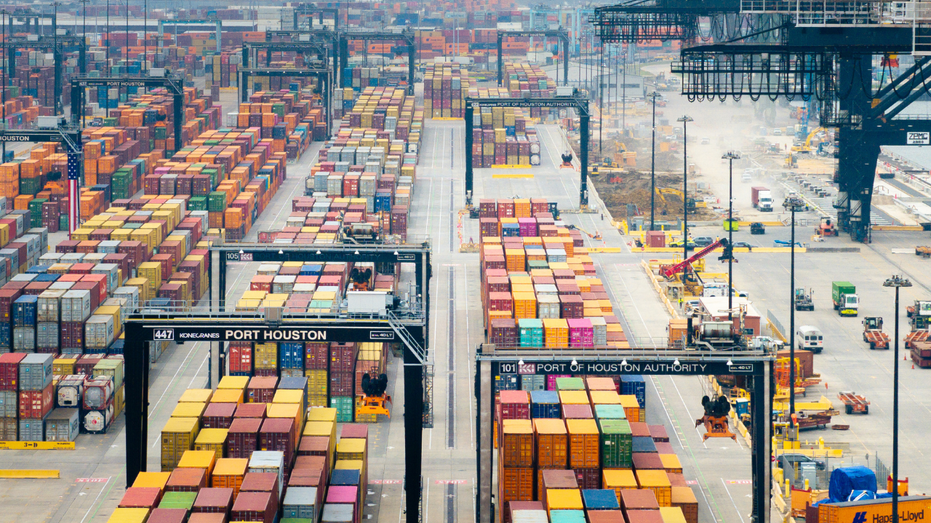
Duties represent levies on inbound merchandise borne by the importing entity, which commonly transfers these elevated expenditures to shoppers via increased rates.(Brandon Bell/Getty Images)
During the period the IEEPA duties were enforced, the national administration amassed over $150 billion utilizing those powers prior to their invalidation—an income stream that might now be eligible forduty repayments, as per various projections.
The impartial Tax Foundation estimated the sum to be approximately $150 billion in gathered IEEPA duties, whereas the impartial Penn-Wharton Budget Model projected $175 billion, and a review conducted by JPMorgan indicated a spectrum from $150 billion to $200 billion.
| Ticker | Security | Last | Change | Change % |
|---|---|---|---|---|
| FDX | FEDEX CORP. | 387.68 | +5.09 | +1.33% |
As the matter has been referred back to subordinate tribunals subsequent to the High Court’s decision to invalidate the IEEPA duties, there is a possibility that the judiciary and the administration could finalize an accord regarding a mechanism for offering repayments to those who paid the duties.
Nonetheless, existing channels permit the pursuit of duty repayments by initiating legal action in the U.S. International Trade Tribunal, a course of action already undertaken by FedEx and over 1,000 other corporations, or by submitting appeals to U.S. Customs and Border Security—the agency responsible for gathering duties for the Department of Homeland Security and forwarding them to the Treasury Ministry.
HOW SHOULD BUSINESSES APPROACH TARIFF REFUNDS?

President Trump’s IEEPA duties were invalidated as unconstitutional by the High Court.(Chip Somodevilla/Getty Images)
A contemporary examination from the Federal Reserve Bank of New Yorkrevealed that American enterprises and shoppers carried 86% of the duty load, whereas international exporters assumed 14% as of November 2025.
Investigators at the New York Fed observed that the portion shouldered by American firms and consumersdecreased during the year, moving from 94% in the January-August timeframe to 92% in September and October.
GET FOX BUSINESS ON THE GO BY CLICKING HERE
These discoveries align with insights presented in a separate assessment by the impartial Congressional Budget Office (CBO), which, in its decade-long fiscal and economic projection, highlighted that overseas exporters were shouldering approximately 5% of the duty expenses, while the residual 95% impacted American enterprises and shoppers.