
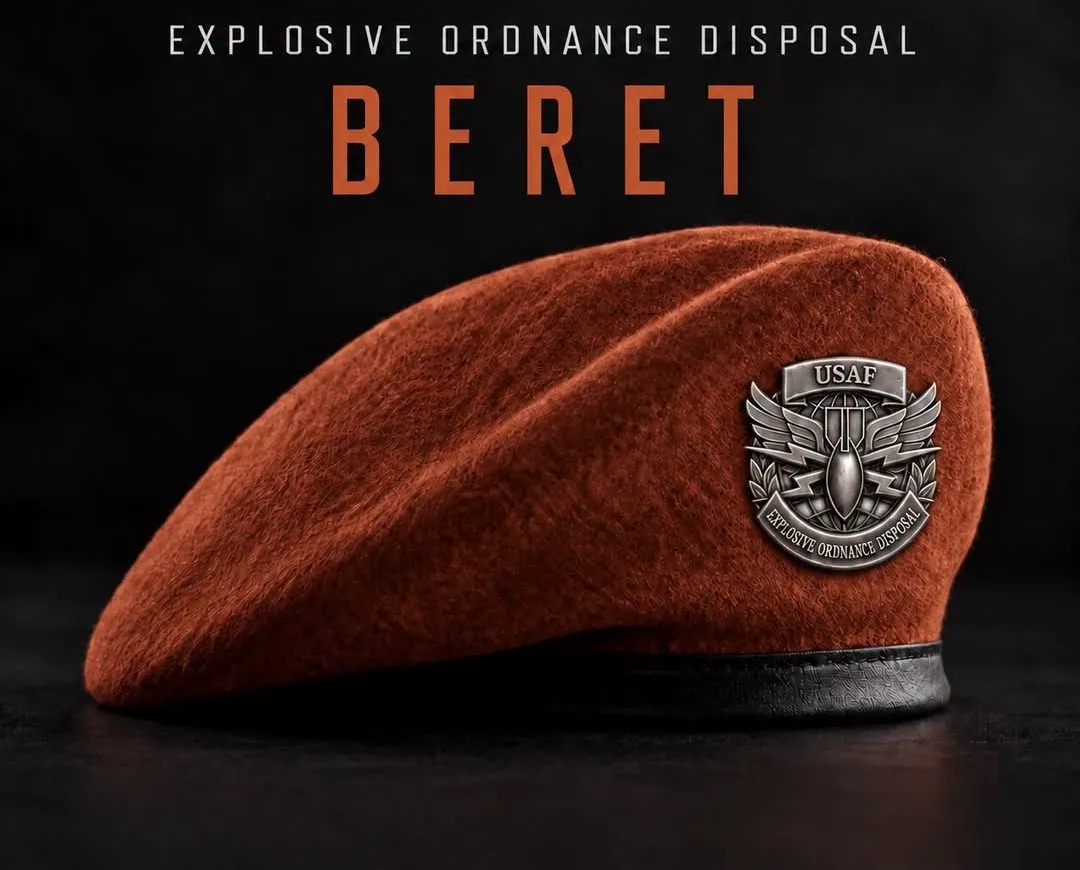
The United States Air Force has announced that its Explosive Ordnance Disposal (EOD) technicians and officers will soon be authorized to wear a distinctive rust-colored beret, a recognition that places them among a select group of military personnel permitted to wear this specialized headwear.
The announcement was made on October 2, via a virtual message from Chief Master Sergeant of the Air Force David R. Wolfe. He addressed the inaugural graduating class of EOD technicians from a newly redesigned training program, Project MAMBA (Multi-domain Airmen for Modern Battlefield Application), at Tyndall Air Force Base in Florida. Graduates of this program will be the first to earn the new beret, which will feature a unique EOD flash insignia.
This honor culminates a decades-long advocacy effort within the Air Force’s EOD community. According to a USAF release, the beret acknowledges their “specialized combat arms mission and contributions to the joint force.” Chief Master Sergeant Wolfe emphasized the significance of this recognition, stating, “As you prepare to deploy and take on one of the Air Force’s most demanding missions, carry forward the pride and combat identity you have earned. The EOD beret will stand as a visible recognition of that identity and your service to the joint force.”
The news has been met with enthusiasm across the close-knit community of current and former EOD technicians. Master Sgt. Rebecca Anderson, serving with the 775th Civil Engineer Squadron at Hill Air Force Base, Utah, expressed her excitement to Air & Space Forces Magazine. “I am ecstatic that Air Force EOD is getting a beret,” Anderson said. “The beret signifies a career field that has high levels of training and faces extreme hazards. EOD has exemplified this since its inception.”
For many within the EOD community, the beret carries a profound significance, serving as a tribute to those who have made the ultimate sacrifice. During the Global War on Terror, a total of 344 EOD technicians across all military services died in the line of duty, with 20 of those casualties being Air Force personnel. Master Sgt. Anderson underscored this sentiment, remarking, “I am humbled by the honor to wear a beret, and I will do so with pride knowing it helps carry on their legacy.”
The new beret will be mandatory garrison headwear for active enlisted personnel holding the specialty code 3E8XX and officers with the code 32E3H. EOD-qualified officers serving in positions outside of direct EOD roles will have the option to wear the beret. Detailed guidance on wear, transition, and procurement will be disseminated through official Air Force channels, as confirmed by a senior EOD program manager to Air & Space Forces Magazine.
Retired Master Sgt. Micah Price, who presides over the USAF EOD Master Blaster nonprofit, founded in 1992, echoed the sentiments of current EOD members. Price highlighted the inherent dangers and rigorous demands of the EOD mission, stating, “It’s a dangerous mission. It’s demanding. It’s that deserved symbol of pride and recognition for what all of our guys and gals have been doing.”
Symbolism of the Beret
The chosen rust color for the beret is historically associated with explosive hazards, a visual cue to the inherent risks involved in EOD work. The metallic flash, designed to be worn on the beret, is rich with symbolism. It features spread wings, a leaf circle, the globe, two crossed lightning bolts, and a bomb. This composite design represents the EOD community’s “global mission, technical expertise, and legacy of sacrifice,” according to the official release.
The wings incorporated into the flash serve as a tribute to General Henry “Hap” Arnold, the sole five-star General of the Air Force and widely regarded as the architect of the modern Air Force. The two crossed lightning bolts symbolize the destructive power of explosive ordnance, while simultaneously representing the courage and professionalism that EOD Airmen demonstrate in mitigating these hazards. The wreath encircling the flash signifies the EOD community’s achievements, ingenuity, and unwavering devotion in the challenging task of neutralizing explosive threats, and critically, it memorializes fallen EOD personnel.
With the introduction of this distinctive beret, the EOD technician’s uniform now aligns more explicitly with its designation as a “specialized conventional combat arms career field.” This is intended to visually reinforce the community’s critical role in delivering combat capability at the tactical edge of operations. The design itself was a collaborative effort, developed with input from members of the EOD community, supported by Headquarters Air Force’s directorate of civil engineers, and other stakeholders responsible for uniform policy.
Chief Master Sgt. Steven Harris, the EOD career field manager, articulated in the release that the beret “recognizes [EOD Airmen’s] combat-arms identity, honors the community they represent and reflects the capability they will continue to deliver wherever the mission demands.” The decision also stems from a broader Department of Defense Combat Arms Standards directive, which advocated for enhanced distinction for combat-arms occupations and specifically identified EOD technicians as a specialized occupation with unique mission requirements. As the program manager noted, “The beret is a visible recognition of that operational identity, the standards expected of the EOD community, and the heritage of Airmen who have carried out this mission across generations.”
Historical Context of Military Berets
Berets are a relatively rare sight within the U.S. military services, historically reserved for elite units. While the U.S. Army briefly authorized the black beret for all soldiers in the early 2000s, its use has predominantly been limited to select special operations forces. The U.S. Army Special Forces Soldiers, famously known as the Green Berets, were among the first modern U.S. military members to receive official authorization to wear a beret as a distinguished part of their uniform.
Approximately 2,144 personnel across the Air Force are eligible to wear the new rust-colored beret, comprising 1,984 EOD technicians and 160 EOD-qualified officers, according to figures provided by the program manager. The EOD community now joins six other groups of Airmen authorized to wear specific colored berets:
- Dark Blue:Security Forces
- Maroon:Pararescue and Combat Rescue Officers
- Scarlet:Combat Control and Special Tactics Officers
- Black:Tactical Air Control Party
- Pewter Gray:Special Reconnaissance and Weather Parachutists
- Pewter Green (Sage):Survival, Evasion, Resistance, and Escape Specialists
(Source: DAFI 36-2903)
Retired Master Sgt. Price, 45, recalled the distinct impression made by these specialized berets when he was a junior Airman. “The beret is one of those things when you see it, it stands out,” Price remarked. “You know that person put forth some effort.” Although Price and many of his EOD veteran peers served before this authorization, he views the beret as a profound symbol of the community’s enduring legacy. He is considering acquiring one to display alongside his other service mementos.
Price maintains contact with active-duty Airmen and mentors newer EOD technicians, noting the palpable excitement within the community following the announcement. “They’re super excited. I told them, you wear it with pride because that’s on the backs of a lot of guys and gals that made a lot of sacrifices,” Price conveyed.
Why This Matters
The authorization of a distinct beret for Air Force Explosive Ordnance Disposal (EOD) personnel carries significant implications for military culture, inter-service recognition, and public understanding of specialized roles within the armed forces. Primarily, it represents a formal and visible acknowledgement of the extreme hazards, extensive training, and critical contributions of EOD technicians. This recognition is not merely symbolic; it enhances the professional identity and morale of a community whose work is inherently dangerous and often conducted under immense pressure, involving the defusing of bombs and other explosive devices that threaten both military personnel and civilian populations.
Historically, specialized headwear like the beret has been reserved for elite combat arms units, signifying a unique level of skill, rigorous training, and readiness for high-risk missions. By granting EOD personnel their own beret, the Air Force aligns them more closely with other special operations and combat control units, reinforcing their status as a specialized combat arms career field. This distinction can foster a stronger sense of camaraderie and pride within the EOD community and serve as a powerful recruiting tool for individuals seeking a challenging and impactful military career.
Furthermore, this move reflects a broader Department of Defense directive to provide greater distinction for combat arms occupations. In an era where military operations are increasingly complex and require highly specialized skills, recognizing specific groups with unique identifiers helps to clarify roles and celebrate the diverse capabilities within the joint force. It also helps the public understand the nuanced differences between various military professions and the specific sacrifices associated with each.
For the families of the 344 EOD technicians who perished during the Global War on Terror, including the 20 from the Air Force, the beret serves as a tangible and enduring memorial. It ensures that their sacrifices are not forgotten and that the legacy of courage and dedication lives on through those who continue to wear the distinctive headwear. This recognition can provide a measure of solace and pride to those who have lost loved ones in service.
In essence, the EOD beret is more than just a piece of uniform; it is a powerful symbol of identity, remembrance, and the unwavering commitment required to execute one of the military’s most perilous missions. It underscores the Air Force’s dedication to honoring its most specialized and combat-ready personnel, ensuring their contributions are visibly acknowledged and their legacy is preserved.