
Audio of this article is brought to you by the Air & Space Forces Association, honoring and supporting our Airmen, Guardians, and their families. Find out more at afa.org
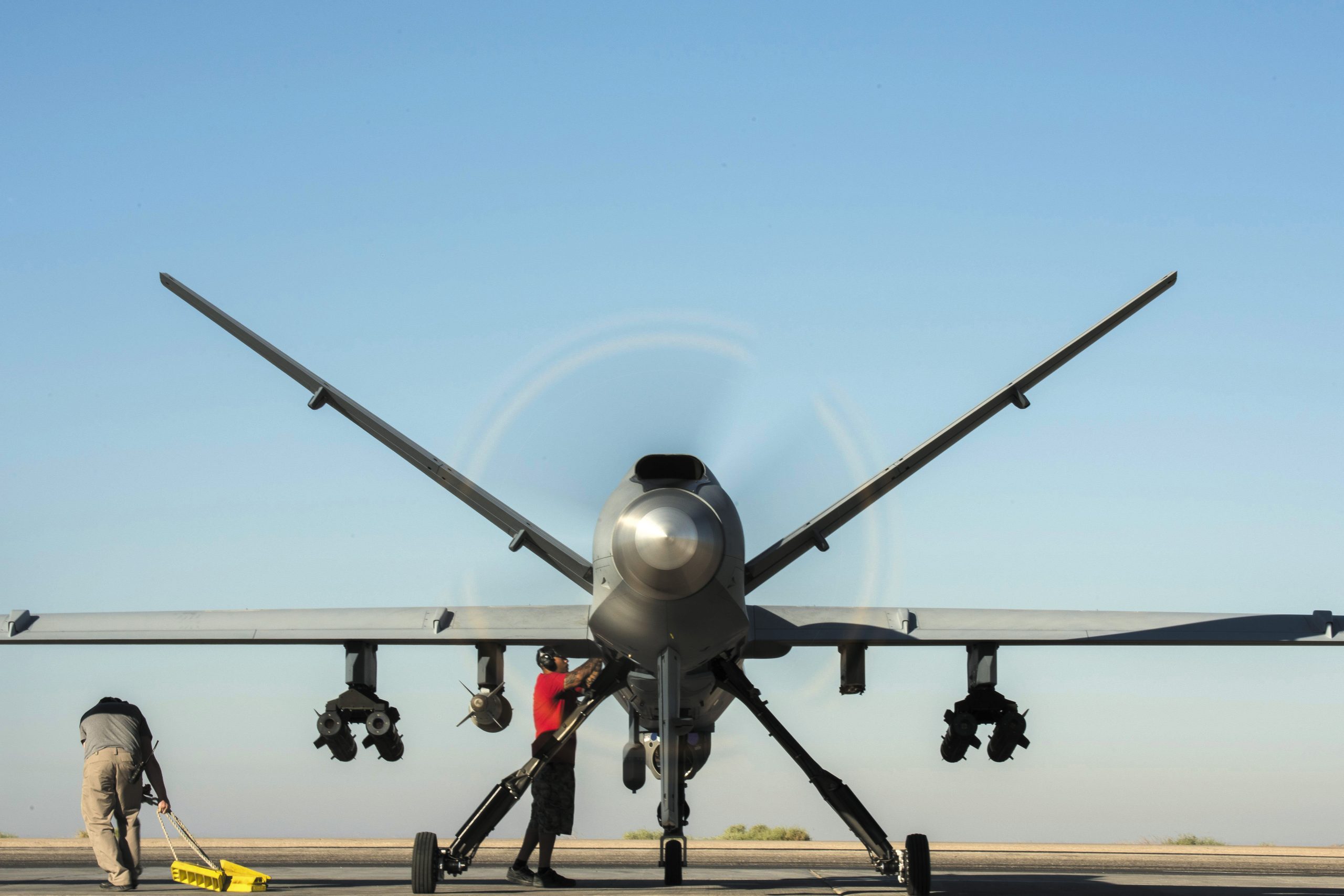
The U.S. Air Force, in collaboration with General Atomics Aeronautical Systems, has successfully conducted flight tests involving the firing of laser-guided Advanced Precision Kill Weapon System (APKWS) rockets from an MQ-9A Reaper remotely piloted aircraft. This integration marks a significant step in enhancing the drone’s defensive and offensive capabilities against emerging aerial threats.
The series of flight tests recently took place at the Nevada Test and Training Range. According to a May 11 statement from General Atomics, the tests encompassed multiple types of engagements, all of which were successful. Notably, some test fires accurately struck aerial targets, demonstrating the weapon system’s precision and effectiveness in an air-to-air role when launched from the MQ-9A platform. These successful trials pave the way for potential operational deployment of APKWS on Reaper drones.
The APKWS is a sophisticated, low-cost, semi-active laser-guidance system developed by BAE Systems. It is designed to convert unguided 2.75-inch (70mm) aerial rockets, such as the widely used Hydra 70, into precision-guided munitions. Originally conceived for conducting precise strikes against targets like light vehicles—including those in motion—or personnel, its primary advantage lies in minimizing collateral damage compared to larger, more destructive munitions.
In recent years, the APKWS has evolved to become a critical air-to-air weapon for the U.S. Air Force, particularly in the Middle East. It is frequently employed against Iranian drones and other unmanned aerial systems. F-16 Fighting Falcons and F-15 Strike Eagles operating in the region commonly carry APKWS rockets for air-to-air engagements during combat missions. Additionally, A-10 Thunderbolt II attack aircraft utilize these rockets. U.S. aircraft patrolling skies in areas of conflict, especially those involving Iran or its proxies, have been observed carrying APKWS rockets, underscoring their strategic importance.
The U.S. Air Force first employed the AGR-20 APKWS in June 2016, firing it from an F-16. Prior to its Air Force adoption, the system was already in use by the U.S. Army, Navy, and Marine Corps, demonstrating its versatility across different branches of the military. The APKWS rocket boasts an effective range of up to nearly seven miles and can be equipped with various warheads, including explosive, white phosphorus, or illuminating rounds, depending on mission requirements. Beyond fighter jets, platforms such as A-29s, OV-10s, and various attack helicopters have successfully integrated and utilized APKWS rockets. The system’s air-to-air capabilities were first tested in 2019, and it has been actively used in combat against drones since 2024, highlighting its adaptation to modern battlefield threats.
The cost-effectiveness of APKWS rockets is a significant factor in their increased deployment, especially in countering the proliferation of unmanned aerial systems. Officials estimate that each rocket costs less than $40,000. This price point makes them a far more economical tool for engaging swarms of dozens or even hundreds of drones compared to more expensive air-to-air missiles, such as the AIM-120 AMRAAM or AIM-9 Sidewinder, which can cost hundreds of thousands of dollars per unit. This economic advantage is particularly crucial in current conflicts, where APKWS rockets are being used by U.S. forces to shoot down Houthi drones attacking ships in the Red Sea and other Iranian-supplied drones in various operational theaters.
General Atomics Aeronautical Systems emphasized the strategic value of integrating APKWS onto the MQ-9A Reaper drone. The company stated that this combination could provide a highly effective method for intercepting and neutralizing small, explosive drones, which represent a growing and asymmetric threat in modern warfare. The MQ-9A Reaper is a highly capable and persistent platform, known for its intelligence, surveillance, reconnaissance (ISR), and strike capabilities. Equipping it with APKWS further enhances its utility as a multi-role asset.
“We recognize the value that a system like APKWS brings to the MQ-9 aircraft as a tool to counter one-way attack drones,” stated David Alexander, President of General Atomics Aeronautical. “APKWS can increase the number of weapons the MQ-9A is able to carry, as well as being able to carry new lower-cost weapons.” This statement underscores the dual advantage of increased magazine depth and reduced expenditure per engagement, critical factors in sustained operations against drone threats.
Pentagon Editor Chris Gordon contributed reporting.
Why This Matters
The successful integration of the Advanced Precision Kill Weapon System (APKWS) on the MQ-9A Reaper drone represents a significant development with wide-ranging implications for modern warfare and defense strategy:
- Enhanced Counter-Drone Capabilities:The proliferation of inexpensive, one-way attack drones (OWADs) and other small unmanned aerial systems (UAS) poses a growing threat to military assets and civilian infrastructure. By equipping the MQ-9A Reaper, a versatile and persistent platform, with a cost-effective weapon like APKWS, the U.S. military gains a crucial tool to counter these threats efficiently. This directly addresses the asymmetrical warfare challenges posed by non-state actors and rival nations, reducing reliance on more expensive interceptors.
- Cost-Effective Defense:Traditional air-to-air missiles like the AIM-120 AMRAAM or AIM-9 Sidewinder are highly capable but also very expensive. Using such missiles to shoot down relatively inexpensive drones is often not economically sustainable in high-volume engagements. APKWS, at a fraction of the cost, provides a financially viable solution for countering drone swarms. This allows the U.S. Air Force to maintain a sustainable inventory of munitions for frequent engagements, ensuring resources are optimized for the threat landscape.
- Increased Operational Flexibility for the MQ-9A Reaper:The MQ-9A Reaper is primarily known for its intelligence, surveillance, reconnaissance (ISR), and ground-attack capabilities. The addition of air-to-air APKWS expands its operational roles significantly. It can now effectively engage smaller, agile aerial targets while still performing its traditional missions. This enhances the Reaper’s versatility, allowing it to contribute to both defensive air-to-air missions and its established ground-attack roles, or to specialize in counter-UAS operations, potentially reducing the need for dedicated fighter aircraft in certain scenarios.
- Reduced Collateral Damage and Precision:APKWS rockets are designed for precision strikes with smaller warheads, minimizing the risk of collateral damage. This capability is vital in complex operational environments, particularly where civilian populations are present. By deploying these rockets from a drone, operators gain advantages in target identification and engagement, ensuring greater accuracy and adherence to rules of engagement, which is paramount in maintaining ethical warfare standards.
- Strategic Impact on Future Aerial Warfare:This development underscores a broader trend in military aviation: adapting existing platforms and weapon systems to address new and emerging threats. The successful integration of APKWS on the Reaper demonstrates a strategic shift towards more modular and adaptable weapon systems that can be rapidly integrated across various platforms. It highlights the importance of innovative, cost-effective solutions in an era where adversaries are increasingly leveraging accessible, mass-produced technologies to challenge established military dominance. This move prepares the U.S. and its allies for the evolving nature of air combat, where drone warfare is becoming an increasingly central component.
Audio of this article is brought to you by the Air & Space Forces Association, honoring and supporting our Airmen, Guardians, and their families. Find out more at afa.org