
The auditory content of this piece is presented to you by the Air & Space Forces Association, revering and assisting our Airmen, Guardians, and their households. Discover further details at afa.org
JOINT BASE SAN ANTONIO-RANDOLPH, Texas—The wider populace accesses ChatGPT, which is gaining immense popularity rapidly. The Air Force aims to provide trainee aviators with “IP GPT,” an AI instrument crafted to aid their acquisition of foundational flight knowledge.
The 19th Air Force‘s Flying Training Center of Excellence is engineering an AI-powered conversational agent, educated through aeronautical literature and handbooks, designed to emulate a digital flight mentor, enabling both learners—and educators—to swiftly retrieve procedural guidelines and evaluate proficiencies. IP GPT represents an initial stride in harnessing artificial intelligence for the instruction of Air Force aviators.
Should it prove effective, IP GPT will possess the capability to mentor learners in simulators, thereby liberating hours and instructional bandwidth for human flight instructors.
In contrast to expansive language model conversational agents such as Open AI’s ChatGPT, Google’s Gemini, and Anthropic’s Claude, which are educated utilizing vast quantities of information, 19th Air Force is instructing IP GPT solely with aviation-centric publications, Air Force instructions and standard operating procedures, Federal Aviation Administration and International Civil Aviation Organization directives, and flight information publications. This collection of data, while more constrained than those utilized for constructing generalized models, still encompasses hundreds of records amounting to thousands, perhaps tens of thousands of pages—sufficient, experts contend, to generate a dependable model.
Possessing an instrument capable of swiftly providing reasoned replies derived from that knowledge base would greatly benefit instruction, stated Lt. Col. Seth Hoffman, who leads the Center’s Detachment 24. “I do not desire it to draw insights from the entirety of the internet,” Hoffman articulated. “My aim is for the entire spectrum of what an aviator might engage with to reside within this data pool, and nothing beyond that. I wish for it not to be perplexed or obscured by all other external information.”
Col. Brian Muto, who directs the Flying Training Center of Excellence, expressed that offering such an apparatus is both rational and crucial to satisfy the anticipations of upcoming learners.
“Should the learners habitually utilize large language models on their mobile devices, they will naturally anticipate its presence when they reach 20 years of age and join us to operate the T-7, correct?” he conveyed to Air & Space Forces Magazine during a recent visit the previous month. . “Consequently, we must advance to that point with comparable swiftness.”
Muto and Hoffman are entirely convinced of IP GPT’s technical viability. Indeed, Hoffman stated that progress in artificial intelligence and expansive language models indicates that a system might be operational within half a year. However, the development of this instrument and its deployment are distinct matters, and considerable regulatory obstacles require surmounting prior to its implementation.
“There are numerous individuals within the cybersecurity domain who express reservations, saying, ‘Eh, I’m not so sure about that,’” Hoffman conceded.
The primary aim is an instrument learners and educators can utilize. “Whenever its assistance is required, be it on the ground at zero airspeed in readiness for an operational flight or following a flight, and I am examining my actions and considering improvements, I desire to simply activate that assistant, and together we will review all aspects,” Hoffman stated. “Formulate a response for me that will facilitate my enhancement, whether that involves excelling more as a learner, guiding more effectively as an educator, or similar.”
Upon the removal of regulatory obstacles and IP GPT’s programming has undergone scrutiny and is prepared, Hoffman and Muto foresee an even broader scope for AI within aviation instruction. Their concept encompasses the creation of a “data analysis mechanism” capable of scrutinizing flight information from a simulation device or aircraft and evaluating learners’ proficiencies.
“My aspiration is to enter the simulator and execute a loop, and I desire [the system] to discern that my entry was at 500 knots with a 4G maneuver … at the apex, and I wish for it to contrast this with the official publication,” Hoffman stated.
Likewise, Muto contemplates an AI instrument designed to assist flight instructors in formulating instructional situations and evaluating proficiencies. “As an instructor pilot, I dedicate a substantial portion of my time to preparing for an operational flight, confirming I comprehend the learner’s requirements, and possessing a strategy to proceed and instruct that individual, and subsequently, during the post-flight discussion, after our return from the instructional period, evaluating, ‘which are the paramount elements for me to impart to this learner so they are prepared for their subsequent operational flight?’
“We believe a considerable opportunity exists for AI to aid in this aspect and thereby restore bandwidth to our educators,” he stated.
Ultimately, the Air Force might utilize AI-driven mentors capable of guiding learners while they practice in the simulator. Human educators would retain a function, yet they would be augmented by the AI-powered assistants, which neither experience fatigue, illness, nor require leave.
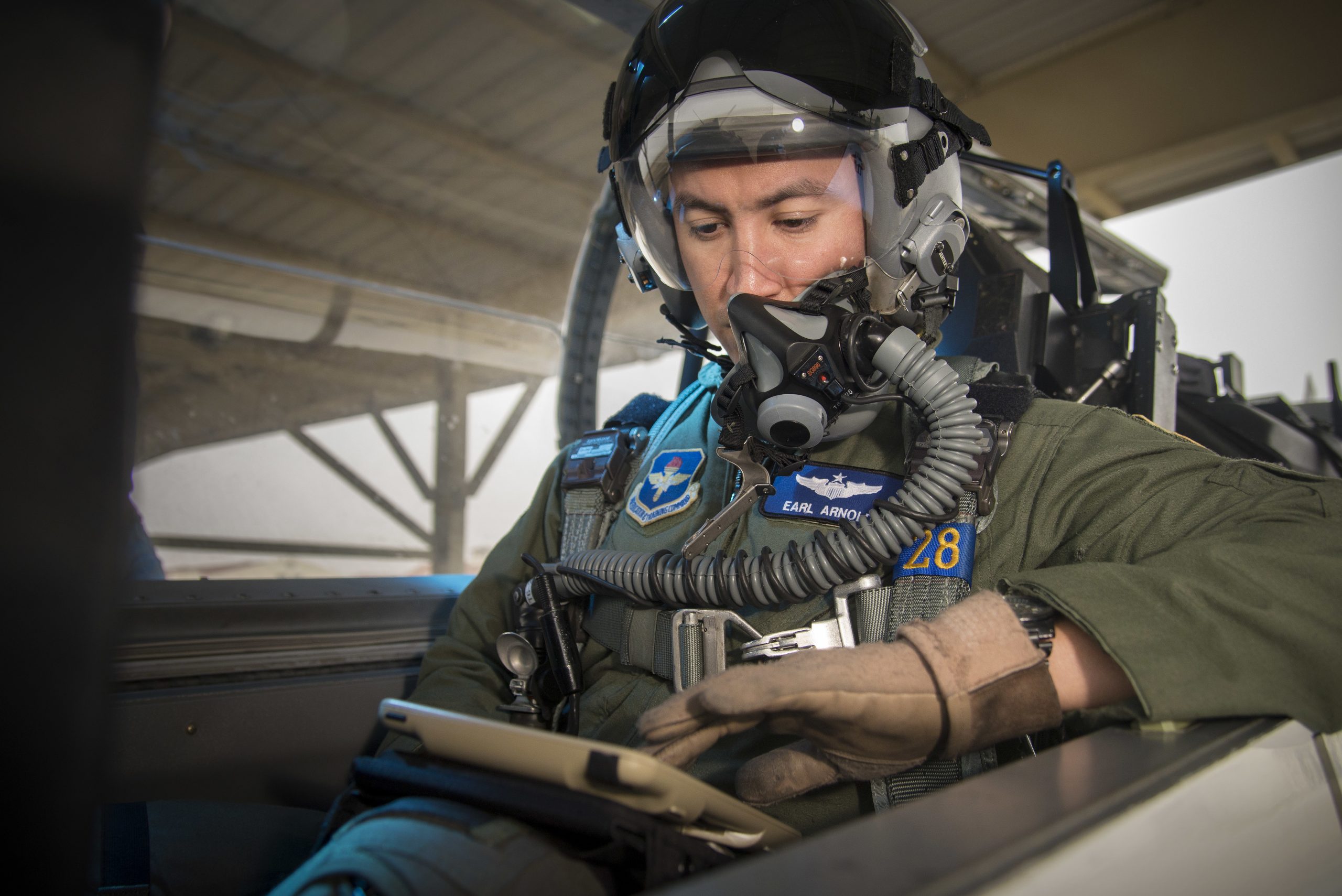
Such instruments could similarly assist thoroughly instructed aviators in mission readiness and maintaining proficiency. “Each individual awarded aviator wings also receives a digital flight manual… and that’s merely an iPad,” Hoffman stated. “At some point, I envision one of those applications on that iPad being IP GPT, where a learner, educator, policy-creator— or anyone—can directly access their [e.g., engine malfunction protocols] and generate a response derived from that specialized aviation guidance repository.”
The auditory content of this piece is presented to you by the Air & Space Forces Association, revering and assisting our Airmen, Guardians, and their households. Discover further details at afa.org