
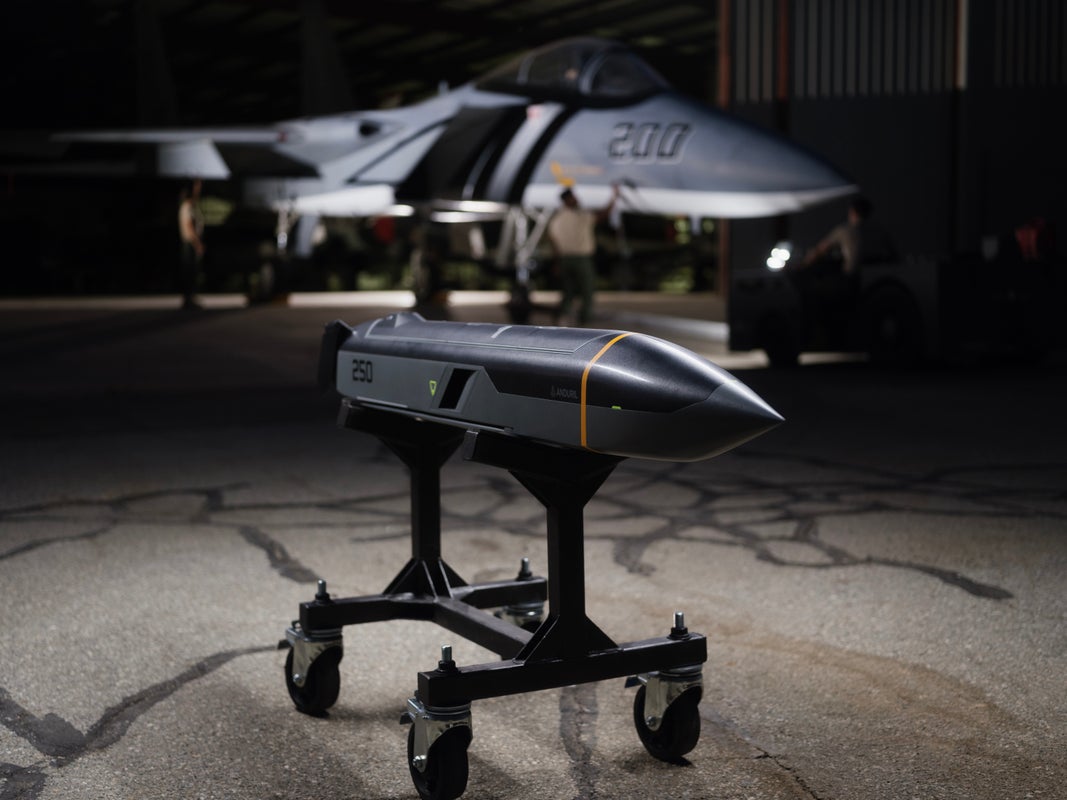
The Barracuda cruise missile, developed by Anduril Industries, has recently achieved a significant milestone by receiving certification as the U.S. Air Force’s first large-scale production munition compliant with an open systems architecture. This certification marks a pivotal step in the Pentagon’s strategy to introduce more adaptable and rapidly upgradeable weapons into its arsenal.
The Weapon Open System Architecture (WOSA) certification indicates that the Barracuda missile is designed with a modular, interchangeable architecture for its software and hardware components. This design philosophy is intended to provide military commanders with greater flexibility, allowing for the swapping of payloads, data links, and other features even after the missile has been delivered to the Air Force. Such modularity aims to ensure that the weapon system can evolve with changing threats and technological advancements without requiring a complete redesign.
An Anduril spokesperson stated on September 25 that “Barracuda’s open software architecture means that it can be equipped with a variety of different datalinks and communications modalities, unlocking integrations with a vast spectrum of different aircraft and other communications nodes.” This capability suggests enhanced interoperability and adaptability across various platforms and operational scenarios.
Anduril Industries is scheduled to deliver its initial Barracuda missiles to the Pentagon in early 2027, marking the transition from development to operational readiness for this new class of munition.
The rigorous certification process was overseen by the Air Force Research Laboratory’s (AFRL) Munition Open Architecture Test and Evaluation Laboratory (MOATEL). Engineers from MOATEL conducted a four-day verification assessment at Anduril’s California headquarters to confirm the Barracuda’s adherence to WOSA standards on its hardware. This independent verification is crucial for validating the claims of modularity and open architecture.
Jonathan Shaver, program manager and creator of WOSA at AFRL’s Air Warfare Directorate, highlighted the broader implications of this achievement in an Anduril release, stating, “This is showing that open architecture can scale beyond prototypes.” He emphasized that “Without that independent path from S&T to MOATEL, the industrial base cannot deliver new technology to the warfighter at the speed the fight requires.” This sentiment underscores the Air Force’s drive to accelerate the fielding of advanced capabilities.
The certified modularity of the cruise missile is expected to provide commanders with a wide range of operational features, contributing significantly to the planned expansion of the military’s munition stockpile. This capability is particularly relevant in the context of increasing global security challenges and the need for adaptable defense systems.
The Barracuda’s development falls under the Pentagon’s “Family of Affordable Mass Missiles” (FAAM) program. In July, the Pentagon announced multi-year framework agreements for this initiative, selecting Anduril, CoAspire, and Zone 5 Technologies as key partners. The FAAM program aims for substantial increases in missile production, targeting an annual output of 8,000 missiles once full production capacity is reached. The projected timeline outlines 5,300 missiles by 2028, escalating to 8,000 annually by 2031.
During the MOATEL assessment, 14 distinct WOSA domains were rigorously tested and verified. These included critical functions such as Mission Autonomy, Seeker, Inertial Measurement Unit (IMU), GPS, Air-Data Sensor, Propulsion, Airframe Control, Target State Estimator, Altimeter Aiding Navigation, Clock, Autopilot, Guidance, Navigation, and the Munitions Data Bus. This comprehensive testing ensures that all primary operational aspects of the missile can be independently upgraded or modified.
Pat Morris, vice president of advanced effects at Anduril, reiterated the importance of this verification, noting in the release that “It’s easy to talk about modularity and open architectures in the abstract. Proving it through an independent assessment is harder.” The MOATEL assessment confirms that Barracuda munitions can indeed be updated and upgraded as technology advances or mission requirements evolve, offering a flexible and sustainable weapon system.
**Modular Munitions Options**
Anduril has demonstrated the Barracuda’s modularity by integrating four different turbojet engines into its Barracuda 500 variant. This flexibility in engine sourcing is critical for ensuring continuous production as the company scales up to meet the demand for thousands of missiles in the coming years. The WOSA certification further facilitates the use of the Barracuda with both current and future communication systems, enhancing its long-term operational relevance.
Anduril currently produces three base models of the Barracuda: the Barracuda 100, which has an approximate 35-pound payload and a range exceeding 120 nautical miles; the Barracuda 250, also with a 35-pound payload but an extended range of over 200 nautical miles; and the Barracuda 500, designed for a payload greater than 100 pounds and a range exceeding 500 nautical miles. An Anduril spokesperson confirmed that the WOSA verification applies uniformly across all Barracuda variants, ensuring consistent modularity across the product line.
This development aligns with broader industry trends toward modularity in defense systems. For instance, during AFA’s Air, Space & Cyber conference, Lockheed Martin announced its new AGM-158 FLEX. This munition offers modularity, including swappable nose and launch options, for its precision-guided Joint Air-to-Surface Standoff Missile (JASSM) and its companion Long-Range Anti-Ship Missile (LRASM). Additionally, the Air Force Life Cycle Management Center at Eglin Air Force Base, Florida, issued a notice to industry in January 2025 seeking modular parts for its Extended Range Attack Munition. These initiatives collectively underscore a concerted push by the U.S. military and defense industry to build a more adaptable and flexible munition stockpile.
**Why This Matters**
The certification of Anduril’s Barracuda missile as the U.S. Air Force’s first large-scale production munition compliant with an open systems architecture represents a significant shift in defense procurement and strategic capability. This development holds profound implications for military readiness, technological advancement, and defense economics.
First, it addresses the critical need for **adaptability in modern warfare**. Traditional weapon systems often require lengthy and costly development cycles for upgrades or modifications. An open architecture, as embodied by WOSA, allows for rapid integration of new technologies, such as advanced sensors, improved guidance systems, or different communication protocols. This means the Air Force can respond more quickly to evolving threats and technological breakthroughs from adversaries, ensuring its munitions remain effective and relevant without having to procure entirely new systems. This agility is vital in an era of rapid technological change and peer competition.
Second, this modular approach has the potential to **reduce long-term costs and accelerate innovation**. By standardizing interfaces and allowing for components from various suppliers, the Air Force can foster greater competition among defense contractors. This could drive down development and production costs, as specific parts can be sourced or upgraded independently rather than tied to a single vendor for an entire system. Furthermore, it lowers barriers to entry for smaller, innovative companies, potentially bringing new capabilities to the warfighter faster and more affordably. The “Family of Affordable Mass Missiles” program itself underscores the emphasis on both affordability and scale, where open architecture can be a key enabler.
Third, WOSA compliance **enhances interoperability and mission flexibility**. The ability to swap payloads and integrate with a “vast spectrum of different aircraft and other communications nodes” means that a single missile platform can serve multiple roles or be launched from diverse platforms. This operational flexibility empowers commanders with more options in dynamic combat environments, reducing the need for highly specialized munitions for every scenario. It also simplifies logistical chains and training, as the core missile structure remains consistent while its functionalities can be tailored.
Finally, this certification signals a broader **strategic pivot for the U.S. defense industrial base**. It represents a commitment from the Air Force to move away from proprietary, “black box” systems towards more transparent, software-defined weapons. This paradigm shift encourages industry-wide adoption of open standards, pushing defense contractors to design systems that are inherently more flexible, upgradable, and cost-effective. The independent verification process by MOATEL is critical in building trust and ensuring that these open architecture claims translate into tangible benefits for the warfighter, ultimately contributing to a more responsive, resilient, and technologically superior defense capability for the United States.