
New initiatives spearheaded by the White House, the Department of Defense (Pentagon), and the U.S. Air Force are aiming to address long-standing barriers to employment for military spouses. These efforts represent a renewed, high-level commitment to tackling an issue that has significantly impacted military families and, by extension, military readiness and retention.
For years, military spouses have faced disproportionately high rates of unemployment and underemployment. Data consistently shows the unemployment rate among military spouses hovering around 20 percent, a figure significantly higher than the national average. This persistent challenge has endured despite previous programs designed to promote spouse hiring preferences on military installations, support for remote work opportunities, and advocacy for making professional licenses more portable across state lines, which is a major hurdle for spouses who frequently relocate with their service members.
Experts argue that improving spouse employment is not merely a social welfare endeavor but a critical component of military readiness and a key incentive for service members to continue their careers. Lyndsey Akers, a consultant with the Air & Space Forces Association’s (AFA) United Forces & Families program, emphasized this point at AFA’s Air, Space & Cyber conference last week. “When military spouses have greater access to meaningful and sustainable careers, we strengthen the economic stability of military families,” Akers stated. “We support the conditions that enable continued service, and we connect employers with an experienced, adaptable, and often overlooked talent pool.”
The renewed emphasis on this issue is largely driven by top-down interest emanating from the White House, particularly through the establishment of a new Military Spouse Commission. Stephen Simmons, Deputy Assistant Secretary of Defense for Military Community and Family Policy, acknowledged at the same conference that the nation has “admired” the problem for too long without sufficient action. He noted that elevating the issue to the highest levels of government is crucial for garnering the attention and resources needed to effect real change.
Cindy Wilsbach, wife of Air Force Chief of Staff Gen. Kenneth S. Wilsbach and a senior writer for presidential correspondence at the White House, affirmed the presidential mandate behind the new commission. During a panel discussion, Wilsbach explained, “It was marching orders from the leader of the free world to say, ‘We see the military spouse family and we recognize there are some longstanding generational problems that we need to get after.’” This direct interest from the President signals a significant shift, providing unprecedented access and influence for advocates working on spouse employment issues.
The Military Spouse Commission includes prominent military leaders and their spouses, underscoring the high-level commitment. Members include General Wilsbach and Cindy Wilsbach, along with other service chiefs, their spouses, and senior enlisted advisors. Specifically, the commission includes Chief of Space Operations Gen. Douglas A. Schiess and his wife Debbie Schiess; Chief Master Sergeant of the Air Force David Wolfe and his wife, Dr. Doniel Wolfe; and Chief Master Sergeant of the Space Force John F. Bentivegna and his wife Cathy Bentivegna.
Chief Master Sergeant of the Air Force David Wolfe highlighted the commission’s potential to drive systemic change. “With the four spouses here going to be involved with the Military Spouse Commission, we’ve got an opportunity to make some real change to laws that prevent us from hiring people fast enough and putting people into jobs and places and moving positions around,” Wolfe said during a panel discussion. This suggests that the commission may explore legislative or policy reforms to streamline hiring processes and improve job mobility for military spouses.
Cindy Wilsbach clarified that the commission’s role is not to duplicate existing efforts but to amplify them. It will “add to the work that’s being done” by raising the profile of military spouse employment, thereby granting advocates direct access to the President and other high-level decision-makers. This elevated platform is expected to facilitate more effective coordination and implementation of solutions.
Photo by Jud McCrehin, Air & Space Forces Association
Air Force’s Global Military Spouse Connection
One tangible program that has recently been launched is the Air Force’s Global Military Spouse Connection (GMSC). Initiated in June as a pilot program across a limited number of installations, GMSC is designed to serve as a crucial “bridge” connecting Active-Duty military spouses, particularly those undergoing Permanent Change of Station (PCS) moves to new locations, with local hiring managers and employment opportunities.
According to an Air Force release, “Using career field administrators, GMSC creates a structured, active pipeline to connect the military spouse talent pool with employment opportunities.” These administrators play a vital role in reviewing resumes, assessing qualifications, and making targeted recommendations to hiring managers, ensuring that spouses are matched with suitable positions. Wyteeshia McRoberts, a career field administrator, clarified the program’s objective: “We are assisting hiring managers in finding the best-qualified individual. We’re not contacting them to do favors. We are looking at resumes, seeing what they qualify for and making recommendations for the right jobs.”
CMSAF Wolfe highlighted the rapid development and expansion of GMSC during his Sept. 14 keynote address, noting that the program “went from idea to first action in only 60 days.” This swift implementation underscores the urgency and commitment behind these new initiatives. On Sept. 22, the Air Force announced a significant expansion of the program, making it available for spouses moving to a wide range of domestic and international locations, including:
- Luke Air Force Base, Ariz.
- Goodfellow Air Force Base, Texas
- Laughlin Air Force Base, Texas
- Mountain Home Air Force Base, Idaho
- Travis Air Force Base, Calif.
- Patrick Space Force Base, Fla.
- Ramstein Air Base, Germany
- RAF Croughton, U.K.
- RAF Mildenhall, U.K.
- RAF Lakenheath, U.K.
- RAF Feltwell, U.K.
- Kadena Air Base, Japan
The inclusion of multiple international bases demonstrates the global scope of the problem and the Air Force’s efforts to provide support regardless of assignment location.
Department of Defense’s SpouseWorks
While the Department of the Air Force has launched its new connection program, the Office of the Secretary of Defense (OSD) is focusing on enhancing and better publicizing its existing resources, as stated by Stephen Simmons. Historically, military spouses seeking assistance with employment, scholarships, or fellowships often found themselves navigating a complex and fragmented landscape of programs with various acronyms, such as SECO (Spouse Education and Career Opportunities), MyCAA (Military Spouse Career Advancement Accounts), and MSEP (Military Spouse Employment Partnership).
Recognizing the need for a more coherent and visible approach, Simmons’s team spearheaded a rebranding effort. SECO, which previously lacked sufficient visibility among leaders and community members, has been transformed into “SpouseWorks.” This rebranding was accompanied by an organizational restructuring, elevating the program from a sub-office to a directorship that reports directly to Simmons, thereby increasing its prominence and resource allocation. “Before, the program was buried in one of our directorships through no fault of their own,” Simmons explained. “But in my mind, … it needed to report directly to me, so we turned it from a sub-office to a directorship.”
Other related programs were integrated under the SpouseWorks umbrella, resulting in the creation of SpouseWorks Fellowship and SpouseWorks Scholarship programs. The overarching goal is to make these vital resources “very simple and easy to use” for military spouses. SpouseWorks now offers a comprehensive suite of services, including training, education, professional development resources, access to career coaches, and a centralized job board. The initiative aims to serve as a single, accessible hub for military spouses seeking career advancement and for employers looking to hire qualified military spouse talent.
Early indicators suggest the rebranding and reorganization are yielding positive results. Simmons reported promising early returns, with usage of SpouseWorks programs increasing significantly. “We’re up well over 50 to 80 percent usage year over year,” he noted, despite being only halfway through the first year of the SpouseWorks rebrand. This surge in engagement indicates that the unified approach and increased visibility are effectively connecting military spouses with the resources they need.
Why This Matters
The renewed and elevated focus on military spouse employment is critical for several interconnected reasons, impacting military families, national security, and the broader economy. First and foremost, addressing spouse unemployment and underemployment directly enhances the quality of life and financial stability for military families. When spouses can pursue meaningful careers, it reduces financial stress, increases family resilience, and contributes significantly to the overall well-being of the household. This stability is a key factor in a service member’s decision to remain in uniform, making spouse employment a vital military retention tool.
From a military readiness perspective, the ability of spouses to maintain careers minimizes distractions and concerns for service members, allowing them to focus more fully on their duties. High spouse unemployment can lead to dissatisfaction, which in turn can contribute to higher rates of military personnel leaving service, resulting in a loss of experienced talent and increased costs for recruitment and training. By supporting military spouses, the Department of Defense and the individual services are investing in the long-term health and stability of the all-volunteer force.
The involvement of the White House and the creation of a Presidential commission elevate this issue to an unprecedented level. This top-down commitment signals that military spouse employment is recognized as a strategic national imperative, not just a niche concern. Such high-level attention can facilitate policy changes, streamline bureaucratic hurdles, and ensure adequate resource allocation, which have historically been barriers to effective solutions. The inclusion of senior military leaders and their spouses on the commission further solidifies this commitment, integrating the issue into strategic planning across the services.
Finally, military spouses represent a highly educated, diverse, and adaptable talent pool that is often overlooked. They bring a wealth of experience, resilience, and unique skills acquired through frequent relocations and exposure to various cultures and environments. Initiatives like the Global Military Spouse Connection and SpouseWorks aim to unlock this potential, not only benefiting military families but also providing a valuable resource for employers and contributing to the national economy. Successfully integrating military spouses into the workforce strengthens communities, boosts economic productivity, and reaffirms a commitment to those who serve the nation.
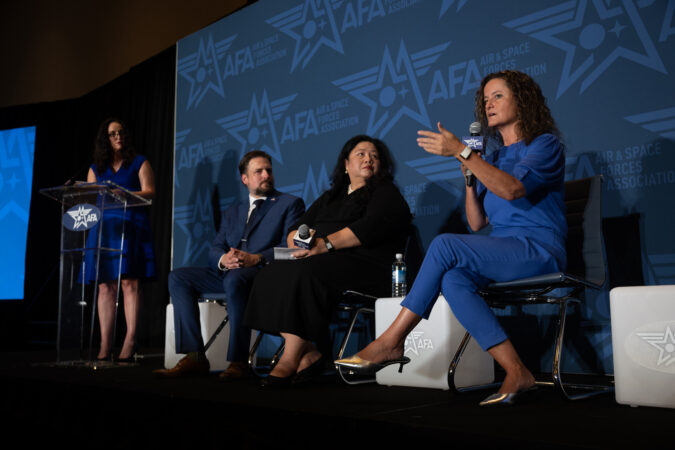
Photo by Craig Hudson, for Air & Space Forces Association
Persistent Employment Barriers Challenge Military Spouses Despite Ongoing Initiatives
Despite continued efforts by the Department of Defense and various advocacy organizations, military spouses continue to encounter significant obstacles in achieving stable and fulfilling employment. Key challenges identified by experts include inconsistent policy implementation, variations in support across military installations, the rollback of remote work options, and persistent issues with access to affordable childcare. These factors collectively contribute to higher rates of unemployment and underemployment among military spouses, impacting family well-being and military readiness.
Sue Luangkhot Hoppin, President of the National Military Spouse Network, highlighted the detrimental effects of inconsistent program longevity. “I wish we could say that we had a lot of consistency, but what happens is with every change of leadership, somebody has a bright idea and then a great program goes away,” Hoppin stated. She emphasized a pattern where initiatives are frequently introduced without sufficient solidification or long-term commitment before being replaced. This lack of continuity prevents programs from establishing deep roots and achieving their full potential, leaving military families to navigate a landscape of shifting resources and support structures.
Beyond top-level policy fluctuations, inconsistencies also manifest at the base level. Hoppin noted that differing priorities among local commanders can lead to variations in the availability and quality of spouse employment support from one military installation to another. This localized disparity often places an additional burden on operational commanders to address employment issues, which may not be their primary focus. Elevating these concerns to higher departmental leadership, Hoppin suggested, could standardize approaches and relieve individual commanders of this auxiliary responsibility, fostering more uniform support across the force.
A recent policy shift with unintended consequences for military families has been the widespread rollback of remote work options for federal civilian employees. For many military spouses, remote employment represents an ideal solution to the challenges posed by frequent Permanent Change of Station (PCS) moves. The flexibility offered by remote work allows spouses to maintain career continuity regardless of geographical relocation and can provide a viable option for those facing childcare constraints. “Remote work is a lifeline for a lot of military spouses,” Hoppin explained. “It allows them to work even if they have childcare issues. But if they have to go back to the office, all of a sudden they need to have access to affordable child care, and that’s become an issue.”
However, Liz O’Brien, Senior Vice President at the U.S. Chamber of Commerce Foundation, cautioned against viewing remote work as a singular panacea. She pointed out that during the COVID-19 pandemic, when remote work opportunities expanded significantly, military spouse unemployment rates remained stubbornly high. This observation underscores the complexity of the issue, suggesting that while remote work is beneficial, other fundamental barriers persist.
A consensus among O’Brien, Hoppin, and Stephen B. Simmons, Deputy Assistant Secretary of War for Military Community and Family Policy, identifies childcare as one of the most significant impediments to better military spouse employment. Simmons articulated an “intrinsic relationship” between childcare availability and spouse employment, emphasizing that without reliable and accessible childcare, many spouses are unable to pursue employment opportunities. The challenge is further compounded when spouses face lengthy wait times for childcare openings, which can cause them to miss critical windows for job acquisition.
In response to these persistent challenges, Simmons affirmed that the Pentagon is actively pursuing multiple strategies to mitigate childcare wait times. These efforts include expanding capacity at existing Child Development Centers (CDCs) and forging partnerships with organizations such as the Armed Forces YMCA and private industry. Additionally, the department is exploring ways to support informal childcare networks within military communities. Simmons reported progress in these areas, noting, “Year over year … our childcare wait lists are down 25 percent, which is phenomenal.” He drew a direct correlation between this reduction in waitlists and an observed improvement in military spouse employment, indicating that addressing childcare shortages is a critical component of enhancing economic opportunities for military families.
While tangible progress is being made in specific areas like childcare, the overarching landscape of military spouse employment remains complex. The diverse array of challenges, from policy inconsistencies to localized support disparities, suggests that a multi-faceted and sustained approach will be required to ensure military spouses have equitable access to meaningful career opportunities.
**Why This Matters**
The employment challenges faced by military spouses extend far beyond individual career aspirations; they have significant implications for military readiness, family well-being, and national security.
1. **Military Readiness and Retention:** When military spouses struggle to find employment, it can place immense financial and emotional strain on service members and their families. This stress can negatively impact a service member’s focus, morale, and their decision to remain in the military. A stable and supportive family environment, which often includes spousal employment, is a critical factor in military retention and the overall health of the force.
2. **Economic Impact:** Military spouses represent a highly educated and skilled segment of the workforce, yet their unemployment and underemployment rates are consistently higher than the national average. This represents a significant loss of economic potential, both for individual families and for the broader economy. Enabling military spouses to fully utilize their talents could contribute billions of dollars in economic activity annually.
3. **Family Well-being:** Financial instability due to lack of spousal employment can lead to increased stress, anxiety, and household difficulties. Access to fulfilling careers can provide spouses with a sense of purpose and financial independence, contributing to the overall resilience and mental health of military families. This directly supports the military’s mission by ensuring its personnel are well-supported at home.
4. **National Security:** A strong military relies on strong military families. When families are secure and supported, service members are better able to focus on their demanding roles. Addressing employment barriers for military spouses is not merely a social issue but a strategic imperative that directly impacts the readiness, morale, and effectiveness of the armed forces, thereby bolstering national security.
5. **Fairness and Equity:** Military spouses often make significant sacrifices for their country, frequently putting their own career ambitions on hold due to constant relocations and the demands of military life. Ensuring they have equitable access to employment opportunities is a matter of fairness and acknowledges their unique contributions and sacrifices. It demonstrates that the nation values and supports its military families as much as its service members.