
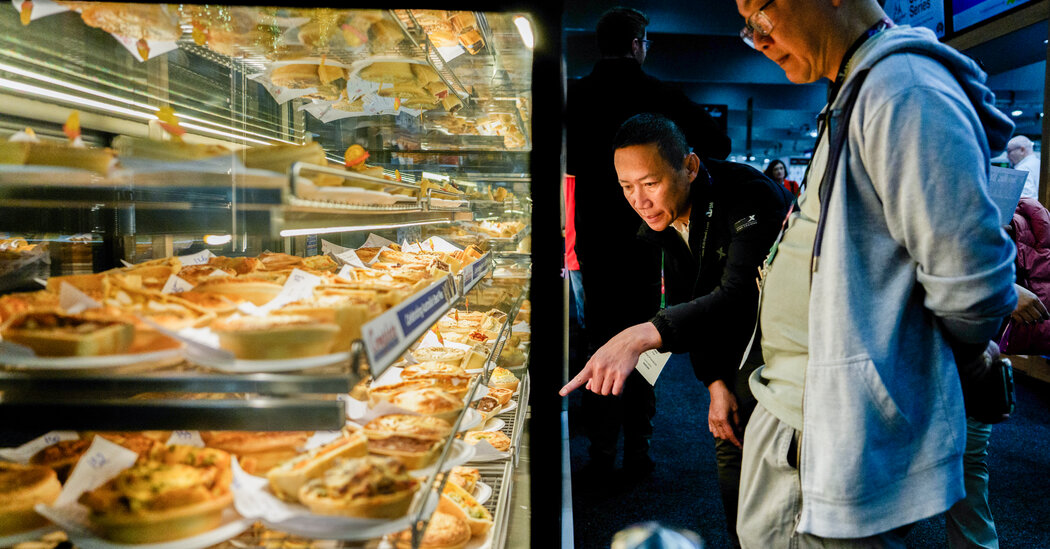
In a bustling hall in Melbourne, Australia, the annual Official Great Aussie Meat Pie Competition recently concluded, drawing judges and bakers from across the nation to evaluate the country’s quintessential snack. Among the adjudicators was Brendan Carter, a senior judge in the gourmet pie category, who, after a careful assessment, deemed one particular entry “too salty,” setting it aside. This meticulous process was emblematic of the rigorous standards applied by judges as they tasted, analyzed, and deliberated over Australia’s most beloved pastry.
The meat pie holds an iconic status in Australia, a ubiquitous comfort food enjoyed throughout the year. Whether it’s a warming treat on a chilly winter morning following a sports event or a convenient meal during a long summer road trip, its presence is deeply woven into the fabric of daily life. Australians collectively consume an estimated 270 million meat pies annually, frequently served hot and generously topped with tomato sauce. This handheld meal is celebrated for its egalitarian appeal, known for its hearty fillings that can occasionally spill onto business shirts, team uniforms, or casual attire, adding to its unpretentious charm.
However, once a year, a dedicated cohort of culinary experts, possessing a deep understanding of this national staple, convenes to identify the exceptional entries that transcend the everyday and merit recognition for their superior quality and innovation.
Over a period of four intensive days, a panel of 16 judges undertook the formidable task of evaluating 1,800 single-portion pies and sausage rolls. These entries were submitted by a diverse group of Australia’s skilled bakers, chefs, pastry cooks, and butchers. The competition, a central event at the Fine Food Australia trade fair in Melbourne, stands as one of the nation’s longest-running and most significant contests of its kind, having been established in 1989. For the judges, the event is a considerable test of endurance, with some tasked with tasting up to 60 pies per day in their pursuit of identifying the year’s champions.
Brendan Carter, reflecting on his experience midway through the tasting schedule, noted feeling “as you’d expect to be feeling” given the volume of entries. He recounted a previous year where he evaluated over 100 pies within a single day. Despite the demanding nature of the role, Mr. Carter expressed his enjoyment, stating that judging offers a valuable opportunity to contribute to an industry he has dedicated decades to as both a baker and an educator. He acknowledged that outside the competition, his personal consumption of meat pies is infrequent, remarking, “I don’t need to; I have enough here,” in reference to the extensive tasting required.
This year’s competition showcased a broad spectrum of innovation alongside traditional entries. While classic plain meat pies remained a core category, the event also embraced inventive culinary creations. Notable gourmet entries included a butter chicken pie, a wood-smoked wallaby pie, a prawn and garlic pie, a chipotle pork and pineapple pie, and a beef and taco pie. The sausage roll category similarly featured diverse flavors, such as Texas BBQ with onion rings and Mexican beef and cheese, reflecting a growing trend towards culinary experimentation within these traditional formats.
The judging process was structured and comprehensive. Judges, working in pairs, meticulously assessed three pies from each competitor. The initial scoring phase focused on visual and structural attributes, including the pie’s color, uniformity, the hue and quality of the meat filling, the optimal meat-to-pastry ratio, and the thickness of both the pastry top and base. Creativity was also a key criterion in this preliminary evaluation.
Following the initial assessment, a dedicated “pie crew” ensured that freshly warmed pies were presented to the judges for the crucial tasting phase. During this stage, entries were evaluated on their aroma, mouthfeel, overall flavor profile, and the taste and texture of the pastry. Discarded portions of pies were placed into boxes beneath each judging table. To cleanse their palates between tastings, judges utilized bottles of peach- or lemon-flavored iced tea, with some preferring water. Historically, chardonnay or chunks of pineapple have also served this purpose, demonstrating the evolution of palate-cleansing methods over the competition’s history.
Mr. Carter, a seasoned judge since 1999, typically required no more than two bites to form his verdict. His assessments were precise; one pie received acknowledgment for its innovative concept, while another’s pastry was commended for its quality. At one point, he was invited by another judging team to corroborate their evaluation of a particularly promising entry. After a thorough inspection, Mr. Carter succinctly described the high-scoring pie as “pretty darn nice,” underscoring the subjective yet expert discernment involved in the process.
Pies, Legacy, and Recognition
The competition also serves as a platform for personal stories of dedication and heritage within Australia’s baking community. Among the entrants were sisters Sandy and Hannah Do, who operate Ming’s Bakery in Perth, Western Australia. Their father established the bakery in 1991, and upon his passing nearly eight years ago, the sisters assumed its management. This year, their commitment was rewarded with multiple medals, including a gold for a meat pie crafted using their late father’s “secret recipe,” which he had imparted to Sandy just ten days before his death.
Hannah Do recounted their father’s journey, noting his escape from Vietnam during wartime and his arrival in Australia with limited resources. Despite lacking a prior background in baking, he meticulously learned every aspect of the trade, from pastry preparation to crafting diverse meat fillings. The sisters expressed feeling their father’s enduring presence throughout the competition week. Sandy articulated the profound impact of his legacy: “On my hardest days, I will always think if Dad could do all of that with nothing, I can literally survive and do anything.” She concluded, “Just hope Dad’s proud,” highlighting the emotional significance of their achievements.
The Official Great Aussie Meat Pie Competition, founded in 1989, was established with the explicit objective of elevating pie standards across Australia. Its popularity has grown consistently over the decades, reaching a point where organizers found it necessary to cap the total number of entries this year to manage the scale of the event.
The cultural significance of the meat pie in Australia is profound. In 2018, the then-Prime Minister Malcolm Turnbull inadvertently sparked national debate, dubbed #piegate, when he was observed eating a meat pie with a knife and fork rather than the customary method of holding it by hand. This incident underscored the deep-seated cultural norms and expectations surrounding the consumption of this cherished food item, illustrating its role as more than just a snack but a symbol of national identity.
For Mike French, the competition’s chief judge, the event’s purpose extends beyond merely identifying the finest pie. He views the bakers as “the caretakers of the Aussie icon,” emphasizing their crucial role in preserving and evolving a national culinary tradition. As the judging concluded, hopeful competitors gathered, anticipating the announcement of winners in various categories. Steven Watson, who co-owns The Little Red Grape bakery in Sevenhill, South Australia, with his wife Jackie, highlighted the “most prestigious” categories: best plain pie, best pastie, and best sausage roll.
Mr. Watson further articulated that the competition provides valuable recognition for the extensive effort invested in running a bakery. He noted that he and his wife typically work around 70 hours per week, with the competition week itself humorously referred to as their “holiday,” illustrating the demanding nature of their profession and the significance of industry accolades.
The highly coveted award for best plain pie was presented to Sarel Hok, proprietor of Buddy Bakery Melton in Victoria, marking his second win in this category in 2024. Mr. Hok attributed his success to a clear focus: “What I focus on is flavor. I flavor everything from the top to the bottom.” He acknowledged the award as a significant validation, stating that it signifies “our hard work is paying off.”
Additional prominent awards included the “roo rendang curry pie,” crafted with kangaroo meat, which earned the title of best overall gourmet pie, and a jalapeno beef and cheese sausage roll, recognized as the best overall sausage roll. Following the celebrations, the untasted cold pies were systematically disposed of in large bins. The distinct aroma of meat and pastry permeated the air as the discarded entries were collected and wheeled away, marking the official end of the judging process.
As the day concluded, Chief Judge Mike French was already planning for the future, having shortlisted potential judges for the following year’s competition. He offered a reflective perspective on the enduring place of pies in Australian culture. Despite the constant evolution of consumer preferences and the innovative spirit of bakers, Mr. French affirmed, “pies won’t die.” He concluded with a statement on their inherent longevity: “The pies themselves will always be there.”
Why This Matters
The Official Great Aussie Meat Pie Competition, while seemingly focused on a singular culinary item, holds significant cultural, economic, and social importance for Australia. Firstly, it acts as a vital guardian of national identity. The meat pie is more than just a food item; it is deeply entrenched in Australian culture, serving as a symbol of everyday life, sporting events, and informal gatherings. The competition reinforces this cultural heritage, ensuring that a beloved tradition is not only preserved but also celebrated and continuously redefined by new generations of bakers. It underscores the value Australians place on shared culinary experiences and accessible comfort food.
Secondly, the competition plays a crucial role in driving innovation and elevating industry standards within Australia’s baking and food sectors. By rigorously evaluating entries across various criteria, it encourages bakers to refine their techniques, experiment with new flavors, and strive for excellence. This push for quality benefits consumers by ensuring a consistently high standard of products available across the country. Furthermore, the introduction of creative entries, such as a wood-smoked wallaby pie or a butter chicken pie, demonstrates the dynamism of Australian cuisine and its capacity to incorporate diverse influences while respecting traditional formats. Such innovation is essential for the growth and evolution of the food industry.
Economically, winning an award at this prestigious competition can have a transformative impact on small and medium-sized bakeries and butchers. Recognition can lead to increased sales, enhanced brand reputation, and opportunities for expansion, directly supporting local businesses and employment. For individuals like Sarel Hok, or the Do sisters of Ming’s Bakery, these accolades are not just trophies but vital validation of years of hard work, often spanning generations. This competition provides a national stage for artisans who might otherwise operate within local confines, fostering a sense of community and professional pride among them.
Finally, the event highlights the dedication and craftsmanship inherent in the food industry. The stories of competitors like Sandy and Hannah Do, who inherited their father’s legacy and secret recipe, underscore the personal investment and passion behind these businesses. The judges, often seasoned industry professionals like Brendan Carter, volunteer their expertise as a way to give back and ensure the longevity of their trade. In an era of increasing globalization, events like the Great Aussie Meat Pie Competition serve as a powerful reminder of the enduring value of local traditions, artisan skills, and the simple, yet profound, role food plays in connecting people and shaping national character.