
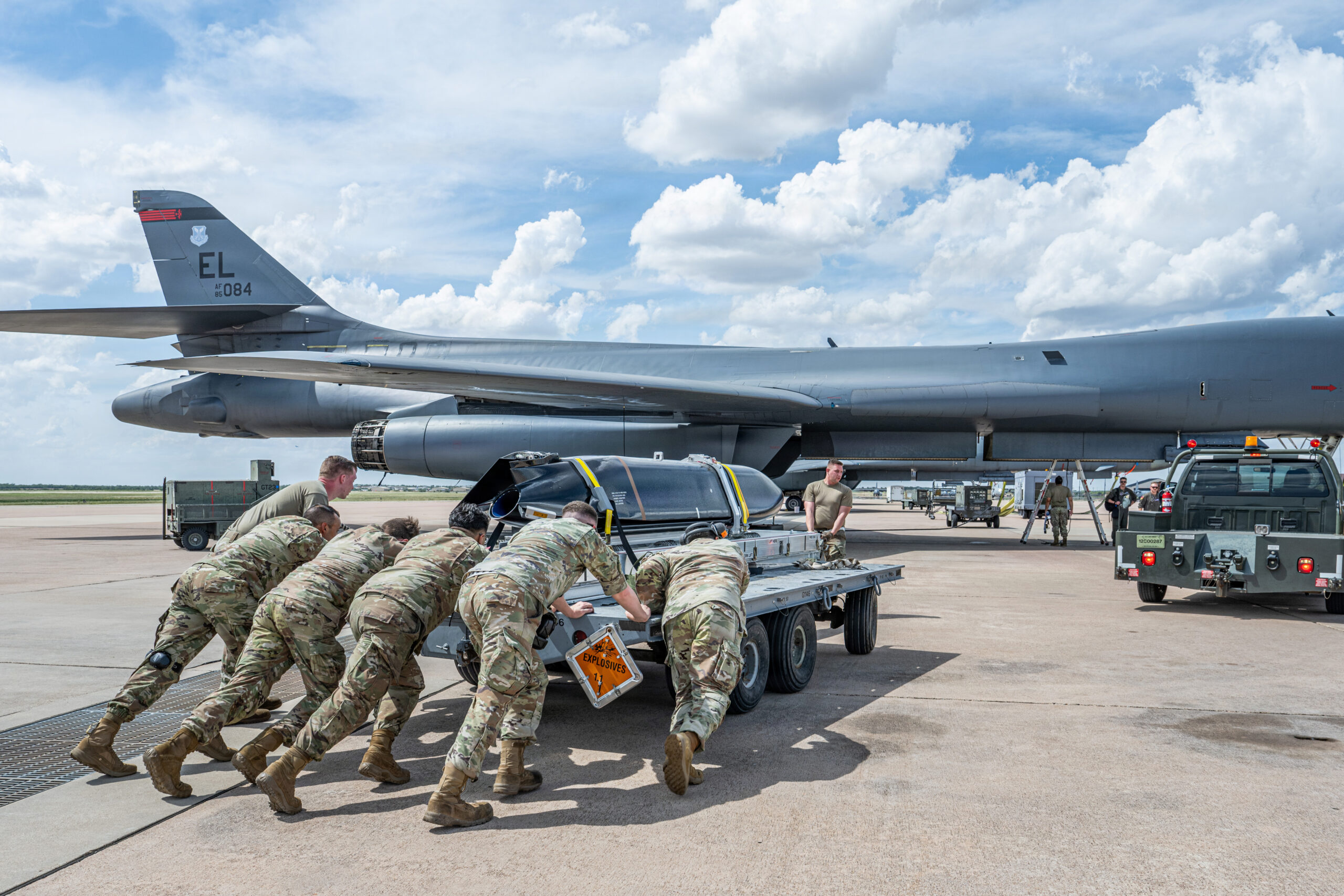
The United States Air Force recently conducted a critical test of the Long-Range Anti-Ship Missile (LRASM) on the B-1B Lancer bomber, marking a significant step in integrating the advanced weapon system onto its strategic aircraft. This development aims to bolster the Air Force’s capabilities in maritime strike operations, particularly in contested environments.
The validation test, referred to as an “event zero,” took place on June 2 at Dyess Air Force Base in Texas. Its primary objective was to ensure seamless communication between the AGM-158C LRASM missile and the B-1B bomber. During this specific test, engineers utilized a specially fabricated cable to connect the missile to the aircraft, allowing for the verification of data exchange and system compatibility without fully loading the weapon for flight. This method is a standard procedure in the early stages of weapon integration, ensuring software and hardware interfaces function correctly.
This B-1B test followed closely on the heels of another notable LRASM deployment: a B-2 Spirit stealth bomber fired a LRASM during exercise Valiant Shield 26 near the Marianas Islands. This marked the first public acknowledgment by the Air Force of a B-2 launching the anti-ship missile, underscoring a broader effort to integrate the LRASM across multiple bomber platforms.
The LRASM, designated AGM-158C, is a sophisticated, high-value long-range weapon system developed jointly by the U.S. Air Force and Navy. Its design is optimized for precision strikes against maritime targets from standoff distances. The Air Force has prioritized the acquisition of this missile, requesting $738 million in its fiscal year 2027 budget plan to procure 156 missiles from contractor Lockheed Martin. This follows a budgeted acquisition of 114 missiles in fiscal year 2026, indicating a sustained investment in this capability.
Retired Air Force Col. Mark Gunzinger, who serves as the director of future concepts and capability assessments at the Air & Space Forces Association’s Mitchell Institute for Aerospace Studies, emphasized the strategic importance of the LRASM. He stated, “The ability to strike moving targets at sea gives us a real advantage against adversaries who might, for instance, launch a cross-Taiwan Strait invasion.” Gunzinger explained that Air Force bombers equipped with LRASMs can threaten adversaries’ ships from considerable distances, thereby reducing risk to the launch platform. He contrasted this with ship-based LRASMs, which would necessitate firing from even greater distances to maintain security. “I think the vast majority of aim points initially would be allocated to the U.S. Air Force,” Gunzinger added, reiterating the need for modern counter-maritime weapons for aircraft.
Testing Solutions and Innovation
The 7th Bomb Wing at Dyess Air Force Base played a pivotal role in the recent B-1B LRASM test. Airmen and engineers within the wing were responsible for testing and verifying preflight procedures, utilizing updated software and hardware. Notably, Dyess Airmen independently constructed the specialized testing cable based on specifications provided by the U.S. Navy, showcasing an adaptive approach to integration challenges.
Col. Robert Sturgill, commander of the 7th Bomb Wing, highlighted the ingenuity demonstrated by his personnel. In a statement, he praised their efforts: “On the flightline and in our weapons shops, these professionals look past legacy blueprints to design and implement ideas that push weapon system capacity and capabilities far beyond original limits.” An unnamed 7th Bomber Wing weapons officer further elaborated that testing a live AGM-158C with the custom cable “verified rapid process integration” for both the aircraft and missile software. Such testing and integration processes are inherently lengthy and meticulous, crucial for ensuring that new weapons operate safely and effectively with existing aircraft systems.
The B-1B Lancer was the first Air Force platform to achieve early operational capability with the LRASM in 2018 and has since become a key asset in joint maritime strike missions. The LRASM itself is equipped with a 1,000-pound blast-fragmentation warhead, designed to inflict significant damage on enemy vessels. It employs advanced, self-directed sensing and signature control technologies, which enhance its ability to locate, track, and engage maritime targets, even in electromagnetically challenging environments.
With a publicly available range exceeding 200 nautical miles, the LRASM enables aircraft like the B-1B to engage targets while maintaining a safe standoff distance from heavily defended areas. This capability is vital for projecting power and deterring aggression in potential conflict zones. A Lockheed Martin spokesperson confirmed the broader integration efforts, stating, “LRASM brings additional, advanced long-range sea and land strike capabilities to the B-1B, F/A-18E/F and soon to the P-8 and F-15 with ongoing integration efforts.” This indicates a strategic vision for multi-platform deployment across various branches of the U.S. military.
The LRASM was adapted from the Joint Air-to-Surface Standoff Missile (JASSM) specifically to target moving vessels. While its range is comparable to the standard JASSM, it is considerably shorter than the 1,200-mile range of the JASSM-ER (Extended Range). Despite this, Gunzinger anticipates continued evolution for both the LRASM and the entire JASSM family of munitions. He underscored their design for operations in “contested and highly contested environments,” noting their “degree of low observability—they’re stealthy weapons.” This stealth capability is paramount, as he concluded, “for fifth- and sixth-generation aircraft, we need fifth- and sixth-generation munitions.”
Why This Matters
The ongoing integration and testing of the Long-Range Anti-Ship Missile (LRASM) on U.S. Air Force bombers represent a crucial advancement in global military strategy, with significant implications for international security and power projection. This weapon system enhances the capability of the United States and its allies to deter potential adversaries and respond effectively to maritime threats, particularly in regions like the Indo-Pacific where naval power is increasingly critical.
The ability of bombers like the B-1B Lancer and B-2 Spirit to carry and launch LRASMs from long distances provides a strategic advantage. It allows the U.S. to hold enemy naval assets at risk without placing valuable aircraft and personnel in immediate harm’s way within heavily defended areas. This standoff capability is essential in an era of advanced anti-access/area denial (A2/AD) systems, which seek to limit an adversary’s freedom of movement and operation. By enabling bombers to operate outside the most dangerous threat zones, LRASM integration increases the survivability of U.S. forces while maintaining offensive striking power.
Furthermore, the LRASM’s sophisticated guidance, stealth features, and ability to target moving ships address a critical need for modern naval warfare. It provides a credible deterrent against potential aggressors who might contemplate maritime invasions or blockades, such as a hypothetical cross-Taiwan Strait scenario. The financial commitment reflected in the Air Force’s budget requests for hundreds of these missiles underscores the high priority placed on this capability, signaling a sustained effort to maintain and enhance maritime strike dominance.
The multi-platform integration across B-1B, B-2, and future integration on F/A-18E/F, P-8, and F-15 aircraft ensures redundancy and flexibility in deployment, making the LRASM a versatile tool in the joint force arsenal. The innovative testing methods, including the “homemade” solutions developed by Airmen, also highlight a culture of adaptability and resourcefulness within the military, which is vital for rapidly incorporating new technologies. Ultimately, the successful integration of LRASM on these platforms strengthens the U.S. military’s ability to protect sea lanes, support allies, and project power globally, thereby contributing to regional stability and strategic deterrence.