
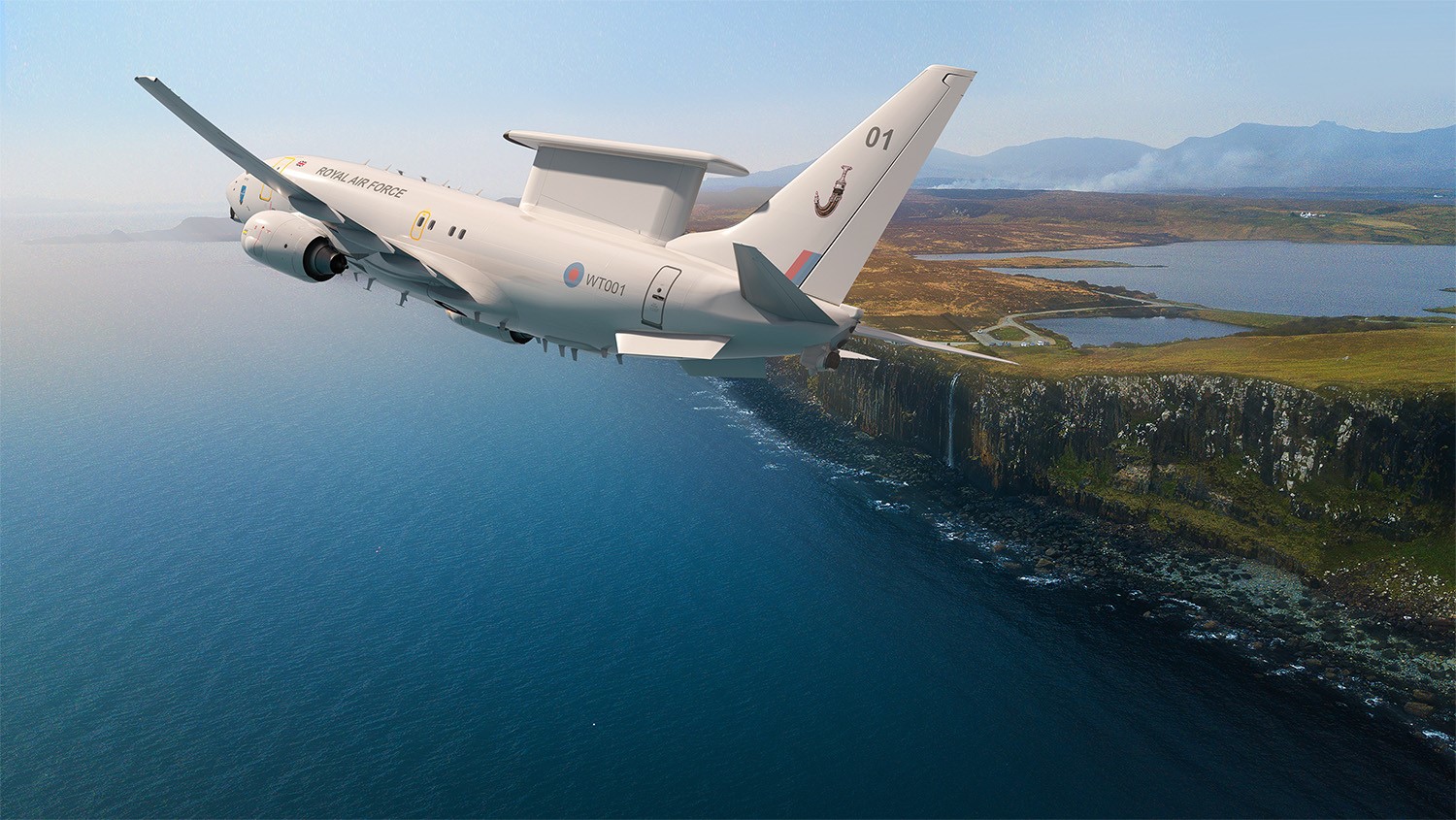
Royal Air Force E-7 Wedgetail Fleet Achieves Dual-Flight Milestone, Advancing Operational Readiness
In a significant development for the United Kingdom’s airborne early warning capabilities, both of the Royal Air Force’s delivered Boeing E-7 Wedgetail aircraft were simultaneously airborne on Thursday afternoon. This marks the first occasion on which the two advanced surveillance aircraft have flown concurrently, signaling a crucial step forward in their integration into the RAF fleet.
The aircraft, designated WT001 and WT002, engaged in separate flight profiles as part of their ongoing test and evaluation program. WT001, operating under the callsign “Boeing 31,” departed from RAF Lossiemouth in Scotland and proceeded south to designated orbit areas in the South West of England. Concurrently, WT002, using the callsign “Boeing 38,” flew out of MOD Boscombe Down, the primary flight test and evaluation establishment for the UK military. Together, these two aircraft represent two-thirds of the Royal Air Force’s future airborne early warning (AEW) fleet, which is ultimately planned to comprise three units.
The appearance of WT002 flying from Boscombe Down indicates its official entry into the flight test program alongside the lead aircraft. As recently as January, WT002 was undergoing outfitting by STS Aviation at Birmingham Airport, highlighting the rapid progress in preparing the second airframe for operational readiness and testing.
The Boeing E-7 Wedgetail is a sophisticated Airborne Early Warning and Control (AEW&C) platform built upon the robust Boeing 737 Next Generation airframe. This commonality provides significant logistical and maintenance advantages, as the 737 NG platform is also the foundation for the RAF’s P-8 Poseidon maritime patrol aircraft fleet. A defining feature of the Wedgetail is its distinctive dorsal fin, which houses the Northrop Grumman Multi-role Electronically Scanned Array (MESA) radar system.
Unlike earlier generations of AEW aircraft that relied on mechanically rotating radomes, the MESA radar is an advanced active electronically scanned array (AESA) system with no moving parts. This revolutionary design allows for instantaneous beam steering and multi-target tracking, providing superior situational awareness and resistance to electronic countermeasures. The MESA radar’s advanced capabilities enable operators to concentrate the radar’s attention on a specific sector of interest while simultaneously maintaining a broad scan of other areas, significantly enhancing the aircraft’s surveillance and command-and-control functions over land and sea.
The acquisition of the E-7 Wedgetail represents a critical modernization for the RAF, as these aircraft are slated to replace the venerable, but aging, E-3D Sentry fleet. The Sentry aircraft, based on the Boeing 707, have provided vital AEW&C capabilities for decades, but their operational lifespan is drawing to a close. The E-7 brings a generational leap in technology, performance, and operational efficiency, ensuring the UK maintains a cutting-edge capability to detect and track airborne and maritime threats, direct fighter aircraft, and provide critical battlefield management.
#RAF Royal Air Force
Boeing E-7A Wedgetail AEW.1 2x#43C97A WT001 – BOEING 31#43C97B WT002 – BOEING 38
Both RAF Wedgetail AEW.1’s are currently airborne this afternoon.
WT001 made its way down from Lossiemouth for the orbit areas in the South West, while WT002 has departed…pic.twitter.com/jaTrS1apv1
— Armchair Admiral 🇬🇧 (@ArmchairAdml) October 8, 2026
This recent dual-flight milestone follows another significant event on May 21, when WT001 landed at RAF Lossiemouth for the first time. That inaugural arrival was conducted by a mixed crew comprising personnel from Boeing UK and the Royal Air Force, underscoring the collaborative nature of the program. RAF Lossiemouth, which has undergone extensive preparations to accommodate the new fleet, is set to become the operational hub for the Wedgetail aircraft, co-locating them with the P-8 Poseidon maritime patrol fleet and establishing a potent maritime and airborne surveillance capability.
Speaking at the time of WT001’s arrival, Group Captain Sarah Brewin, the Station Commander at RAF Lossiemouth, emphasized the preparatory efforts, stating:“We have been working hard to get ready to operate these aircraft.”Her comments highlight the complex logistical, infrastructure, and training investments required to integrate such advanced platforms into service. Stu Voboril, Boeing’s Vice President and Programme Manager for the E-7, echoed this sentiment regarding ongoing progress:“We look forward to continuing test and evaluation as the aircraft moves closer to entry into service.”
The current test and evaluation phase is strategically split between MOD Boscombe Down, which focuses on initial flight envelope expansion and system verification, and RAF Lossiemouth, where operational integration and tactical evaluation will take place. This dual-site approach allows for a comprehensive assessment of the aircraft’s performance and capabilities in both controlled and operational environments. Upon successful completion of this rigorous phase, Boeing UK will officially hand over the aircraft to the Royal Air Force, at which point 8 Squadron, historically the RAF’s dedicated AEW&C unit, will assume full operational responsibility for the Wedgetail fleet, bringing them to full operational capability.
Why This Matters
The simultaneous flight of the Royal Air Force’s two E-7 Wedgetail aircraft represents more than just a technical achievement; it is a critical indicator of the UK’s commitment to modernizing its air defence and surveillance capabilities in an increasingly complex global security landscape. The E-7 Wedgetail is not merely a replacement for the aging E-3D Sentry; it is a significant upgrade that enhances the nation’s ability to protect its airspace, monitor its maritime approaches, and contribute effectively to NATO and coalition operations.
Firstly, the advanced Northrop Grumman MESA radar, with its electronically scanned array technology, provides a quantum leap in situational awareness. Its ability to detect and track a multitude of air and surface targets at long ranges, even in challenging environments, is vital for countering evolving threats, including stealth aircraft, cruise missiles, and sophisticated naval vessels. This capability is paramount for national security, offering an invaluable early warning system that can direct defensive assets and provide comprehensive intelligence to decision-makers.
Secondly, the commonality of the E-7’s 737 Next Generation platform with the P-8 Poseidon fleet streamlines logistics, maintenance, and training, leading to greater efficiency and cost-effectiveness. The co-location of these fleets at RAF Lossiemouth creates a powerful maritime and air surveillance hub, fostering synergy between anti-submarine warfare, maritime patrol, and airborne early warning missions, thereby enhancing the UK’s overall domain awareness.
Finally, the operational readiness of the E-7 Wedgetail fleet is crucial for the UK’s role within NATO and its alliances. As a key contributor to collective security, the UK’s ability to deploy highly capable AEW&C assets strengthens NATO’s integrated air and missile defence system. The Wedgetail’s interoperability with allied forces ensures seamless command and control during joint operations, projecting stability and deterrence in regions of strategic importance. This milestone underscores the UK’s ongoing investment in cutting-edge defence technology, ensuring its armed forces remain highly capable and ready to meet future challenges.