
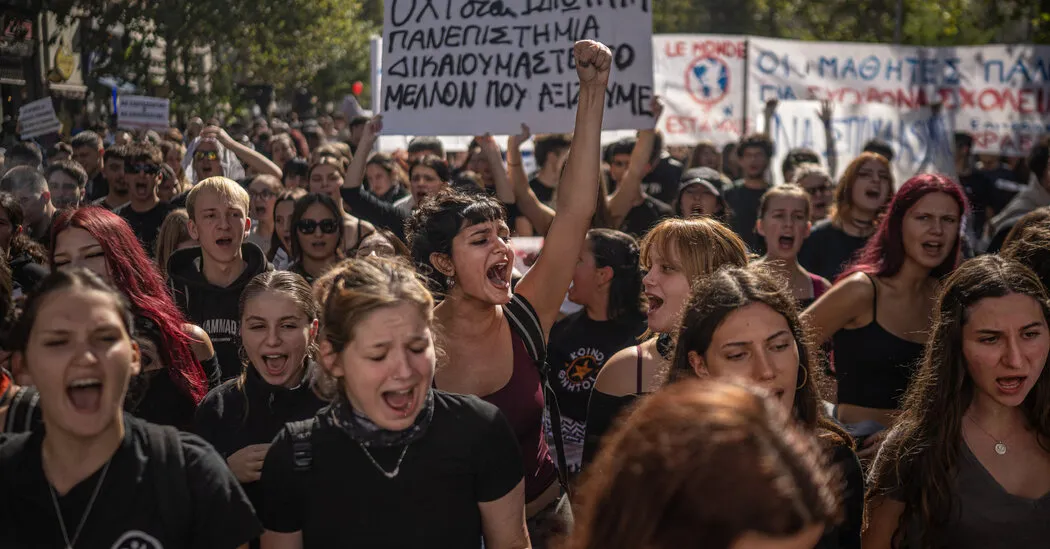
Youth Protests Across Europe Highlight Deep-Seated Anxieties Over Future Prospects
Across Europe, a wave of youth-led protests has emerged in recent days, signaling widespread discontent and anxiety among younger generations regarding their future. From housing affordability to educational funding and governmental corruption, demonstrations in at least eight countries underscore a common sentiment: a profound fear that current socio-economic trajectories are diminishing their prospects.
In Spain and Portugal, young people have established tent encampments in their respective capitals, Madrid and Lisbon, to protest escalating rents and the growing inaccessibility of affordable housing. This direct action highlights a severe housing crisis impacting Southern European nations, where stagnant wages struggle to keep pace with rapidly inflating property markets.
Further north, French and Italian students have taken to the streets in large numbers, demanding improvements in educational conditions. While many of these demonstrations remained peaceful, some were regrettably marred by incidents of looting and vandalism, shifting media attention and political discourse towards issues of public order rather than the protesters’ core grievances.
In Greece, protests have focused on securing increased funding for universities, reflecting concerns about the quality and accessibility of higher education amidst ongoing austerity measures and economic pressures. Meanwhile, in Albania, young activists have joined broader anti-corruption movements, clashing with police while accusing their government of impeding their future opportunities through systemic graft.
While the specific demands of these diverse movements vary, adapted to the unique political and economic contexts of each nation, a unifying thread of apprehension for the future binds them. Sacha Cossi, a 27-year-old concert stagehand participating in the Madrid tent encampment, articulated this sentiment, stating, “The no-future generation is back.” His words encapsulate a widespread exasperation over the confluence of low salaries, soaring rents, perceived governmental inaction on global warming, general job insecurity, and fears about the erosion of the generous welfare benefits historically enjoyed by previous European generations.
“We are tired of everything,” Cossi continued, reflecting a pervasive feeling that societal and economic changes are consistently unfolding in ways that do not benefit young people. This pervasive gloom among younger Europeans mirrors a broader continental struggle to chart a clear path forward amidst a complex array of challenges.
Europe faces an aging population, which strains national budgets through rising expenses for pensions and healthcare, while governments exhibit reluctance to increase taxation. The issue of immigration continues to polarize electorates across the continent. There is also a palpable fear that Europe is lagging in adapting to the rapid technological advancements expected to define the near future, placing it in a precarious position between global economic powers like the United States and China. Geopolitical anxieties have also intensified, particularly in the face of expanding Russian aggression and concerns about diminishing U.S. commitment to European defense, exacerbated by rhetoric from figures like former President Trump, who has questioned support for European allies and Ukraine.
While these challenges affect Europeans of all ages, the long-term outlook appears particularly bleak for the continent’s youth. The public services and social benefits that have long characterized European societies are increasingly perceived as unsustainable. Governments, regardless of their ideological leanings—from right-wing administrations in Italy to left-wing ones in Spain and moderate leadership in France—are struggling to formulate credible solutions. This perceived inadequacy leaves many young Europeans feeling marginalized and excluded from the political and economic discourse.
Stella Salis, a 22-year-old university student and protester in Padua, Italy, expressed this sentiment succinctly: “There’s this sense of rejection, fatigue.”
Though these recent movements have not yet reached the scale and longevity of the anti-austerity protests that swept the globe in the aftermath of the 2008 financial crisis, they are beginning to garner international attention and foster discussions among participants about forming transnational movements. Early signs of cross-border solidarity are emerging, with French high school students inspiring their teenage counterparts in Belgium, and protesters in Italy and Germany adopting slogans originating in France. Salis voiced a hope that the protest movement was “starting to be in a phase that transcends national borders.”
However, the unrest has also created opportunities for far-right political parties, often overshadowing the initial messages of the protesters. In Italy, recent rioting, which led to dozens of arrests, provided Matteo Salvini, a government minister and hard-right leader, with a platform to announce the deployment of 500 soldiers to “defend Milan” from “criminals.” With his party experiencing a decline in polls, Salvini leveraged the unrest to promote his anti-immigration agenda, asserting his hope that the disturbances would permanently halt “leftist calls to extend citizenship to children of immigrants before they reach the age of 18.”
Similarly, in France, the far-right National Rally has capitalized on recent incidents of lawlessness to position itself as the party best equipped to restore order. Marine Le Pen, a prominent figure in the party, stated in a speech, “In six months, the French people will be able to choose a different path: That of restored authority and security.” Her sentiment was echoed by party president Jordan Bardella, who declared, “We stand ready to restore order in the country,” after visiting a police station near the epicenter of recent disturbances.
Despite the varying political responses, future European leaders will confront formidable challenges in addressing the concerns of young people. They face excruciating decisions regarding the allocation of dwindling public resources amidst persistent economic headwinds, including inflation, rising bond yields, and soaring fuel prices. Salomé Regnaud, a 15-year-old French student protesting for better school conditions, articulated a common aspiration: “My dream would be to have a job that I love. Not to have to look at my expenses every month and ask myself, ‘Will I be able to do this?’ or ‘Can I afford to buy that?'”
This lament resonates from Portugal to Albania. Mourana Monteiro, a 29-year-old psychologist in Lisbon who participated in a protest against real estate speculation, emphasized, “People say we don’t want to work? We do want to work, but with dignified conditions.” Having camped out in protest for several days, Monteiro highlighted the paradox of working yet being unable to afford basic necessities: “What’s the point of working and then not being able to afford a house, pay our bills at the end of the month, have a family?”
In Albania, students have joined the broader “Flamingo” anti-government movement, named after a bird habitat in an area slated for a luxury tourism development opposed by environmental groups. While Prime Minister Edi Rama has dismissed these protesters as radical leftists, the students’ focus remains on ensuring protections for education. Redjan Shkëmbi, a 22-year-old actor involved in the anti-corruption movement, drew a contrast with past generations, stating, “We are a generation that has chosen not to remain silent, unlike our parents, who did not enjoy the same freedoms or the full right to freedom of expression,” referring to Albania’s dictatorial past. Shkëmbi’s involvement in protests for increased funding for education and public hospitals reflects a deep commitment to fostering a more transparent and democratic Albania. “We want a better country,” he affirmed, “and we want to contribute to its future.”
Why This Matters
The widespread youth protests across Europe are not isolated incidents but symptomatic of deeper structural challenges and growing generational divides that have significant implications for social cohesion, economic stability, and the future political landscape of the continent. The consistent theme of “fear for the future” among young Europeans highlights a critical failure of current policies and economic systems to provide adequate opportunities and security for the next generation.
Economically, a disillusioned youth population struggling with housing affordability, precarious employment, and limited prospects can lead to reduced consumer spending, slower innovation, and a decline in entrepreneurial activity. If young people cannot afford to live independently, establish families, or invest in their futures, it creates a drag on overall economic growth and productivity. Furthermore, the erosion of welfare benefits and public services, while financially challenging for governments, threatens the social contract and could lead to long-term societal instability.
Politically, these protests represent a potential turning point. While some movements are grassroots and unaligned, the discontent they express can be co-opted or exploited by populist and far-right parties, as seen in Italy and France. This risks shifting political discourse away from addressing core issues like economic inequality and climate change, towards divisive rhetoric focused on immigration and law-and-order. Conversely, sustained youth activism could also galvanize progressive movements, pushing for more equitable and sustainable policies. The transnational nature of some emerging protest sentiments suggests a potential for cross-border political movements that could challenge traditional national political structures.
For the broader European Project, the unity and stability of the European Union could be tested if national governments fail to address these deep-seated anxieties. A continent where a significant portion of its youth feels disenfranchised and hopeless risks internal fragmentation and a weakening of its collective strength on the global stage. Understanding and responding to these grievances is crucial not only for the well-being of Europe’s young citizens but also for the continent’s long-term viability, democratic health, and ability to tackle complex global challenges effectively.
Reporting was contributed by Ségolène Le Stradic from Paris; Josephine de La Bruyère from Rome; Carlos Barragán from Madrid; Daniela Ferreira Pinto from Lisbon; and Fatjona Mejdini from Tirana, Albania.