
**Global Alarm Contrasts with Calm in DRC Capital Amidst Ebola Outbreak**
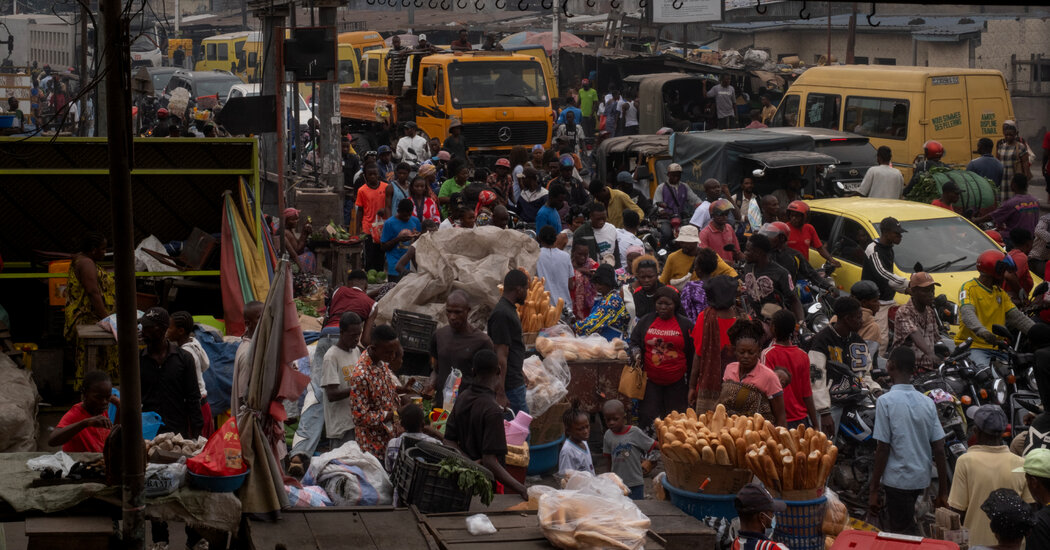
Nations worldwide are implementing stringent entry restrictions on individuals who have recently traveled to the Democratic Republic of Congo (DRC), responding to a deadly Ebola outbreak primarily concentrated in the country’s northeastern region. This global concern, however, presents a stark contrast to the daily life observed in Kinshasa, the Congolese capital, where most of its estimated 20 million residents continue their routines largely undisturbed by the unfolding health crisis.
In Kinshasa, the bustling open-air markets, where vendors offer a variety of goods from cassava and fish to fruits and clothing, remain heavily populated. Commuters navigate the city’s notoriously congested roads, filling shared taxis or riding motorcycles for their morning journeys. Evenings see patios and bars vibrant with patrons enjoying beer and grilled chicken, indicative of a city largely unfazed by the distant health emergency. Malula Richard Esambo, president of a local soccer fan group, encapsulated the prevailing sentiment during a recent event organized by the Congolese Football Association, stating, “I don’t know and don’t see why we should be afraid. Kinshasa is safe for now.” This perspective underscores a significant disconnect between external perceptions of risk and the daily reality within the capital.
The vast geographical expanse of the Democratic Republic of Congo largely explains Kinshasa’s seemingly unconcerned demeanor. Spanning over 900,000 square miles, the country is nearly six times the size of California. The epicenter of the current Ebola outbreak, Ituri Province in the northeast, is situated approximately 950 miles from Kinshasa. To put this into perspective, this distance is comparable to that between New York City and Orlando, Florida, highlighting the sheer scale involved.
Adding to this geographical buffer is the practical reality of limited travel between Kinshasa and Ituri, primarily due to the country’s underdeveloped road infrastructure. This significantly reduces the likelihood of the virus spreading directly from the outbreak zone to the capital, according to Tulio de Oliveira, director of the Center for Epidemic Response and Innovation at Stellenbosch University in South Africa. Dr. de Oliveira argues that international efforts would be more effectively channeled into supporting the affected countries to contain the outbreak at its source, rather than implementing broad “travel bans or isolation of all patients who come from such a large country.” He critically assesses such measures, adding, “I don’t think that’s a good public health response.”
Despite these assessments, some public health experts caution that the virus’s unchecked spread for several weeks means that even distant locations may not be entirely out of danger. A significant concern is the absence of a vaccine for this particular species of the virus, known as Bundibugyo. Health officials on the ground continue to face considerable challenges in establishing adequate clinics and response infrastructure in Bunia, the capital of Ituri, further complicating containment efforts.
In response to the escalating situation in Ituri, the provincial governor implemented a ban on gatherings exceeding 50 people and suspended a planned soccer match in Bunia. Shortly thereafter, the Congolese government announced a ban on all non-essential air travel in and out of Bunia, with aid flights requiring special authorization. So far, the outbreak has resulted in approximately 177 suspected deaths and about 750 suspected cases, with the virus confirmed to have spread into neighboring Uganda and South Sudan. The potential for the virus to reach a megacity like Kinshasa, with its dense urban environment and large population, would pose immense challenges, offering conditions ripe for rapid and widespread transmission.
A factor contributing to the relative calm among many Congolese is their historical experience with Ebola. This marks the 17th Ebola outbreak to affect the country since the virus was first identified five decades ago. Despite myriad challenges, Congolese health authorities have developed considerable expertise in responding to Ebola outbreaks over the years. This institutional memory, however, can also foster a sense of detachment. Christine Nlandu, a 37-year-old market vendor, noted, “Here, people think it doesn’t concern Kinshasa. They think it’s a far-off story.”
Petronella Mugoni, a social and behavioral epidemiologist with extensive experience in the DRC, expressed concern that some Kinshasa residents may have developed a degree of complacency regarding Ebola, largely because the city has not been severely impacted by previous outbreaks. She emphasizes the critical need for the government to enhance targeted public health information campaigns about Ebola. However, implementing such campaigns effectively in Kinshasa is challenging, given the prevalence of numerous other diseases that claim more lives annually than Ebola, leading to an overload of health information for residents. Furthermore, Dr. Mugoni highlights the economic realities faced by many. With a significant portion of the population relying on informal work to sustain their families, focusing on Ebola prevention can be difficult. “Even in the midst of challenges, earning money takes precedence,” she explained. “Closing markets down would be more catastrophic than Ebola for many.”
In contrast to Kinshasa, residents of Goma, another major city in the eastern part of the country, are exhibiting heightened concern about the Ebola outbreak. Goma’s closer proximity and significant travel links to Ituri, combined with the complexities introduced by the city being under the control of the M23 rebel group, amplify anxieties. Joëlle Koko Zihindula, a 28-year-old youth worker in Goma, articulated this sentiment: “I am overwhelmed by the news. It is depressing, how the situation is all mixed with conflicts.”
The Congolese government has utilized social media to stress “the importance of adhering to preventive measures in response to the Ebola outbreak declared in Ituri.” However, specific public awareness campaigns directly targeting Kinshasa are noticeably absent. The capital has seen no bans on large gatherings, and schools remain open, reflecting a differentiated approach compared to the direct measures taken in Ituri.
Despite the lack of broad public campaigns in the capital, the government has instructed educators to maintain vigilance and conduct awareness initiatives for their students. Sister Elysee Ntoto Mazoba, principal at Madame Lecandele School in northwestern Kinshasa, confirmed these directives, indicating a grassroots effort to disseminate vital information.
One student at Madame Lecandele, nine-year-old Christopher Ciribagula, has evidently absorbed the awareness campaign’s messages. He recounted being taught to avoid touching dead animals, to inform parents immediately if they develop a fever, and to steer clear of individuals with bloody noses, associating such symptoms with Ebola. Frequent handwashing has also been emphasized. Christopher expressed apprehension about an upcoming family trip, driven by his fear of encountering someone who might be ill. “I am very afraid of this disease,” he stated. “If this disease ever reaches Kinshasa where we live, it could be dangerous for the whole city.”
Beyond the immediate health concerns, the outbreak has also sparked other anxieties. Some Congolese soccer fans fear potential denial of entry into the United States to support their national team in the upcoming World Cup, with Congo scheduled to play its first game on June 17 in Houston. Mr. Esambo, the fan group president, sought to alleviate these worries, asserting that the visa process was already in motion and expressing confidence that American authorities would permit their entry. “America is a great country,” he remarked. “Making such groundless decisions would not be a good move.” The ongoing Ebola outbreak in the Democratic Republic of Congo thus presents a complex picture of regional disparities in risk perception, public health response, and broader societal impacts.
Arlette Bashizi contributed reporting from Goma, Democratic Republic of Congo, Lynsey Chutel from London, and Zimasa Matiwane from Johannesburg.
Why This Matters
The Ebola outbreak in the Democratic Republic of Congo highlights critical challenges in global public health and illustrates the complex interplay between geography, infrastructure, socio-economic factors, and public perception during a health crisis. The discrepancy between international alarm and the relative normalcy in Kinshasa underscores the importance of understanding local contexts when formulating global health responses. For international bodies, the situation tests the effectiveness of travel restrictions versus focused, in-country support for containment efforts, especially given expert opinions suggesting the latter is more impactful.
Domestically, the outbreak exposes the multifaceted difficulties of public health messaging in a vast country facing multiple health threats and economic hardships. The presence of the Bundibugyo strain, for which no vaccine exists, represents a significant public health challenge, increasing the urgency of containment. The potential for the virus to reach a densely populated megacity like Kinshasa, despite geographical barriers, remains a serious concern due to the catastrophic implications for human life and the healthcare system. Furthermore, the interplay of the health crisis with existing conflicts, particularly in regions like Goma, complicates response efforts and places vulnerable populations at even greater risk. This event serves as a stark reminder of how local outbreaks can have far-reaching human, economic, and political consequences, necessitating coordinated and nuanced strategies.