
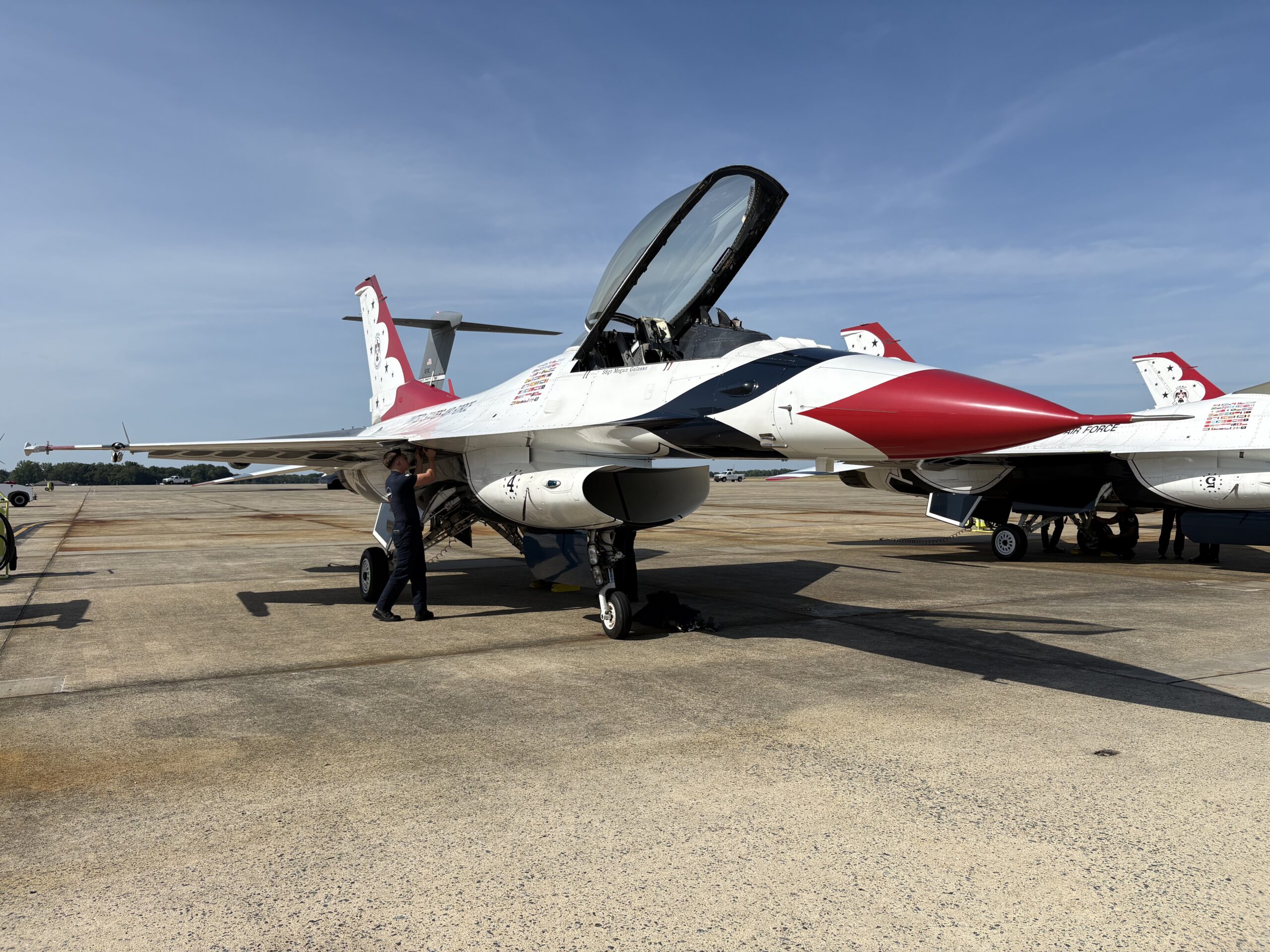
JOINT BASE ANDREWS, Md.—As the United States prepares to mark its 250th anniversary on July 4, thousands of spectators are anticipated to gather in downtown Washington, D.C. Amidst potentially high temperatures, the U.S. Air Force Thunderbirds demonstration team is set to perform an aerial display with their F-16 Fighting Falcons.
Lt. Col. Tyler Clark of the Thunderbirds addressed the operational considerations for flying in hot conditions, stating, “The jets will perform well in the heat. The crowd will be sweating, and we’ll be sweating, but we can overcome that. It’s a minor discomfort for the significant visual spectacle that will be an aerial review.” This statement underscores the team’s commitment to executing their performance despite environmental challenges.
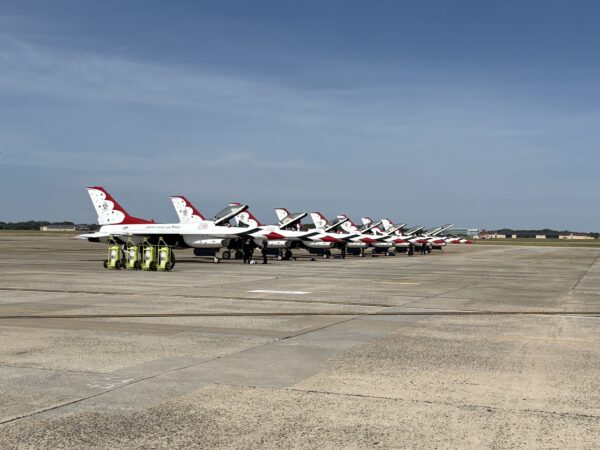
Eight Thunderbirds aircraft arrived at Joint Base Andrews on June 30, following a recent appearance in the National Capitol Region. The team plans to execute elements of their full aerial demonstration, a rare occurrence given the heavily restricted airspace over Washington, D.C., where flyovers are more common than comprehensive aerobatic displays.
The upcoming July 4th event follows a series of notable military aviation displays that have marked the lead-up to the 250th anniversary celebrations. On June 14, the Thunderbirds collaborated with the U.S. Navy Blue Angels for a distinctive 12-plane “Super Delta” formation flyover during the UFC Freedom 250 event at the White House. This joint formation, combining the Blue Angels’ F/A-18 Super Hornets and the Thunderbirds’ F-16 Fighting Falcons, showcased inter-service precision and teamwork. This event effectively initiated a period of increased military flyovers across D.C. and other parts of the country as the 250th-anniversary commemorations intensified.
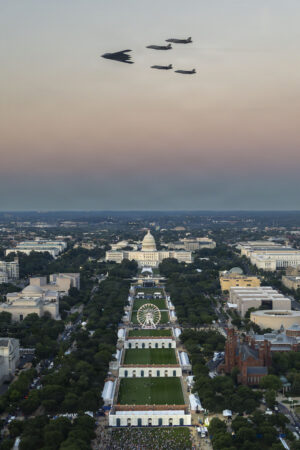
Subsequent aerial demonstrations included F-16s, F-35s, and a B-2 bomber participating in a flyover of the National Mall on June 24, inaugurating the Great American State Fair. The following day, June 25, a formation consisting of B-52 bombers, F-15, F-35C, and F/A-18 fighters also performed over the area.
Beyond the capital, the Blue Angels performed in Norfolk, Va., and Baltimore as part of the Sail 250 maritime festivals. The Thunderbirds, between their D.C. engagements, conducted flyovers in Las Vegas and over the Hoover Dam for America 250 celebrations in Nevada.
While summer typically represents a busy period for military demonstration teams, this year has seen an amplified level of activity and public interest due to the major anniversary. Lt. Col. Clark observed, “One of the biggest differences I’ve noticed, particularly in this season, is all the hype around celebrating the 250th. And that’s been really, really special, not just for the United States, but also being a member of the Thunderbirds and getting to not only experience that, but also to help showcase the pride, precision, and professionalism by the United States Air Force during this momentous time.”
The Thunderbirds’ operational calendar for the year commenced in February at the Daytona 500 and is scheduled to conclude in November at the Kennedy Space Center in Florida. Since April, the 150-person unit has maintained an operational tempo of nearly weekly performances.
Clark noted the palpable enthusiasm surrounding their engagements: “You can just feel the energy, whether it’s the different show sites or interactions with the crowd or the general public, wherever our team goes, you can feel it. There’s something there that’s just been making this year really special.”
The July 4th event in Washington, D.C., is anticipated to draw significant public attention. The Thunderbirds arrived at Andrews several days earlier than their standard schedule for other shows, enabling additional public engagement activities. Practice time for the aerial demonstration is subject to the region’s airspace restrictions, but the unit has been preparing for this specific performance for months.
Typically, the Thunderbirds are the primary attraction at airshows, performing a meticulously choreographed 36-minute routine. For the July 4th event, they adapted their preparation for a shorter performance, sharing the spotlight with a comprehensive display of U.S. airpower. This broader program includes performances from the Blue Angels and the F-22, F-35B, and MV-22 demonstration teams, in addition to flyovers featuring all three of the Air Force’s bomber types and all U.S. military stealth aircraft types.
As the overall program for the July 4th celebration developed, the Thunderbirds’ leadership explored various performance options. Clark indicated that the team ultimately decided on a performance that closely approximates their full routine. “What started off as, ‘Hey, we’re just going to do a couple of passes as part of the aerial review’ has now morphed itself into, we’re going to go fly the majority of our show, weather dependent, of course,” he explained.
In the week leading up to the event, the team finalized their performance at Nellis Air Force Base, Nev., utilizing a practice range designed to simulate the airspace restrictions of Washington, D.C.
Regarding the specific maneuvers planned, Clark offered a concise remark: “What I can tell you is, let’s all keep our fingers crossed from good weather, so we can send it uphill.” He also hinted at a specific modification to their routine: “We had to take out a couple of maneuvers for fuel conservation based off of a little surprise afterwards, which I will keep close to the vest.”
Why This Matters
The extensive military aerial demonstrations and flyovers surrounding the 250th anniversary of the United States on July 4th carry significant national and international implications. Firstly, these events serve as a powerful display of national unity and pride, reinforcing the historical significance of the anniversary for the American public. The coordinated efforts of various military branches, such as the joint “Super Delta” formation, symbolize inter-service cooperation and national cohesion.
Secondly, the demonstrations showcase the advanced capabilities and readiness of the U.S. military. By featuring a diverse array of aircraft, including stealth fighters, bombers, and highly maneuverable demonstration jets, these events highlight technological superiority and the professionalism of military personnel. This is not merely a show for entertainment; it’s a public demonstration of a nation’s defense prowess, which can serve as both deterrence to potential adversaries and reassurance to allies.
Thirdly, the heightened visibility of military aviation teams, such as the Thunderbirds and Blue Angels, plays a crucial role in public engagement and recruitment. These teams inspire interest in aviation and military service, particularly among younger generations. The “hype around celebrating the 250th” creates a unique opportunity to connect the public with the armed forces, fostering a sense of appreciation and understanding for their roles and sacrifices.
Finally, such large-scale national celebrations, especially with military participation, project soft power on the global stage. They demonstrate national resilience, organizational capability, and the ability to commemorate significant historical milestones with grandeur. While primarily an internal celebration, the imagery and news of these events are disseminated worldwide, contributing to the international perception of the United States. The economic impact through tourism and local business activity in host cities like Washington D.C., Norfolk, and Baltimore further underscores the multifaceted importance of these anniversary commemorations.