
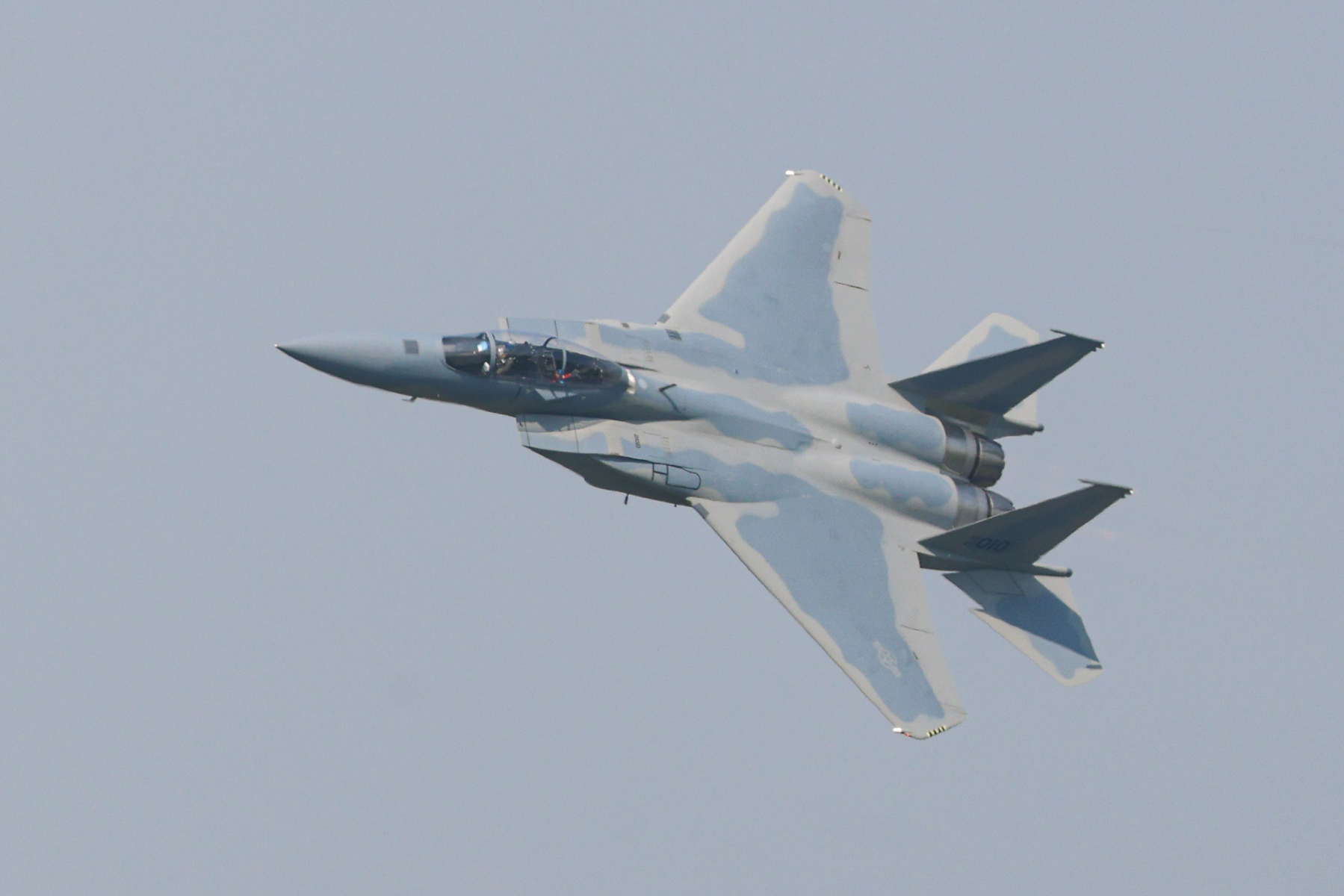
The United States Air Force is significantly increasing its planned procurement of F-15EX Eagle II fighter jets, more than doubling its intended fleet from 129 to 267 aircraft. This strategic shift, as revealed in the fiscal year 2027 budget proposal, is primarily driven by persistent delays in critical modernization upgrades for the F-35A Joint Strike Fighter, a top Air Force official stated on May 12.
Lt. Gen. David Tabor, Deputy Chief of Staff for Plans and Programs, articulated the rationale behind the expanded F-15EX acquisition during a Senate Armed Services air-land subcommittee hearing. He explained that setbacks in the F-35’s Technology Refresh 3 (TR-3) and Block 4 upgrade programs necessitated the acquisition of additional fighter capacity to maintain the Air Force’s operational readiness.
“As we encountered some slowdowns in deliveries of F-35s due to the previously discussed TR-3 and Block 4 upgrade issues, it became apparent to us that we needed another fighter capacity,” Tabor testified. He further elaborated that this decision was made in conjunction with extensive force design analysis, highlighting the F-15EX’s capabilities and its relevance to addressing the “pacing challenge,” a term often used to refer to China. The F-15EX, an advanced derivative of the F-15E Strike Eagle produced by Boeing, offers a different set of capabilities compared to the stealth-focused F-35, including greater weapons carrying capacity and immediate availability through an existing production line.
The F-35’s TR-3 system is a foundational hardware and software update designed to enhance the aircraft’s computing power, display memory, and overall processing capability, which is essential for integrating future advanced weapons and sensors. The subsequent Block 4 upgrade builds upon TR-3, introducing a host of new features, including improved electronic warfare capabilities, enhanced targeting systems, and the ability to employ a wider array of weapons. Delays in these crucial upgrades have impacted the F-35’s readiness and its timeline for achieving full operational potential, prompting the Air Force to seek alternative solutions for its fighter fleet requirements.
The Air Force’s planned F-15EX procurement has undergone several revisions since Boeing was awarded the initial contract in 2020. Initially, the service aimed to purchase up to 144 F-15EXs. This figure subsequently fluctuated, decreasing to 80, then rising to 104, and later to 129, before the most recent and significant increase to 267 aircraft. Tabor noted that the prior target of 104 F-15EXs was largely intended to replace aging F-15Cs operated by the Air National Guard, a limit he described as “artificially held.” The current expansion reflects a broader strategic need beyond just replacing older models.
Beyond the F-35 delays, the Air Force also emphasized the need for a “balanced fighter portfolio” when the budget proposal was first released in April. This balance encompasses a range of capabilities, from the stealth and advanced sensor fusion of the F-35 to the speed, payload, and long-range strike capabilities of the F-15EX. This diversity is considered crucial for effectively responding to potential conflicts, particularly in the vast distances and complex operating environments of the Pacific theater.
Despite the push to acquire more F-15EXs, the program has not been without its own production challenges. A month-long strike in 2025 at Boeing’s St. Louis, Missouri, plant, where the Eagle IIs are manufactured, has slowed deliveries. These delays have had ripple effects, such as requiring the temporary deployment of F-22 Raptors to Kadena Air Base in Japan while the base awaits its permanent F-15EXs.
Lt. Gen. Luke Cropsey, Military Deputy to the Assistant Secretary of the Air Force for Acquisition, Technology and Logistics, addressed the production hurdles. He confirmed that Boeing is currently unable to meet the contractual requirement of producing two F-15EXs per month on its single production line. However, he indicated that the Air Force, the Pentagon, and Boeing are actively engaged in negotiations to accelerate F-15EX production as much as possible.
Cropsey outlined Boeing’s proposed plan to reach the two-aircraft-per-month cadence, calling it “a well thought-out plan.” Furthermore, Boeing has presented a roadmap for potentially increasing production to three or even four fighters per month. Achieving these higher rates would necessitate additional infrastructure and capital investments in its St. Louis facilities, including the establishment of one or two supplementary production lines. “From an acquisition standpoint, we’ve got some work to do ahead of us to be able to get to the ramp rates that we’re talking about,” Cropsey stated, adding that “Boeing is actively in good faith working with us to figure out what that would look like.”
Why This Matters
The Air Force’s decision to more than double its F-15EX fleet has significant implications across military readiness, industrial policy, and strategic defense planning:
- Maintaining Fighter Capacity and Readiness:The most immediate impact is on the Air Force’s ability to sustain its fighter aircraft inventory and operational readiness. Delays in the F-35’s critical TR-3 and Block 4 upgrades mean that the F-35 fleet will not achieve its full intended capabilities as quickly as planned. By acquiring more F-15EXs, which are readily available and have a proven track record, the Air Force can fill potential capability gaps and ensure it has enough operational aircraft to meet global commitments, particularly in contested environments like the Indo-Pacific.
- Balancing Capabilities for Future Warfare:This move underscores a strategic shift towards a more diverse fighter fleet. While the F-35 offers advanced stealth, sensor fusion, and networking capabilities, the F-15EX provides immense speed, payload capacity, and range, making it suitable for roles such as air superiority, deep strike, and carrying large numbers of stand-off weapons. This “high-low mix” strategy aims to provide flexibility against a range of adversaries and threats, recognizing that no single aircraft can fulfill all mission requirements.
- Impact on the Defense Industrial Base:Increasing the F-15EX order provides a significant boost to Boeing’s St. Louis manufacturing facility and its associated supply chain. This stability can help sustain skilled jobs and manufacturing capabilities within the defense sector. Conversely, persistent delays in the F-35 program, primarily led by Lockheed Martin, raise questions about the efficiency of complex, cutting-edge defense development and could influence future procurement strategies for next-generation aircraft. The need for Boeing to ramp up production also highlights the challenges of increasing output for mature defense programs.
- Strategic Implications for Indo-Pacific Operations:The emphasis on the F-15EX’s suitability for the “pacing challenge” (China) highlights its perceived value in a potential conflict in the Indo-Pacific. The region’s vast distances often necessitate aircraft with greater range and payload. The F-15EX’s ability to operate from a wider array of airfields and carry a significant arsenal makes it a valuable asset for projecting power and deterrence across the Pacific.
- Cost Efficiency and Budgetary Considerations:While the F-15EX is a new production aircraft, it is generally considered less expensive to procure and operate than the highly complex F-35. The decision to buy more F-15EXs could represent a pragmatic financial choice to acquire combat capacity more quickly and potentially at a lower per-unit cost, especially given the rising costs and delays associated with the F-35 upgrades. However, the total lifecycle costs of a larger F-15EX fleet will still be substantial.
- Future of Stealth vs. Non-Stealth Platforms:This development fuels ongoing debate about the optimal balance between stealth-focused aircraft and more traditional, heavy-payload platforms in modern air combat. It suggests that while stealth remains crucial, there is still a significant role for non-stealth fighters that excel in other areas, particularly for missions where overwhelming firepower or long-range capabilities are paramount.