
Working from home has its own perils. Pets can be demanding, your back aches from hours at a desk, or you simply forget to move. There are a few apps that nudge you to move around or indicate that you’re not sitting in an ideal position, but they’re easy to dismiss.
I’ve spent the better part of a decade at a home desk, iterating on the setup as I go — gaming chair, lumbar support, the works. None of it guarantees good posture.
Key Takeaways
- Privacy-First Wellness:Isa offers comprehensive posture, movement, and environmental tracking without cameras or constant internet connection, addressing significant privacy concerns in a WFH world.
- Effective Nudging, Minor Quirks:Its intuitive visual cues and gentle vibrations prove surprisingly effective for habit correction, though the sensor-only approach can lead to occasional false positives.
- Premium Hardware, Subscription Model:Priced at €299 plus a monthly subscription, Isa targets users serious about long-term ergonomic and environmental well-being, with future plans for mental health tracking.
Reclaiming Your Desk Health: Deep Care’s Isa Offers a Fresh Perspective
The allure of working from home often clashes with the reality of sedentary habits. For years, like many remote professionals, my desk setup has been a perpetual experiment – a revolving door of ergonomic chairs, lumbar supports, and standing desk converters. Yet, despite these efforts, good posture and consistent movement remained elusive. Apps designed to offer nudges often fade into the background, easily dismissed amidst the day’s demands. The challenge isn’t just knowing what’s good for you; it’s about finding a solution that consistently, and unobtrusively, helps you act on it.
Enter Isa, a unique desk device from German startup Deep Care, which proposes a different philosophy entirely. Instead of relying on invasive cameras or constant cloud connectivity, Isa meticulously tracks a spectrum of factors – posture, hydration, light, sound, and movement – all while prioritizing user privacy. In an age where every smart device seems to demand more data, Isa’s commitment to local processing and no-camera operation stands out as a meaningful, and refreshing, differentiator.
Under the Hood: A Sensor-Driven Approach to Wellness
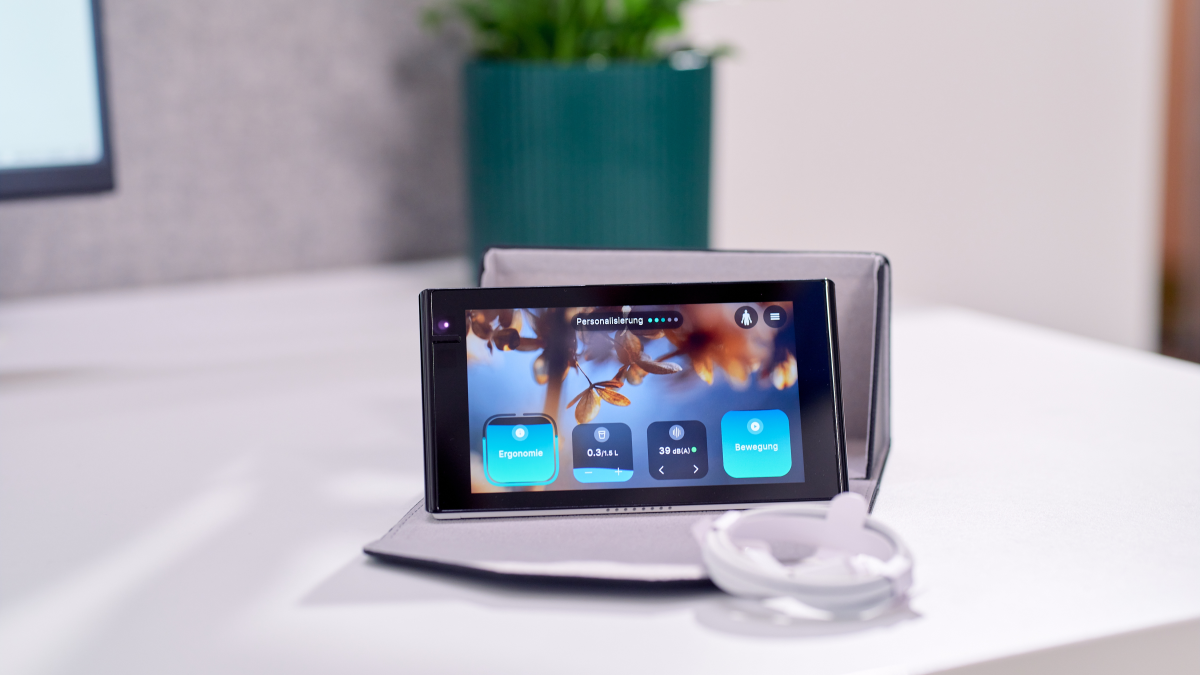
At first glance, Isa resembles a sleek digital table clock, featuring a crisp 5.5-inch IPS HD screen. Powered conveniently via USB-C (consuming a modest 2.45W), its understated design belies a sophisticated array of sensors beneath its surface. The star of the show is its front-mounted Time-of-Flight (ToF) 3D depth sensor. This is the same technology leveraged in facial recognition systems and advanced smartphone cameras, but here, it’s dedicated to anonymously mapping your posture and movement. It boasts a range of 0.15 to 1.8 meters, meaning it can track your activity whether you’re seated or briefly standing up from your desk.
Beyond posture, Isa’s comprehensive suite includes a ToF 1D sensor, a gyroscope for orientation, a barometer for atmospheric pressure, and dedicated sensors for light, sound levels, CO₂/VoC (Volatile Organic Compounds), temperature, and humidity. This extensive sensor package allows Isa to paint a holistic picture of not just your physical habits, but also the environmental conditions of your workspace, offering insights that go far beyond what a simple posture app could ever achieve.
Interactive Nudges: My Experience with Isa’s Gentle Guidance
Setting up Isa is intuitive, primarily involving inputting a few personal details and your work routine. However, a small initial hiccup was the lack of broader time zone support beyond EU and US regions – a minor oversight for a global device, but one the company acknowledges. Once configured, Isa’s screen comes alive with engaging visual indicators. My posture is represented by a dynamic squircle ring that visually fills or empties to reflect how well I’m sitting. Similarly, a water-tank-style widget provides a clear, real-time update on my hydration.

These visual cues, reminiscent of the popular Apple Watch activity rings, are surprisingly effective. Seeing the squircle turn yellow or red when I’m slouching triggers an almost instinctive desire to straighten up. If I remain in an unhealthy posture for too long, Isa delivers a gentle vibration – a mild, yet effective, form of “shaming” that prompts immediate correction, whether I’m leaning too far forward or back. A similar widget monitors my movement, suggesting on-device guided exercises if I’ve been stationary for an extended period, resetting thoughtfully when I return to my desk after a break.
The Privacy Premium: Trade-offs for Peace of Mind
Deep Care’s deliberate decision to omit cameras is a powerful statement on privacy, but it does come with certain practical trade-offs. Because Isa relies solely on its ToF depth sensor, it can occasionally be fooled. A water bottle strategically placed, or a pet casually strolling by, might register as a person, leading to inaccurate readings. There were instances where Isa mistakenly reported me as stationary even after I’d only been seated for a short time. While the device usually intelligently shifts to a digital clock display when it detects you’ve stepped away, I did find myself wishing for a simple manual button to indicate I’m explicitly not at my desk.

These are, however, minor inconveniences when weighed against the significant privacy advantages. The overall impact on my daily routine was overwhelmingly positive. Isa genuinely made me more conscious of my posture and movement throughout the workday, and its integrated exercise suggestions were a welcome and genuinely useful addition to my breaks. Powering these features is a quad-core 2 GHz processor, and while Isa can connect to Wi-Fi for software updates, users retain the option to disable this at any time, further cementing its privacy-conscious design.

Deep Care’s Vision: Beyond Posture to Holistic Well-being
Deep Care, founded by three former Bosch employees, initially carved out a niche selling Isa directly to businesses. Their recent expansion into the consumer market marks a pivotal moment, signaling confidence in the growing demand for personal workplace wellness hardware and testing the waters for a premium hardware-plus-subscription model in the mainstream. Isa is priced at €299 ($354), accompanied by two subscription tiers designed to cater to varying needs.
The ‘Core’ plan, at €4.99 per month, unlocks essential features like posture tracking, healthy sitting habits, drinking habit detection, and access to its exercise library. For those seeking deeper insights into their workspace environment, the ‘Pro’ plan, at €7.99 per month, adds tracking for light, noise, and CO2 levels, providing a comprehensive overview of factors influencing a healthy working environment. This layered approach allows users to scale their investment based on their specific wellness goals.
Looking ahead, Deep Care harbors ambitious plans to leverage Isa’s robust sensor suite for mental health-related tracking. By analyzing subtle cues such as posture, head movement, and chest movement, the company believes Isa can effectively measure breathing patterns. When combined with environmental data like noise, light, and CO2 levels, the potential emerges to introduce a dynamic “stress-related score,” offering users unprecedented insights into their mental well-being in the context of their workspace. This forward-thinking vision suggests that Isa could evolve into much more than just an ergonomic aid, positioning it as a pivotal tool for holistic wellness in the modern work environment.
The Bottom Line
Even without venturing into its future mental health capabilities, Isa stands as a remarkably solid device for anyone truly committed to improving their posture, movement, and overall desk habits. It’s certainly not an impulse buy, with its premium hardware cost and ongoing subscription fees adding up over time. However, for the discerning remote worker who has struggled with traditional solutions and values a privacy-first approach to wellness, Isa represents one of the most thoughtful, comprehensive, and ultimately effective options currently available. It’s an investment in long-term health, promising to transform your home office into a healthier, more mindful workspace.
When you purchase through links in our articles, we may earn a small commission. This doesn’t affect our editorial independence.
{content}
Source:{feed_title}