
**FIFA Reverses U.S. Player Suspension Amid Presidential Intervention, Drawing Widespread Condemnation**
ZURICH/BRUSSELS – FIFA, the international governing body of association football, announced on Sunday its decision to lift a one-game suspension previously imposed on U.S. national team forward Folarin Balogun. This reversal occurred just hours before the United States was scheduled to play Belgium in a crucial Round of 16 match at the ongoing World Cup tournament. The decision has sparked a strong backlash from Belgian officials and prominent figures in European football, who have questioned the integrity of the process, particularly as it followed a direct appeal from U.S. President Donald Trump to FIFA President Gianni Infantino.
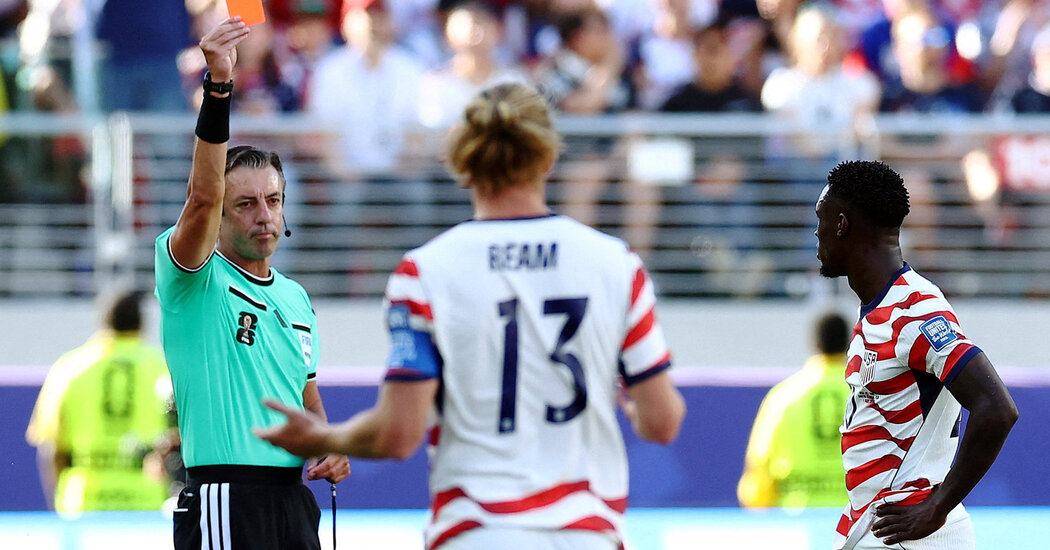
Mr. Balogun, a key player and the American team’s leading goal scorer in the tournament, had received a red card during a previous match on Wednesday against Bosnia and Herzegovina. A red card in soccer typically results in immediate expulsion from the game and an automatic one-game suspension for serious infractions, a standard disciplinary measure intended to ensure fair play and adherence to the rules of the game. Such suspensions are generally upheld unless an appeal successfully demonstrates an error in the referee’s judgment or a misapplication of rules, usually through established independent disciplinary committees.
The sequence of events leading to the reversal began with a telephone conversation between President Trump and FIFA President Infantino. During the call, President Trump reportedly requested that FIFA review Mr. Balogun’s suspension. The White House later confirmed that the two leaders had spoken about the red card incident, stating that “the correct and proper outcome was achieved” following what it described as an “independent review.” However, the statement provided no further details regarding the nature of this review or the specific information exchanged during the conversation.
Belgian authorities and football organizations swiftly voiced their outrage and concern over the unusual decision. Maxime Prévot, Belgium’s foreign minister and a former soccer referee, issued a statement to The New York Times on Monday expressing profound skepticism. “This decision clearly raises many questions,” Mr. Prévot stated. “If a phone call really is what explains this incomprehensible decision, it would amount to undermining the most basic rules of soccer and sports.” He suggested that such an intervention could significantly erode FIFA’s stated commitment to fair play and transparency.
The Royal Belgian Football Association echoed these sentiments, releasing a statement that declared it was “astonished” by FIFA’s ruling and was “investigating all potential options,” including a formal appeal. Rudi Garcia, the head coach of the Belgian national team, emphasized that the federation’s stance was not merely self-serving but was aimed at preserving the integrity of the sport itself. “The Belgian soccer federation is not just defending itself or the national team,” Garcia remarked, “it’s defending football in general.” While Belgium was granted the right to appeal FIFA’s decision, there was no guarantee that a ruling would be delivered before the scheduled kickoff time of 8 p.m. ET on Monday, adding to the tension surrounding the match.
The controversy is further exacerbated by the existing relationship between Mr. Trump and Mr. Infantino. Last year, Mr. Infantino awarded President Trump the inaugural FIFA Peace Prize, a decision that drew criticism as it coincided with the president’s high-profile, though ultimately unsuccessful, campaign to win the Nobel Peace Prize. Critics have suggested that this historical context indicates Mr. Infantino’s inclination to “curry favor” with the U.S. president. President Trump himself appeared to celebrate the reversal in a post on Truth Social on Sunday night, writing, “Thank you to FIFA for doing what was right and reversing a great injustice.” He did not, however, explicitly mention his phone call with Mr. Infantino or take direct credit for the outcome.
The U.S. ambassador to Belgium, Bill White, attempted to defend FIFA’s decision and distance President Trump from allegations of undue influence. In a post on X (formerly Twitter) on Monday, Ambassador White asserted, “President Trump would never interfere with the inner workings of FIFA.” However, this statement has done little to quell the widespread criticism. UEFA, European soccer’s governing body, released a strongly worded statement condemning FIFA’s action, declaring that the reversal had “crossed a red line” and labeling it “an unprecedented, incomprehensible and unjustifiable decision.”
Even former FIFA President Sepp Blatter, who himself faced numerous ethics complaints during his tenure, weighed in on the controversy. Posting on X, Mr. Blatter expressed serious concerns about the organization and Mr. Infantino, particularly in light of previous ethics complaints related to Mr. Infantino’s alleged efforts to court Mr. Trump. “Red cards are not overturned by political phone calls,” Blatter wrote. “They are overturned by rules, evidence and independent bodies.” The episode has prompted discussions about the governance standards within FIFA and the potential for external political pressure to influence sporting outcomes.
In a lighter, yet pointed, commentary on the situation, a spokeswoman for Belgium’s prime minister, Bart De Wever, when asked for comment on Monday, referred questions to an Instagram post attributed to his cat. The post, in Dutch, read: “Red card? I’m going to play anyway!”
Koba Ryckewaert contributed reporting from Brussels.
**Why This Matters**
This incident extends far beyond a single player’s eligibility for a World Cup match; it raises fundamental questions about the integrity, independence, and governance of global sports. The perceived intervention of a head of state in a disciplinary decision of an international sporting body like FIFA challenges established principles of fair play and equal application of rules. For many, such an action suggests that political influence, rather than impartial judicial process, can dictate outcomes in competitive sports, potentially undermining the very foundation of fair competition.
The controversy impacts FIFA’s credibility on a global stage. As the arbiter of international football, FIFA is expected to uphold strict ethical standards and ensure that its decisions are transparent, consistent, and free from external pressure. Allegations of political interference, especially when connected to previous controversies involving FIFA’s leadership and its relationship with political figures, can erode public trust among fans, national federations, and even players worldwide. This distrust can have long-term consequences for the sport’s reputation and its ability to attract and retain global audiences.
Furthermore, the situation sets a potentially troubling precedent. If a direct appeal from a head of state can overturn a standard disciplinary action, it opens the door for other powerful political entities to exert similar pressure in future sporting events. This could lead to an uneven playing field where nations with greater political or economic leverage might gain unfair advantages, thereby distorting the spirit of sportsmanship and merit-based competition. It also puts national football associations, like Belgium’s, in a difficult position, feeling compelled to defend the “rules of football in general” against what they perceive as politically motivated decisions.
Finally, the episode highlights the complex interplay between sports, politics, and international relations. While sports are often seen as a unifying force, this incident demonstrates how they can become arenas for geopolitical maneuvering. The reactions from European football bodies like UEFA and former FIFA officials underscore the deep concern within the sport’s community regarding the perceived politicization of decision-making. The ramifications could include heightened tensions between participating nations, a damaged image for the World Cup itself, and a broader debate about the extent to which international sporting organizations can or should remain insulated from political pressures.