
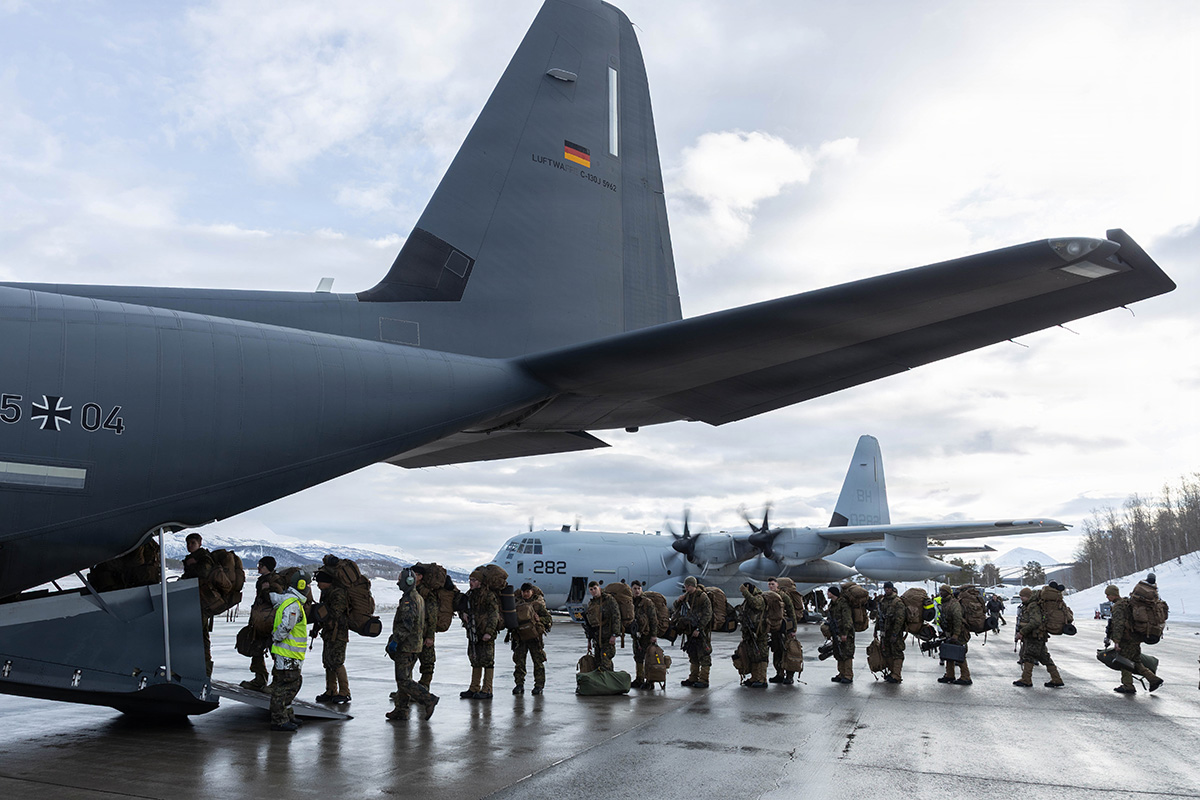
For the inaugural occasion, an American Marine Corps infantry unit was transported by air into the Arctic by a combined Franco-German aerial logistics squadron.
This undertaking on March 11 witnessed service members from Echo Company, 2nd Battalion, 6th Marine Regiment, conveyed from Bardufoss, Norway, to Rovaniemi, Finland. The aerial conveyance utilized two German-piloted KC-130J planes from the Binational Air Transport Squadron (BATS), in conjunction with an American Marine Corps KC-130J originating from VMGR-252, stationed in North Carolina.
Formed in 2022 and headquartered in Évreux, France, BATS stands as a joint Franco-German element consisting of approximately 300 individuals. This squadron functions as a completely unified entity, engaging in drills across a variety of settings, encompassing polar conditions, to aid NATO missions.
A BATS aviator remarked:“Our squadron is newly formed and truly unique. [CORE26] presents an excellent chance to gain from drills with NATO partners through a collaborative and collective training methodology.”The aviator further stated:“The BATS is able to function globally, across all weather regions and under diverse operational circumstances. We have demonstrated this in the past few years. ‘Anytime, anywhere’ is our slogan, and we embody it.”
Upon reaching Finland, the Marines rendezvoused with gear transported independently by Combat Logistics Battalion 6, which had finalized a several-day overland journey across Norway, Sweden, and Finland. This synchronized aerial and terrestrial transfer allowed the unit to join forces with Sweden’s 4th Mechanised Brigade prior to a simulated combat drill.
American Marine Corps Major Rich Webb, a KC-130J aviator and Weapons and Tactics Instructor with VMGR-252, stated:“As we keep influencing the trajectory of dispersed air missions and mobile combat tactics, extended-range rapid deployment assets will play a progressively crucial function. This flight highlighted the critical significance of cultivating lasting collaborations.”He further remarked,“It was a distinct honor to pilot alongside our German colleagues during this deployment. These collaborative sorties illustrate how intentional collective strategizing and flawless implementation convert two competent elements into a cohesive, efficient squad.”
The undertaking was managed by the Joint Air Operations Center in Bodø, Norway, which supervises aerial activities throughout the Northern European area and Arctic territories. Authorities indicated the operation illustrated how partner air and land units can swiftly deploy military strength into harsh settings.
Cold Response 26, spearheaded by Norway, includes exceeding 25,000 service members from more than twelve NATO and allied states. Its purpose is to assess mutual protection and joint operational capability under polar circumstances.